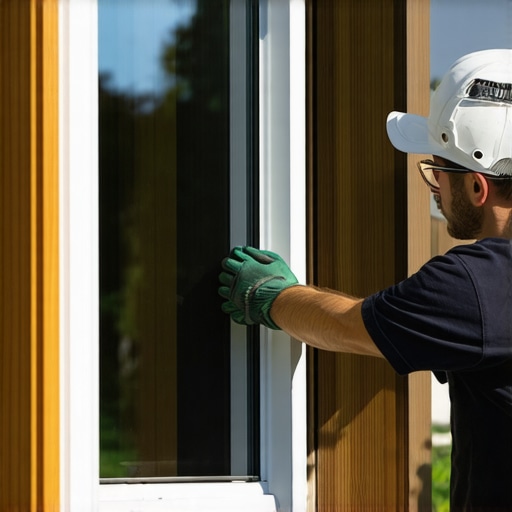
The Death of an Insulated Glass Unit: Why Your Windows Are Failing
When you see that milky haze or those stubborn water droplets trapped between your glass panes, you are not just looking at a cosmetic nuisance. You are looking at the corpse of a dead Insulated Glass Unit (IGU). In my 25 years in the glazing trade, I have seen every imaginable ‘hack’ to bring these dead units back to life, and frankly, most of them are the equivalent of putting a band-aid on a sucking chest wound. A homeowner once called me in a panic because their expensive new windows were ‘sweating’ and turning opaque. I walked in with my hygrometer and a thermal imager, and within minutes, I showed them that the internal humidity was at 65% and the seals had completely delaminated. It was not a window defect; it was a failure to manage the dew point within the home coupled with poor exterior drainage that allowed water to sit against the secondary seal. This is the reality of window repair that the DIY kits won’t tell you.
“Installation is just as critical as the window performance itself. A high-performance window installed poorly will fail.” – AAMA Installation Masters Guide
The Physics of Solar Pumping
To understand why your double glazing failed, you have to understand ‘Solar Pumping.’ Throughout the day, the sun hits your windows, heating the gas (usually Argon or air) between the panes. This gas expands, putting immense pressure on the primary seal (typically polyisobutylene) and the secondary seal (silicone or polysulfide). At night, the unit cools and the pressure drops. This daily expansion and contraction is a mechanical stress test that happens 365 days a year. Eventually, the seal develops a microscopic fissure. Once that happens, the Sash is no longer airtight. The desiccant—the material inside the spacer bar designed to absorb tiny amounts of moisture—becomes saturated. Once the desiccant is full, the next time the temperature drops to the dew point, that moisture condenses on the cold glass surface inside the unit. This is the point of no return. No window cleaner can reach this, and no amount of exterior scrubbing will fix the internal fog.
The Myth of the ‘Drill and Dry’ DIY Kit
You will see advertisements for kits that suggest you can drill a small hole in the glass or the Glazing Bead, inject a cleaning solution, and then plug the hole with a one-way valve. As a master glazier, this makes my skin crawl. First, drilling into tempered glass will cause it to explode into a thousand pieces. Second, even if the glass is annealed, you are destroying the thermal integrity of the unit. You are effectively turning a high-performance double-pane window into a poorly functioning single-pane window with a dirty glass shield. The ‘valve’ does nothing to replace the lost Argon gas or the exhausted desiccant. You might clear the fog for a few months, but the internal glass surfaces will eventually develop ‘calcium staining’ or ‘glass etching’ from the minerals in the evaporated water. Once the glass is etched, it is permanently ruined.
The Proper Anatomy of a Window Installation
If you are looking to replace windows or repair them, you must look at the Rough Opening and the Sill Pan. Often, I find that seal failure is a direct result of the window sitting in a pool of water. Modern windows are designed with Weep Holes in the frame. These are not mistakes; they are critical drainage paths. If an amateur painter or an over-zealous window cleaner clogs these holes, water backs up into the sash. The bottom edge of the IGU then sits in standing water. Even the best silicone secondary seals are not designed for ‘prolonged immersion.’ They will eventually emulsify, allowing liquid water to be sucked into the vacuum of the unit during the next cooling cycle. This is why the ‘shingle principle’ is the law of the land: every layer of Flashing Tape and every Shim must be placed to ensure water flows down and out, never inward.
“Standard Practice for Installation of Exterior Windows, Doors and Skylights requires that the flashing system must be integrated with the water-resistive barrier to prevent water penetration into the wall cavity.” – ASTM E2112
U-Factor and the Cold Climate Reality
In northern climates where the temperature regularly drops below freezing, the U-Factor is the most critical metric. The U-Factor measures the rate of heat loss. When your seal fails and the Argon gas escapes, your U-Factor skyrockets. You are losing money every minute the heater is running. In these environments, we look for ‘Warm-Edge Spacers.’ Older windows used aluminum spacers, which acted as a thermal bridge, conducting cold directly to the inner pane and encouraging condensation. Modern high-performance units use structural foam or composite spacers that break that thermal bridge. If you are dealing with failed seals in a cold climate, the only legitimate fix is to replace the IGU with a unit that features a Low-E coating on Surface #3, which reflects long-wave infrared radiation back into your living space, keeping you warm while the winter wind howls outside the Muntins.
The ROI of Replacement vs. Repair
When is it time to stop patching and start replacing? If your frames are wood and you see black rot on the header or the sill, the structural integrity is compromised. A window repair that only addresses the glass while ignoring a rotting Rough Opening is a waste of capital. However, if the frames are high-quality vinyl or fiberglass and are still ‘square and plumb,’ you can often perform a ‘glass-only’ replacement. This involves popping the Glazing Bead, removing the failed IGU, and dropping in a new, factory-sealed unit. This is significantly cheaper than a full-frame tear-out and restores the window to its original thermal performance. But remember: if the original failure was caused by poor frame drainage, the new unit will fail just as fast as the old one unless you clear those weep holes and ensure the Sill Pan is doing its job.