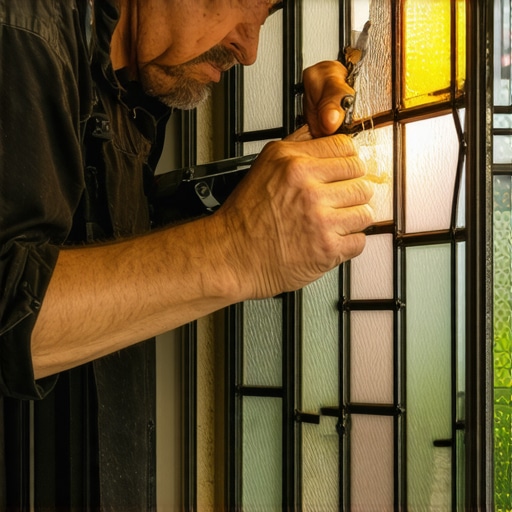
The Hidden Physics of Leaded Glass Decay
Leaded glass is not a static object; it is a dynamic assembly of glass, metal, and organic cement that lives and breathes with the thermal cycles of your home. When people talk about needing to replace windows, they are often reacting to the symptoms of structural fatigue rather than actual glass failure. In my twenty-five years as a master glazier, I have seen more historic glass ruined by an overzealous window cleaner or a handyman who treats leaded glass like modern insulated units than I have by time itself. The lead came (the ‘H’ or ‘U’ shaped metal channels) is a soft, malleable alloy. Its primary job is to hold the glass in place while allowing for slight movement. However, over seventy to one hundred years, the cement that fills the gap between the glass and the came begins to crumble. Once that cement fails, the window loses its rigidity, air starts whistling through the muntins, and you see the characteristic ‘bowing’ or ‘sagging’ of the panel.
“Installation is just as critical as the window performance itself. A high-performance window installed poorly will fail.” – AAMA Installation Masters Guide
The Condensation Crisis: A Narrative Warning
I recall a specific project in a historic district in the Northeast. A homeowner called me in a panic because their new interior storm windows were ‘sweating’ so badly that water was pooling on the sill. I walked in with my hygrometer and showed them the humidity was 60%. It wasn’t the windows; it was their lifestyle choices—specifically, a massive collection of tropical plants and a poorly vented dryer. Because the leaded glass was the coldest surface in the room, it acted as a dehumidifier, pulling moisture out of the air. This moisture sat against the lead cames, accelerating the oxidation process. This white powdery crust you see on old lead is lead carbonate. If you don’t manage the interior environment, no amount of window repair will save that glass. You have to understand that in a cold climate, the lead came acts as a massive thermal bridge. Unlike a modern thermally broken frame, the metal transfers heat directly to the exterior, keeping the interior metal surface below the dew point for most of the winter. This is why properly designed storm windows must have weep holes to allow that moisture to escape before it rots the sash.
The Anatomy of the Lead Came
To restore these windows without damage, you must understand the metallurgy. Lead is incredibly soft, but it is often alloyed with antimony, tin, or copper to increase its tensile strength. When you are performing a window repair on a leaded panel, you aren’t just cleaning glass; you are managing a structural grid. The ‘came’ has a heart (the vertical center bar of the H) and two leaves (the parts that wrap over the glass). Over time, the leaf can lift away from the glass. A common mistake is to try and push it back with a screwdriver. Don’t. You will create ‘fiddling marks’ or pressure points that can crack the historic glass. Instead, restoration involves a process called ‘re-cementing.’ This isn’t caulk. It is a specialized slurry of linseed oil, calcium carbonate, and a drying agent like lampblack. This slurry is scrubbed into the gaps under the lead leaves using a natural fiber brush. It is messy, but as it cures, it hardens to a rock-like consistency, restoring the structural integrity of the panel without the need to replace windows entirely.
Why Modern Chemicals Are the Enemy
If you are looking for a window cleaner for historic glass, stay away from the grocery store aisle. Ammonia is the primary enemy of leaded glass. It reacts with the lead and the solder joints, causing a chemical breakdown known as ‘lead rot.’ To clean leaded glass during restoration, I use nothing but distilled water and a pH-neutral non-ionic detergent. You have to be incredibly careful around the solder joints. The solder is a mix of tin and lead that has a lower melting point than the came itself. If the solder joints are cracked, the window will rattle. You can’t just ‘glob’ more solder on top. You have to clean the joint back to shiny metal, apply a flux (often tallow-based in the old days), and then flow a new joint. This requires a precise touch with a 100-watt iron; too much heat and you’ll melt the came right out of the rough opening.
“The primary purpose of a window is to provide light and air, but the secondary purpose is the management of environmental loads. When the structural assembly of leaded glass fails, it no longer manages those loads effectively.” – AAMA Selection and Maintenance Guide
Strategic Installation and the Rough Opening
When we re-install a restored leaded panel, the rough opening must be prepared with the same level of detail as a modern high-performance install. We use a sill pan to ensure that any water that manages to penetrate the secondary glazing or the flashing tape has a clear path back to the exterior. We never use ‘caulk and walk’ methods. Instead, the panel is set into the sash with a bed of non-hardening glazing compound. We use shims to ensure the glass isn’t taking any of the building’s structural load. If the building settles and the window is tight in the frame, the glass will crack—a phenomenon known as ‘stress fractures.’ By providing a 1/8-inch gap around the perimeter, we allow the wood frame to expand and contract without crushing the delicate leaded assembly.
The Math of Preservation vs. Replacement
Many salesmen will tell you that you should replace windows to save money on your heating bill. In a cold climate like Minneapolis or Chicago, they will push for triple-pane glass with a Low-E coating on surface #3. While that works for a new build, for a historic home with leaded glass, the ROI (Return on Investment) for replacement windows is often forty to fifty years. A much more effective strategy is to restore the original leaded glass and add a high-quality exterior storm window with a low-emissivity coating. This creates a dead-air space that rivals the performance of a modern IGCC (Insulating Glass Certification Council) unit while preserving the glazing beads and the historic character of the home. You keep the soul of the house and achieve a U-factor that keeps the room comfortable even in the dead of January. This isn’t just about aesthetics; it is about building science. A well-restored leaded window, protected by a storm, will outlast three generations of modern vinyl replacements.