The Microscopic Reality of Your Glass
When you look through your window, you see a clear portal to the outside world. As a master glazier with a quarter-century in the field, I see a complex chemical lattice that is constantly under siege. Most homeowners approach window cleaning as a chore of aesthetics, but it is actually a matter of structural preservation. I remember a call from a homeowner in a high-humidity suburb who was convinced their three-year-old high-performance units were failing. They were in a panic because the glass looked perpetually hazy, regardless of how much blue-dyed detergent they sprayed on it. I walked in with my hygrometer and a high-powered loupe. The issue wasn’t the windows; it was a ‘condensation crisis’ born from a 60% interior humidity level and a layer of soap film that had become a magnet for particulates. The ‘haze’ was a chemical buildup of the very cleaners they thought were helping. By switching to a protocol involving nothing but pure water and a specific ultra-fine weave microfiber, we restored the glass to its original visible transmittance (VT) without the need for a costly window repair.
The secret lies in understanding that glass is not perfectly smooth. At the microscopic level, the surface of a float glass pane is filled with peaks and valleys. When you use traditional window cleaner, the surfactants and detergents fill these valleys. These chemicals are designed to be ‘wet,’ meaning they lower the surface tension of water, but they leave behind a residue that acts like a microscopic glue. This glue traps dust, pollen, and skin cells. This is why, two weeks after a traditional cleaning, your windows look dusty again. A specialized microfiber cloth, specifically one with a split-fiber density of at least 200,000 fibers per square inch, works through mechanical action rather than chemical reaction. The fibers act like millions of tiny squeegees, reaching into the ‘pores’ of the glass and lifting out contaminants that water alone has loosened.
“Installation and maintenance are just as critical as the window performance itself. A high-performance window that is neglected or cleaned with abrasive chemicals can suffer premature seal degradation.” – AAMA Installation Masters Guide
The Physics of Water and Microfiber
Why water? Pure H2O is a universal solvent. When applied to glass, it begins to break the ionic bonds of surface pollutants. However, the water needs a vehicle to carry the debris away. This is where the ‘special cloth’—typically a polyamide/polyester blend—comes into play. In my 25 years of installing everything from standard double-hung sashes to complex curtain walls, I have seen how chemical cleaners can actually attack the glazing bead and the secondary seals of an Insulated Glass Unit (IGU). If you are using ammonia-based cleaners, you are effectively shortening the life of your window seals, leading to the dreaded fogging that necessitates a total unit replacement.
In northern climates where we battle extreme temperature differentials, the dew point is a constant enemy. When warm, moist air hits a cold glass surface, condensation forms. If your glass is covered in a film of soap residue, that condensation has more surface area to cling to, leading to larger droplets and eventual runoff that can rot your rough opening or damage the sill pan. A ‘naked’ pane of glass—one cleaned only with water—allows for more uniform evaporation. This is a critical distinction for those looking to maximize their U-Factor performance. While the dirt itself doesn’t significantly change the thermal conductivity, the moisture trapped by that dirt certainly can.
The Anatomy of the Window: Beyond the Glass
When you are cleaning, you are also performing an informal inspection. This is the best time to check the health of your window’s mechanical systems. As you move your cloth along the perimeter, you should be looking at the glazing bead—the strip of plastic or wood that holds the glass in the sash. Is it cracked? Is it pulling away? If water can get behind that bead, it will sit against the spacer bar of your IGU. This is the primary cause of seal failure. Similarly, check your weep holes in the bottom of the frame. If these are clogged with the same gunk you’re trying to clean off the glass, water will back up into the house, leading to mold on the drywall and rot in the structural headers.
During a professional window repair session, I often find that homeowners ignore the weatherstripping during their cleaning routine. A clean sash is useless if the air is leaking through the gaps. Use your microfiber cloth to wipe down the compression seals. Removing the grit from these surfaces ensures a tighter seal when the window is locked, which is the only way to achieve the air infiltration ratings promised by the NFRC label.
“The energy performance of a fenestration product is only as good as its long-term airtightness and the integrity of its thermal barriers.” – NFRC Performance Standards
The Science of Solar Heat Gain and Maintenance
In the southern regions, where the Solar Heat Gain Coefficient (SHGC) is the metric that matters most, the cleanliness of the exterior Surface #1 is paramount. Modern windows often have a Low-E coating on Surface #2 (the inner face of the outer pane). While the cleaning doesn’t touch this protected layer, any buildup of soot or hard water minerals on the exterior surface can absorb solar radiation, heating the glass and increasing the radiant heat transfer into your home. This defeats the purpose of your high-tech glazing. By using a ‘water only’ approach, you ensure there is no film to absorb this heat.
For those considering to replace windows, the maintenance profile should be a top priority. Fiberglass frames, for instance, are incredibly stable and don’t expand or contract like vinyl. This stability means the seals around the glass remain intact longer, making your ‘water and cloth’ cleaning routine more effective because you aren’t fighting internal dust leaks. If you have older wood windows, the cleaning process is also a time to inspect the paint or stain. Any moisture that lingers because of a soapy residue will accelerate the peeling of the finish, eventually reaching the raw wood of the muntins or the sash itself.
The Professional Protocol: Step-by-Step
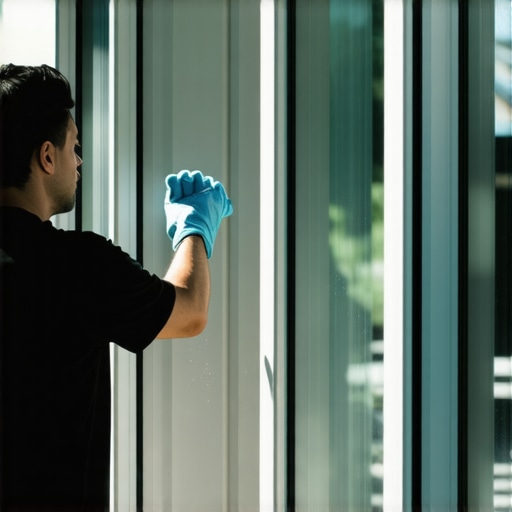
To clean like a master glazier, follow this protocol: First, use a damp, high-quality microfiber cloth to break the surface tension and lift the bulk of the particulates. Do not use circular motions; move in a vertical or horizontal pattern to ensure you are pushing the debris into the fibers rather than just moving it around. Second, immediately follow with a dry, ‘waffle-weave’ or ultra-smooth microfiber cloth to buff the surface. This second step is crucial because it removes the microscopic droplets of water before they can evaporate and leave behind the minerals found in your tap water. This ‘mechanical’ cleaning leaves the glass truly bare, which is the secret to that ‘invisible’ look. No squeegees, no crumpled newspapers, and certainly no expensive chemical sprays are required to maintain the structural and aesthetic integrity of your windows.