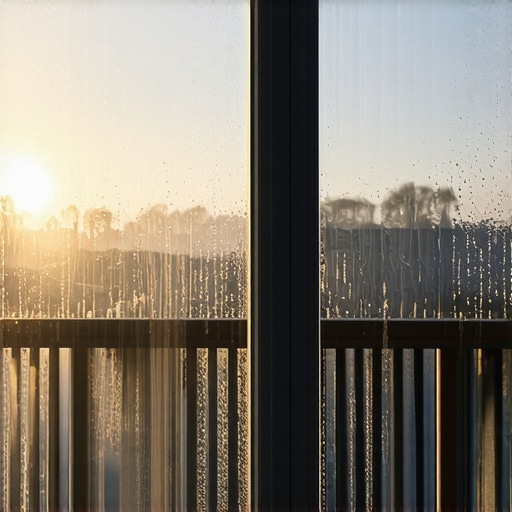
The Morning the View Vanished
I remember a call from a client in the Pacific Northwest named Arthur. He had just invested thirty thousand dollars to replace windows throughout his colonial-style home with top-tier, triple-silver Low-E casements. He called me at 6:30 AM, his voice tight with the kind of controlled anger you only hear from someone who feels they have been swindled. Arthur was staring at a wall of white mist. He could not see his backyard. He was convinced the seals had failed on every single unit overnight. I told him to put the coffee on and wait for the sun to hit the glass. By the time I arrived with my hygrometer, the mist was gone, and I had to explain a paradox: his windows were ‘sweating’ on the outside precisely because they were working perfectly. It was not a window repair issue; it was a physics success story.
The Anatomy of the Dew Point
To understand why your glass is foggy on the exterior, we have to talk about the dew point and radiative cooling. In my 25 years as a glazier, the most common misconception is that windows generate heat or cold. They do not. They manage the transfer of energy. When you have a high-performance Insulated Glass Unit (IGU), the Low-E coating—usually located on surface number two—is designed to reflect long-wave infrared radiation back into your home during the winter. This is a miracle of modern glazing, but it has a side effect. Because the heat from your living room is so effectively blocked from escaping, the exterior pane of glass stays cold. It becomes decoupled from the building’s internal thermal envelope. On a clear night, that outer pane loses heat to the night sky via radiation. If the temperature of that glass surface drops below the dew point of the ambient air, moisture will condense on the surface. It is the same reason you see dew on the grass or your car windshield. If your old, drafty windows never did this, it is because they were so inefficient that enough heat was leaking through the glass to keep the exterior surface warm enough to prevent condensation. You were literally melting the dew with your heating bill.
“Condensation on the exterior surface of an insulating glass unit is a natural atmospheric phenomenon and does not indicate a defective product or a seal failure.” National Fenestration Rating Council (NFRC) Homeowner Guide
The Science of Surface Temperatures and Low-E Coatings
When we look at the physics of a modern sash, we are looking at a battle between conduction, convection, and radiation. In a standard double-glazed unit with a warm-edge spacer, the edges of the glass are better protected against thermal bridging, but the center-of-glass temperature remains the primary area where this exterior fogging occurs. The Low-E (low emissivity) coating is a microscopically thin layer of silver or other low-emissive materials. In a heating-dominated climate, we want that coating to keep the heat inside. However, by doing its job so well, the exterior pane of glass can actually become colder than the surrounding air. This is especially common in the shoulder seasons—spring and autumn—when the nights are clear and the humidity is high. If you find yourself reaching for a window cleaner to wipe away the exterior fog, you are fighting a losing battle against the local microclimate. The moisture will dissipate as soon as the sun or a light breeze warms the glass surface above the dew point.
When Should You Actually Worry?
Not all condensation is created equal. As a master glazier, I categorize moisture into three zones. Zone one is the interior surface. If you have moisture on the inside of the glass, you have a humidity problem inside your home. This is often caused by lack of ventilation, over-active humidifiers, or even a large number of houseplants. Zone two is the exterior surface, which we have established is often a sign of high-performance glass. Zone three is the ‘inter-pane’ space—the gap between the two pieces of glass. This is the danger zone. If you see fog, calcium deposits, or ‘rivering’ inside the sealed unit, the desiccant in the spacer bar is saturated and the primary seal has breached. At this point, the argon or krypton gas has escaped, replaced by moisture-laden air. This is the only scenario where you truly need to replace windows or at least the IGU itself. You cannot ‘repair’ a failed seal in a way that restores the original R-value; any ‘defogging’ service that drills holes in the glass is a temporary cosmetic fix that leaves you with a glorified single-pane window in terms of thermal performance.
“Proper installation according to ASTM E2112 ensures that the rough opening is protected from moisture, but the glass performance remains subject to the laws of thermodynamics regarding surface temperature and dew point.” AAMA Installation Masters Manual
The Role of the Frame and Spacer
While the glass gets all the attention, the frame material and the spacer system play a supporting role in how condensation manifests. Older aluminum frames without a thermal break are notorious for conducting cold directly to the interior glazing bead, which causes interior condensation. Modern vinyl, fiberglass, or wood-cladded frames have much lower conductivity. The spacer—the part that separates the two panes of glass—has also evolved. We used to use hollow aluminum spacers filled with desiccant, which were essentially ‘cold-track’ conductors. Today, we use warm-edge spacers made of structural foam or thermoplastic. These spacers help keep the perimeter of the glass warmer, which can actually reduce the likelihood of condensation at the edges, though the center-of-glass exterior fogging may still occur on high-performance units. If you are looking to replace windows specifically to solve a condensation issue, you must ensure the new units have a high Condensation Resistance (CR) rating, which is a metric provided by the NFRC that scores how well a window resists moisture formation on the interior surface.
Environmental Factors and Microclimates
I once had a project where only the windows on the north side of the house exhibited exterior condensation. The homeowner was baffled. I had to point out the heavy tree cover and the nearby creek. The shade from the trees prevented the morning sun from warming the glass, and the creek kept the local humidity levels higher than on the south side of the property. This is why you might see your neighbor’s windows are clear while yours are foggy. It could be down to the angle of the house, the presence of an overhang or ‘drip cap’ that provides some shelter from the clear night sky, or even the type of curtains you use. Heavy blackout curtains can actually increase the risk of condensation because they prevent the house’s ambient heat from reaching the glass, further cooling the panes. It is a complex dance of variables, but the takeaway remains: exterior fog is a sign that your home is insulated, and the heat is staying exactly where you paid for it to be—inside.
Conclusion: Embracing the Fog
So, the next time you wake up and can’t see through your new windows, don’t rush to call for a window repair specialist. Check which side of the glass the moisture is on. If it is on the outside, take a breath and appreciate the fact that your investment is paying off. Your windows are so efficient that they are colder than the air around them. You have successfully managed the hole in your wall. If you are a window cleaner, you know that this moisture is pure distilled water and leaves no residue once it evaporates. It is a temporary veil, a scientific proof of performance that will clear as the day begins. In the world of high-end glazing, a clear window in the middle of a cold, humid night is often the one that is failing you by leaking heat. The ‘sweating’ window is the one that is doing its job with honors.