Understanding Optical Clarity in the Modern Building Envelope
As a Master Glazier with a quarter-century in the field, I have seen every imaginable failure in a window system. I have watched high-rise curtain walls weep from poor Sill Pan installation and historic wood Sash units rot into mulch because of improper Flashing Tape application. But one of the most common complaints I receive from homeowners is not about structural failure, but about optical integrity. A scratch on a glass pane is more than a cosmetic flaw; it is a disruption in the Visible Transmittance (VT) of the unit and a potential stress point in the material. While many modern installers will immediately tell you to replace windows at the first sign of a hairline scratch, there are old-school techniques involving simple organic chemistry that can often salvage a pane before you commit to a full window repair or replacement.
The Condensation Crisis: A Master Glazier Narrative
A homeowner called me in a panic because their new windows were ‘sweating.’ I walked in with my hygrometer and showed them the humidity was 60%. It was not the windows; it was their lifestyle. They were boiling water for pasta without an exhaust fan and running a humidifier in the bedroom because of the dry winter air. The glass was doing exactly what it was designed to do: providing a cold surface for moisture to condense upon because the dew point had been reached inside the home. I had to explain that even the most advanced triple-pane unit with a warm-edge spacer cannot overcome physics if the indoor environment is saturated. This same homeowner had tried to scrub the ‘fog’ off with a coarse pad, resulting in micro-scratches across the interior Glazing Bead line. This is where the physics of glass repair meets the chemistry of the kitchen.
“Installation is just as critical as the window performance itself. A high-performance window installed poorly will fail.” – AAMA Installation Masters Guide
The Science of the Potato Skin Trick
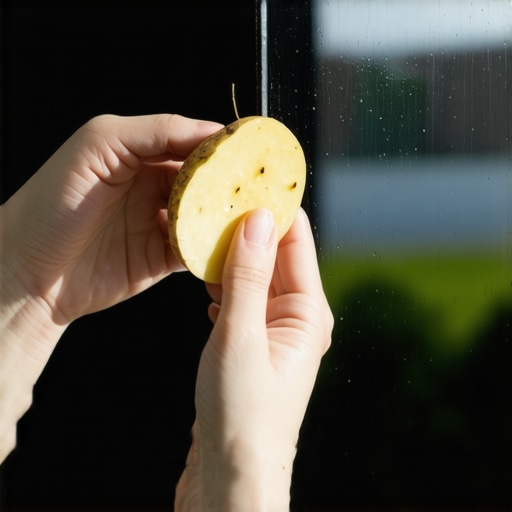
The use of a potato skin to polish glass is not magic; it is an application of mild abrasives and starch-based surfactants. A potato contains amylose and amylopectin. When you rub the raw, moist side of a potato skin against a glass surface, the starch acts as a microscopic filler and a very fine polishing agent. Glass, while it appears smooth, has a porous structure at the molecular level. Scratches occur when the silica lattice is physically displaced. The starch particles from the potato help to lift away minor contaminants that a standard window cleaner might miss, while the friction helps to smooth the edges of very shallow scratches, reducing their refractive impact. This makes the scratch less visible to the human eye by normalizing the way light passes through the glass. However, you must be certain that the scratch has not penetrated the Low-E coating. If you have a soft-coat Low-E on surface #4 (the interior surface), rubbing it with a potato or any abrasive will permanently damage the metallic silver layer, leading to oxidation and a clouded appearance that no amount of polishing can fix.
The Glass Class: Decoding Thermal Performance
In our northern climates, where the winter wind howls and the temperature drops well below zero, the glass is the primary barrier against massive heat loss. When evaluating a window repair versus a total replacement, you must understand the U-Factor. This number represents the rate of heat loss. In a cold climate like Chicago or Minneapolis, we want a U-Factor as low as possible, typically below 0.27. We achieve this through the use of Argon or Krypton gas fills between the panes. These heavy gases slow down the convection currents within the IGU (Insulated Glass Unit). If your glass is scratched deeply enough to compromise the seal, that gas escapes, and the thermal performance plummets. This is why a simple polish only works for superficial damage. If the Rough Opening is leaking air or the Shim placement has caused the frame to bow, the integrity of the glass is already under mechanical stress, making it more prone to cracking during any repair attempt.
“The glass type and its coatings determine the overall energy efficiency of the building envelope.” – NFRC
Surface Chemistry and the Polishing Process
To execute the potato skin trick, you must first ensure the glass is free of grit. Using a professional-grade window cleaner, remove all surface dust. If you leave a single grain of sand on the glass, you will turn your polishing attempt into a sanding operation that will ruin the Sash. Take a raw potato, cut it to expose the starch, and work in small, circular motions over the scratch. The moisture in the potato acts as a lubricant. After several minutes of polishing, you must wipe the residue away with a microfiber cloth and inspect the glass from an angle. In many cases, the micro-abrasions will have been smoothed out. This is a far more natural and gentle approach than using cerium oxide, which is the industry standard for heavy glass polishing but can easily ‘fish-eye’ the glass if used by an amateur. If the scratch is deep enough to catch your fingernail, the potato skin will not be sufficient, and you are likely looking at a situation where you need to replace windows or at least the individual IGU.
When Maintenance Fails: The Reality of Window Replacement
There comes a point where no amount of polishing or window cleaner can save a failing unit. If you see ‘fogging’ between the panes, the seal has failed. This usually happens because the Weep Hole system in the frame was clogged, allowing water to sit against the secondary seal of the IGU for years. This is a common flaw in ‘caulk-and-walk’ installations where the installer didn’t understand the importance of water management. When we perform a full-frame replacement, we aren’t just looking at the glass. We are looking at the Sill Pan, the Muntin alignment for aesthetic consistency, and ensuring the Operable parts of the window move without friction. A window is a mechanical system, and the glass is its most visible, yet most fragile, component. Treat your glass with the technical respect it deserves, and it will provide decades of clarity and thermal protection.