The High-Altitude Glazing Challenge: Why Your Transom Windows Demand More Than a Ladder
In my twenty-five years as a master glazier, I have seen every imaginable failure of glass and frame, but the most consistent calls for help come from homeowners with vaulted ceilings and those beautiful, unreachable transom windows. These architectural features are designed to flood a room with light, yet they often become the first point of failure for the building envelope. When a homeowner asks me about a window cleaner recommendation for their twenty-foot ceilings, I usually start by asking if they have noticed any fogging or staining. You see, a high window is more than an aesthetic choice: it is a thermal trap where the laws of physics and the quality of the original installation collide.
The Condensation Crisis: A Master Glazier Narrative
I remember walking into a custom-built home in Chicago during a particularly brutal January. The homeowner was in a panic because their brand-new, high-efficiency transom windows were ‘sweating’ so heavily that water was dripping onto their hardwood floors. They were convinced they needed to replace windows that were less than two years old. I pulled out my hygrometer and a thermal imaging camera. I didn’t see a window failure: I saw a lifestyle conflict. The indoor humidity was hovering at sixty percent because of a lack of proper air exchange, and that warm, moist air was rising to the highest point in the house. As it hit the cold glass of the transom, it reached the dew point instantly. It wasn’t a window repair issue; it was a thermal stratification problem. I had to explain that even the best IGU (Insulated Glass Unit) has its limits when the interior micro-climate is out of balance. This is the reality of managing a hole in your wall.
“Installation is just as critical as the window performance itself. A high-performance window installed poorly will fail.” – AAMA Installation Masters Guide
The Microfiber Pole Trick: More Than Just Cleaning
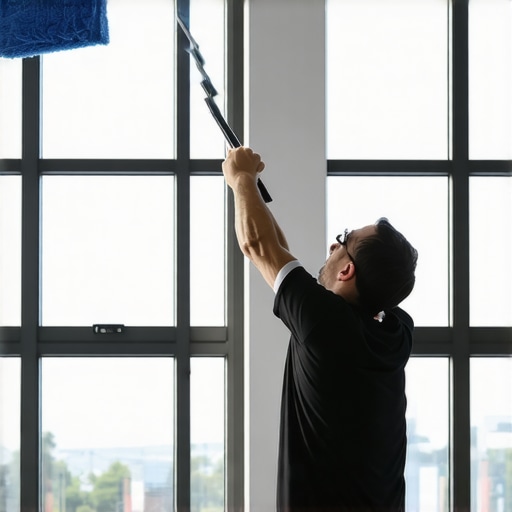
When we talk about a window cleaner approach for high glass, we aren’t just talking about aesthetic clarity. The microfiber pole trick is actually a vital maintenance inspection tool. By using a high-modulus carbon fiber telescopic pole equipped with a pivot-head microfiber sleeve, you are doing more than removing dust. You are performing a tactile audit of the glazing bead and the frame’s structural integrity. When you apply pressure with that pole twenty feet up, you can feel if the sash is seated properly or if there is excessive movement in the rough opening. A quality microfiber sleeve, when used with deionized water, utilizes capillary action to lift particulates rather than scratching the Low-E coating that might be present on the exterior surface. For those in cold climates like Chicago or Minneapolis, keeping this glass clean is essential for maximizing solar heat gain during the winter months. Dust and grime can actually interfere with the glass’s ability to admit short-wave infrared radiation, which helps warm your home.
The Physics of Thermal Performance in High Glass
In a northern climate, the enemy is heat loss and the resulting condensation. We focus heavily on the U-Factor, which measures the rate of non-solar heat loss. For a high transom window, you want the lowest U-Factor possible. This is achieved through the use of warm-edge spacers, which separate the panes of glass while reducing conductivity at the perimeter. If you are looking to replace windows in a high-ceiling environment, you must demand argon-filled units with a Low-E coating on Surface #3. This placement reflects the long-wave infrared radiation back into the room, keeping that rising heat from escaping through the top of your house. Many installers who ‘caulk-and-walk’ don’t understand that the shim placement in a high transom is critical. If the window isn’t perfectly level and square within the rough opening, the weight of the glass can cause the frame to sag over time, compromising the primary seal and leading to gas dissipation.
Water Management and the Shingle Principle
When a client calls for a window repair because they see water damage around a high transom, I immediately look at the flashing system. Water management is a science dictated by the ‘Shingle Principle’: everything must overlap so that gravity carries water down and away from the structure. A common failure in high-reach installations is the lack of a proper sill pan. Because these windows are hard to reach, installers often skip the flashing tape or fail to integrate the drip cap with the building’s house wrap. This leads to water entering the wall cavity, where it rots the header long before you ever see a drop inside. If your window cleaner notices any discoloration in the muntins or the glazing bead, you are likely looking at a failure of the external seal. A proper repair involves more than a bead of silicone; it requires ensuring the weep hole system is clear so that any moisture that bypasses the primary seal can escape to the exterior.
“The selection of a window for a specific orientation and climate is as important as the structural design of the building itself.” – NFRC Performance Standards
Material Science: Choosing the Right Frame
For high-reach areas, the frame material is non-negotiable. While vinyl is a popular budget choice, its high coefficient of thermal expansion makes it a risky bet for large transom units. In extreme temperature swings, vinyl can expand and contract so much that it pulls away from the rough opening, breaking the air seal. For these applications, I recommend fiberglass or thermally broken aluminum. Fiberglass is incredibly stable because it is made of the same base material as the glass itself, meaning the frame and the IGU expand and contract at nearly the same rate. This protects the integrity of the seals for decades. When you invest in a window repair or replacement for high ceilings, you are paying for the stability of the system, not just the view. Remember, the installer who treats a window like a simple piece of furniture is the one who will leave you with drafts and rot. A true professional understands that the window is a dynamic part of the wall, requiring precision shimming and a deep understanding of thermal dynamics.
Final Glazier Verdict
Whether you are using a microfiber pole to maintain your view or contemplating a full-frame replacement, respect the physics of your windows. High glass is a high-stakes environment. Don’t settle for superficial solutions. Understand your U-Factor, insist on proper flashing tape, and never ignore a foggy pane. Your windows are the eyes of your home: keep them clear, keep them sealed, and keep them performing at the highest technical standard.