The Invisible Threat to Your Thermal Envelope
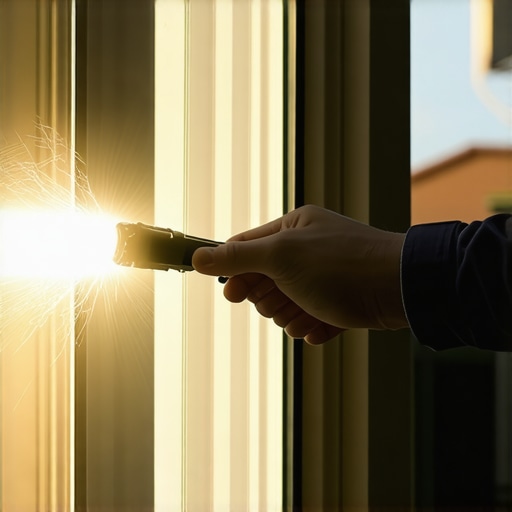
As a master glazier with a quarter century in the field, I can tell you that most homeowners do not realize their windows are failing until the drywall is soft or the energy bill spikes. A hairline crack in an Insulated Glass Unit (IGU) is not just an aesthetic flaw: it is a breach in a pressurized system. These micro-fractures often hide in plain sight, masked by the reflections of the sky or the interior light. To find them, we use the grazing light technique, often called the flashlight method. This is not about shining a light through the glass; it is about bouncing light off the surface at an acute angle to reveal the fracture wings that signify a structural failure in the sash.
“Correct installation is critical to the performance of any fenestration product. A high-performance window installed poorly will fail to meet its thermal and structural ratings.” – ASTM E2112 Standard Practice
The Condensation Crisis: A Master Glazier’s Perspective
I recall a specific case where a homeowner called me in a panic because their new windows were ‘sweating’ and they were convinced the seals had blown within a month. I walked in with my hygrometer and a high-lumen LED torch. I showed them that the interior humidity was sitting at a staggering 60 percent. It was not a product failure; it was their lifestyle: three humidifiers running in a sealed environment. However, when I applied the flashlight method to the guest bedroom window, I found a tiny, nearly invisible stress crack originating from the glazing bead. The window was not sweating because of the humidity alone; the crack had allowed the argon gas to escape, lowering the center-of-glass temperature below the dew point. This is why a precise diagnosis is required before you jump to replace windows.
The Physics of the Micro-Fracture
In cold climates like Minneapolis or Chicago, the U-factor is the metric that dictates your comfort. The U-factor measures the rate of non-solar heat loss: the lower the number, the better the insulation. When a hairline crack develops, the hermetic seal of the IGU is compromised. Most modern high-performance windows utilize a dual-seal system: a primary seal of polyisobutylene (PIB) and a secondary structural seal of silicone or polysulfide. These seals hold the argon gas in place. Argon is denser than air and significantly reduces the convective heat transfer between the two panes of glass. Once a crack occurs, the argon dissipates and is replaced by moisture-laden air. This increases the thermal conductivity of the window, rendering your expensive Low-E coating nearly useless. The Low-E coating itself is a microscopic layer of silver deposited on Surface 3 (the inward-facing side of the exterior pane in cold climates). It is designed to reflect long-wave infrared radiation back into the heated room. Without the gas buffer, the temperature differential across that glass becomes too extreme, leading to further glass tension and eventual total failure.
How to Perform the Flashlight Method
To identify these defects, you first need a professional window cleaner to strip the glass of any organic debris or salt spray. Dirt can easily mimic the appearance of a crack. Once the glass is pristine, wait until dusk or pull the interior shades. Take a high-intensity flashlight and hold it nearly parallel to the glass surface, about one inch away from the frame. Move the beam slowly from the bottom rail up toward the header. What you are looking for are ‘fracture wings’: tiny, shimmering lines that catch the light. A stress crack usually begins at the edge of the glass, hidden under the glazing bead, and meanders toward the center in a wavy pattern. This is often caused by a ‘Rough Opening’ that was not properly squared, causing the frame to rack and put uneven pressure on the glass. In contrast, an impact crack will have a clear point of origin with radiating lines, often resembling a spider web. Finding these early determines if you need a simple window repair or a full-frame intervention.
“Proper labeling and certification ensure that the window meets the thermal requirements for the specific climate zone, but only if the physical integrity of the glazing remains intact.” – NFRC Performance Guidelines
The Installation Autopsy: Why Windows Crack
When I perform an installation autopsy on a leaking or cracked window, I often find that the ‘Shingle Principle’ was ignored. Water must always be directed down and out. If an installer fails to use a proper sill pan or neglects the flashing tape at the head, water can seep into the rough opening. This water causes the wooden framing to swell, which exerts massive pressure on the window frame. If the installer did not leave the proper 1/4 inch gap for a shim, there is no room for this expansion. The frame compresses the sash, the sash compresses the IGU, and the glass eventually snaps. This is why I have a zero-tolerance policy for ‘caulk-and-walk’ installers who skip the mechanical flashing. A window repair might fix the glass, but if the underlying framing is rot-blackened and swollen, you are just waiting for the next crack to appear. You must ensure the weep holes in the bottom rail are clear of debris; if water backs up in the glazing channel, it can freeze, expand, and shatter the edge of the glass from the inside out.
Replacement Reality: Choosing the Right Materials
If your flashlight test reveals multiple failures, you must decide on a replacement strategy. For those in northern latitudes, triple-pane glass with a warm-edge spacer is the gold standard. These spacers are made of low-conductivity materials rather than traditional aluminum, which further prevents condensation at the glass edge. When you replace windows, consider the frame material’s expansion coefficient. Vinyl is cost-effective but has a high rate of thermal expansion. In extreme cold, it can shrink away from the rough opening if not shimmed perfectly. Fiberglass is much more stable, as it expands and contracts at nearly the same rate as the glass itself, reducing the risk of the very stress cracks we are looking for. Do not be swayed by high-pressure sales tactics regarding krypton gas fills in standard residential windows: the ROI is often measured in centuries. Stick to high-quality argon, proper Low-E placement on Surface 3, and, above all, a master-level installation that respects the science of water management and thermal dynamics.