Beyond the Bucket: The Professional Glazier’s View on High-Rise Maintenance
When you spend a quarter-century looking through glass from the perspective of an installer and repair specialist, you stop seeing a window as a simple transparent barrier. To a master glazier, every pane in a high-rise office building is a dynamic membrane under constant stress from wind loads, thermal expansion, and atmospheric pressure. High-rise window cleaning is not merely about aesthetics; it is the first line of defense in a comprehensive maintenance strategy. If you are approaching a 40-story curtain wall with a bottle of blue spray and a paper towel, you are not a technician; you are a liability. Proper maintenance requires a deep understanding of glass chemistry and mechanical integrity. We often see facility managers who treat window cleaner tasks as low-skill labor, only to realize later that improper tools have scratched thousands of dollars of tempered glass or that neglected weep holes have led to catastrophic sill pan failures.
A homeowner called me in a panic because their new windows were ‘sweating’ and they were convinced the seals had failed within six months. I walked in with my hygrometer and showed them the humidity was 60 percent. It was not the windows; it was their lifestyle and the lack of proper air exchange. This same principle applies to commercial high-rise environments. High-rise windows often show signs of ‘sweating’ or condensation that janitorial staff might try to wipe away, but as a specialist, I look for the root cause. Is the HVAC system failing to de-humidify, or is the thermal break in the aluminum frame compromised? Cleaning is the moment of inspection where we identify the need for window repair or to replace windows entirely before a small leak becomes a structural rot issue.
“Installation is just as critical as the window performance itself. A high-performance window installed poorly will fail.” – AAMA Installation Masters Guide
The Physics of the High-Rise Cleaning Kit
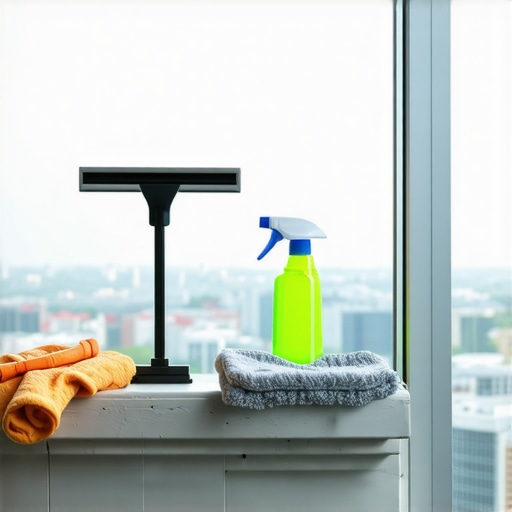
The essential kit for a professional high-rise window cleaner starts with the squeegee, but not the variety you find at a local hardware store. We use professional-grade channels made of brass or aircraft-grade aluminum. The rubber blade itself is graded by durometer. In colder northern climates, we use a ‘soft’ rubber that maintains flexibility when the temperature drops, ensuring a consistent seal against the glass. In hotter climates, a ‘hard’ rubber is required so the blade does not skip or ‘chatter’ across the glass surface. This chattering is more than a nuisance; it leaves microscopic deposits of rubber that can bake into the Low-E coating if the glass is not properly lubricated.
Speaking of Low-E coatings, this is where the science of window cleaner solutions becomes critical. High-rise glass often features a metallic oxide layer on Surface #2 to reflect solar heat. If the glass is monolithic or if the coating is exposed, using an ammonia-based cleaner is a recipe for disaster. The chemical reaction can strip the coating, leading to permanent ‘bluing’ of the glass. Our kits utilize de-ionized water systems. By removing all Total Dissolved Solids (TDS) from the water, we create a ‘hungry’ solution that naturally attracts minerals and dirt without the need for harsh surfactants. This pure water method ensures that when the water evaporates, there are no mineral deposits left to create ‘ghosting’ or spots that can eventually lead to glass corrosion.
The Anatomy of the Frame: Rough Opening to Weep Hole
During a professional cleaning cycle, a technician must inspect the glazing bead and the weep holes. The weep hole is a small exit point at the base of the frame designed to allow water that bypasses the gaskets to escape. In many high-rise office buildings, these become clogged with debris or are accidentally painted shut. When water cannot escape, it sits in the sill pan, eventually rotting the shims and compromising the rough opening. I have seen billion-dollar assets suffer from internal wall rot because a window cleaner didn’t know to check if the weep holes were clear. This is the difference between simple cleaning and professional maintenance.
If you are identifying a need for window repair, the kit must include a high-quality sealant. We do not use standard hardware store caulk. We use high-movement silicone sealants that can handle the 200 percent elongation required when a building sways in high winds. If the glass itself is cracked, the decision to replace windows must be made based on whether the glass is heat-strengthened or fully tempered. In a high-rise, you cannot simply swap a pane; you must ensure the new glass matches the original’s Solar Heat Gain Coefficient (SHGC) and U-Factor to maintain the building’s energy balance.
“The window assembly must be designed to manage water penetration by either a barrier system or a water-managed system that collects and drains water to the exterior.” – ASTM E2112 Standard Practice
Tools of the Trade: Beyond the Squeegee
A comprehensive kit includes carbon fiber water-fed poles. These allow a technician to reach surfaces from a stable platform without always needing to hang from a rig. However, when a ‘drop’ is necessary, the kit expands to include specialized harnesses and anchors. The scraper is another misunderstood tool. We use 6-inch surgical grade stainless steel blades, but they are only used on wet glass. Dry-scraping tempered glass can release ‘fabricated debris’—microscopic glass particles fused to the surface during the tempering process—which then act like sandpaper, ruining the pane. This is why we insist on a professional-grade window cleaner who understands the molecular structure of the surface they are treating.
Thermal Logic and Climate Specifics
In northern climates, the focus of the cleaning and maintenance kit is on the integrity of the seals to prevent heat loss. We look for ‘fogging’ between the panes, which indicates the desiccant in the spacer bar is saturated and the argon gas has escaped. When this happens, the U-Factor of the window skyrockets, and your heating bills follow. In these cases, cleaning won’t help; it is time to replace windows. In southern climates, the priority is the integrity of the reflective films. The heat from the sun is intense, and any degradation of the glass surface can lead to massive increases in radiant heat transfer, making the office space uncomfortable for tenants. The kit for these regions often includes specialized glass polish to remove hard water stains caused by rapid evaporation on hot glass surfaces.
Conclusion: The Glazier’s Final Word
Maintaining a high-rise office building requires more than a bucket of soapy water. It requires an kit built on the principles of structural engineering and glass science. Whether you are performing a routine window repair or a full-scale project to replace windows, the tools and techniques you choose will dictate the longevity of the building envelope. Do not settle for ‘caulk-and-walk’ solutions. Invest in the right equipment, understand the physics of your climate, and treat every window as the critical engineered system it is. Proper care today prevents the structural failures of tomorrow. [IMAGE_PLACEHOLDER]