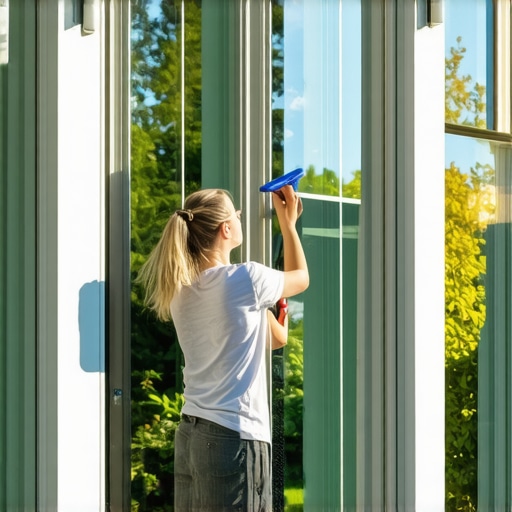
In twenty-five years of handling high-performance glazing, I have seen every possible failure of a window system. I have watched water ingress rot out a rough opening because a contractor forgot a simple sill pan, and I have seen homeowners spend thousands on a window repair that could have been avoided with simple maintenance. But the most common frustration I encounter is the homeowner who spends an entire Saturday scrubbing their glass only to find it covered in a hazy, iridescent film the moment the sun hits it. They blame the window cleaner or the squeegee, but the culprit is almost always the laws of thermodynamics. As a master glazier, I look at a window as a complex thermal barrier. When you clean your windows, you are interacting with the outermost surface, known in the trade as Surface #1. To get a professional result, you must understand how that surface reacts to ambient temperature and radiant heat.
The Condensation Crisis and Surface Temperature
A homeowner once called me in a panic because their brand-new, high-efficiency windows were ‘sweating’ on the exterior every morning. They were convinced the seals had failed or the gas fill had leaked. I walked into their home with my hygrometer and showed them that their indoor humidity was hovering at sixty percent, while the exterior glass was dropping below the dew point. It was not a window failure; it was a testament to the glass doing exactly what it was designed to do: isolate the indoor climate from the outdoor one. This same phenomenon dictates your cleaning schedule. If you attempt to clean a window when the glass temperature is significantly different from the air temperature, you are fighting a losing battle against physics. When the sun beats down on a pane of glass, the Solar Heat Gain Coefficient (SHGC) becomes your enemy. The glass absorbs energy, and Surface #1 can reach temperatures far exceeding the ambient air. If you apply a liquid window cleaner to glass that is 110 degrees Fahrenheit, the carrier (usually water or alcohol) evaporates almost instantly. This leaves the surfactants and dissolved minerals behind in a chaotic, uneven pattern. We call this ‘evaporative ghosting,’ and no amount of buffing will remove it once it has baked onto the surface.
“Installation is just as critical as the window performance itself. A high-performance window installed poorly will fail.” AAMA Installation Masters Guide
The Physics of the Streak: Why Noon is Your Enemy
The best time to clean exterior windows for a streak-free finish is early morning or late afternoon when the windows are in the shade. Specifically, you want the glass surface temperature to be between 50 and 70 degrees Fahrenheit. In a North or Cold climate, like Chicago or Minneapolis, where U-Factor is king, we often use windows with Low-E coatings on Surface #3 to reflect heat back inside. This means the exterior pane (Surface #1) stays colder longer into the morning. If you spray cold water onto a pane of glass that has been sitting in the sun, you risk more than just streaks; you risk thermal shock. While tempered glass is resilient, annealed glass used in many older window repair projects can crack if the thermal gradient becomes too steep. When you clean in the shade, you allow the cleaning solution to remain in a liquid state long enough for your squeegee to physically transport the suspended dirt particles off the glass and into the glazing bead. If the solution dries before the stroke is finished, those particles are simply redistributed into a thin, visible film.
Decoding the Glass: When to Repair or Replace
Sometimes, what looks like a dirty window is actually a permanent failure of the glazing unit. If you see a milky white haze or ‘calcium bloom’ that won’t come off with a professional-grade window cleaner, you are likely looking at a compromised seal. When the desiccant inside the spacer bar becomes saturated, moisture enters the dead air space between the panes. This is the point where you stop looking for a cleaner and start looking to replace windows. A failed IGU (Insulated Glass Unit) cannot be ‘cleaned’ back to health. I often tell clients that a window is a machine that never stops working; it is constantly expanding and contracting. The sash moves within the frame, the glass moves within the sash, and the seals are under constant pressure. If your windows are twenty years old and the muntin bars are starting to sag or the weep hole system is clogged with debris, no amount of cleaning will restore the U-factor or the structural integrity of the unit.
“The performance of a fenestration product is dependent on the integrity of the entire system, including the frame, glass, and the interface with the building envelope.” NFRC Performance Standards
The Professional Technique: Tools and Trade Cant
If the glass is cool to the touch and in the shade, you can begin the process. Professional glaziers do not use paper towels or spray bottles. We use a t-bar scrubber and a high-quality squeegee with replaceable rubber. The ‘trade cant’ for a perfect clean involves a ‘cut-in’ stroke. You start by wiping a thin strip of dry glass at the top of the sash with a microfiber cloth. This prevents ‘top-run,’ where water hidden behind the glazing bead or the top of the frame drips down onto your clean glass. You then use the squeegee in a continuous ‘fanning’ motion, never lifting the blade from the surface. This keeps the liquid moving and prevents the formation of ‘lines’ at the edge of the blade. If you find that the water is ‘beading’ up rather than sheeting off, it is a sign that the glass has a high surface tension, often caused by wax-based cleaners used in the past. You may need to use a dedicated glass stripper to return the surface to its original state before you can achieve a truly streak-free finish.
The Role of Frame Material in Cleaning and Longevity
The frame material also dictates how you approach window maintenance. Vinyl frames, while affordable, have a high coefficient of thermal expansion. They move significantly more than fiberglass or wood. During the cleaning process, you should inspect the flashing tape and the perimeter sealant. If the caulk is pulling away from the rough opening, you have a water intrusion path that could lead to rot. Wood windows require even more care; if you soak the sash with too much water during cleaning, you can trigger rot in the lower corners where the muntins meet the sill. Always ensure your weep holes—those small slots at the bottom of the exterior frame—are clear. These are designed to allow water that gets past the glazing bead to escape. If they are plugged with dirt or paint, that water will back up into the house, causing the very damage that leads to a costly window repair. Ultimately, cleaning your windows is the best time to perform a ‘health check’ on your home’s envelope. If you notice the shim space is visible or the window is difficult to operate, it may be time to consult a specialist to determine if you need to replace windows or if a simple adjustment will suffice. By understanding the physics of the glass and the timing of the sun, you can maintain your windows’ performance and aesthetic for decades.