The Frustrating Resistance of a Failing Lock
You reach for the cam-action lock on your double-hung window, ready to secure your home for the night, but the lever refuses to budge. You apply more pressure, feeling the metal grind against the keeper. There is a specific, tactile resistance that tells a master glazier exactly what is happening: friction is winning the battle against your hardware. In my 25 years in the field, I have seen homeowners break handles off $1,000 fiberglass units because they did not understand the simple mechanics of friction. Before you call a contractor to replace windows or look for a window repair specialist, you need to understand the molecular advantage of a $4 graphite pen. This is not a hack; it is mechanical engineering applied to your home’s fenestration.
The Condensation Crisis: A Narrative of Mechanical Failure
I recall a client in Chicago during a particularly brutal January. They called me in a panic because their brand-new, high-performance windows were sweating, and the locks had become almost impossible to operate. They were convinced the units were defective. I walked in with my hygrometer and showed them that their indoor humidity was hovering at 60 percent. It was not the windows; it was their lifestyle choices combined with a lack of ventilation. That moisture was not just sitting on the glass; it was infiltrating the hardware housing, causing micro-corrosion and increasing the friction coefficient of the internal gears. I did not suggest a window repair in the traditional sense. I handed them a graphite stick and taught them about dew point management. Within minutes, the locks were sliding with the precision of a Swiss watch. This story illustrates a fundamental truth: environmental factors dictate hardware performance.
“Installation is just as critical as the window performance itself. A high-performance window installed poorly will fail.” – AAMA Installation Masters Guide
The Physics of Graphite versus Liquid Lubricants
When most people encounter a sticky lock, they reach for a can of spray oil or WD-40. As a glazier, this makes me cringe. Liquid lubricants are dust magnets. In the world of windows, dust is an abrasive. When you spray oil into a sash lock or a sliding track, you are creating a slurry that will eventually grind down the metal. Graphite is a dry lubricant. It consists of carbon atoms arranged in hexagonal lattices that slide over one another with minimal resistance. When you use a graphite pen on a muntin-supported sash or a lock keeper, you are depositing these microscopic plates between the metal surfaces. These plates slide with incredible ease, providing lubrication that does not attract the dirt brought in by a window cleaner or the natural wind infiltration through the rough opening.
Why Locks Stick: The Technical Causes
A sticky window lock is rarely just about the lock itself. It is often a symptom of the window’s relationship with the house. In northern climates, the primary enemy is heat loss and the resulting contraction of materials. If your shim placement was off during the initial install, the frame might have shifted over time. This is known as racking. When the frame is no longer perfectly square, the sash does not sit flush against the glazing bead. This misalignment means the lock and the keeper do not line up perfectly. You are not just fighting friction; you are fighting the structural integrity of the rough opening. If the misalignment is less than an eighth of an inch, the graphite pen can bridge that gap by allowing the metal components to slide into place without binding.
“The window assembly must be installed in a manner that maintains the integrity of the water-resistive barrier.” – ASTM E2112 Standard Practice
The Role of the Window Cleaner and Maintenance
Many homeowners overlook the importance of a professional window cleaner in the longevity of their hardware. It is not just about the glass. A proper cleaning involves clearing the weep hole of debris and ensuring the tracks are free of grit. If you are performing a window repair, the first step is always decontamination. Once the tracks and hardware are clean, that is when you apply the graphite. For those in cold climates, where the U-Factor is the most critical metric, maintaining a tight seal is paramount. A lock that does not fully engage prevents the weatherstripping from compressing. If the weatherstripping does not compress, your expensive triple-pane window with a Low-E coating on surface three is effectively useless because air is bypassing the entire assembly.
Glazing Zooming: The Molecular Level of Lubrication
To truly understand why the graphite pen is superior, we must look at the lamellar structure of the material. Each layer of carbon is bonded strongly to the atoms within its own layer but weakly to the atoms in the layers above and below. This allows the layers to flake off and coat the metal of your window lock. When you use the pen to mark the strike point of the lock, you are essentially creating a sacrificial layer of carbon. Instead of metal rubbing on metal, which leads to galling and eventual failure, you have carbon sliding on carbon. This is particularly vital for operable windows that are used frequently. In a southern climate, where the Solar Heat Gain Coefficient (SHGC) is the priority, the radiant heat can actually cause liquid lubricants to thin and run, potentially staining the sash or the sill pan. Graphite remains stable at temperatures far exceeding anything your window will ever face.
When the $4 Fix Isn’t Enough: Knowing When to Replace
There comes a point where no amount of graphite or window repair can save a failing unit. If you see black rot on the header or if the flashing tape has failed and allowed water to bypass the sill pan, it is time to replace windows entirely. If the sash has warped beyond the tolerances of the frame, the lock will never line up. This is common in low-quality vinyl windows that have undergone too many thermal expansion cycles. In these cases, the graphite pen is a diagnostic tool: if you lubricate the lock and it still requires excessive force to close, your frame is likely racked or the house has settled significantly. At that stage, you are looking at a full-frame tear-out to correct the underlying structural issues in the rough opening.
Practical Application: How to Use the Graphite Pen
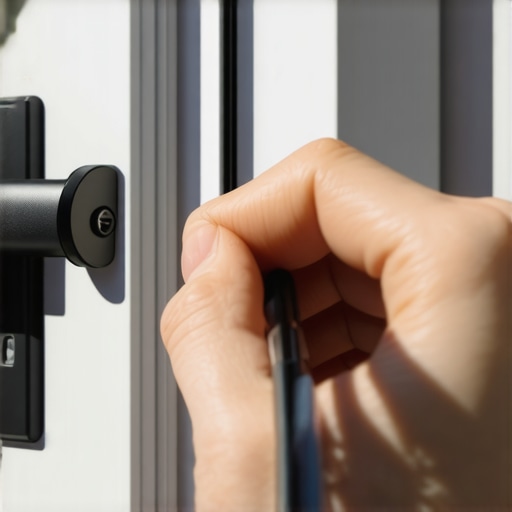
To apply this fix, start by opening the window and using a dry brush to remove any loose debris from the lock and keeper. If there is old grease present, use a mild window cleaner on a microfiber cloth to strip it away. Once the metal is dry, take your graphite pen and heavily mark the areas where the lock hook meets the keeper. You want to see a visible, dark grey coating. Operate the lock several times to distribute the graphite particles into the internal mechanism. You will notice an immediate reduction in the force required to turn the handle. This simple maintenance task, performed once a year, can extend the life of your hardware by decades and ensure your home remains energy efficient by allowing for a proper, airtight seal.