The Clarity Crisis: Why Your Windows Look Like Smudge Maps
Most homeowners look at their windows and see a clear view of the yard. I look at them and see a complex thermal envelope consisting of an Insulated Glass Unit (IGU), a precisely engineered Sash, and a delicate balance of gas fills and metallic coatings. When you reach for that blue bottle of ammonia-based cleaner, you aren’t just cleaning glass; you are potentially compromising the chemical integrity of your glazing components. In my 25 years as a Master Glazier, I have seen more glass damaged by aggressive ‘grocery store’ cleaners than by actual environmental wear. The streaks you see aren’t just dirt; they are often the residue of surfactants that have no business being on high-performance glass.
The Condensation Crisis: A Master Glazier’s Narrative
I remember a call from a homeowner in a suburban development who was convinced her triple-pane units had failed within six months. She called me in a panic because her new windows were ‘sweating’ so profusely she had towels on the sills. I walked in with my hygrometer, ignored the windows for a moment, and checked the ambient air. The humidity was sitting at 62% in the dead of winter. It wasn’t a seal failure; it was her lifestyle. She was running a whole-house humidifier at 50% while boiling large pots of water without the range hood fan. The windows were performing exactly as they should, providing a cold surface for the excessive interior moisture to condense upon. We didn’t need a window repair; we needed a lesson in psychrometrics. This taught me that most people don’t understand how their windows interact with their environment, and that misunderstanding extends to how they clean them.
“Installation is just as critical as the window performance itself. A high-performance window installed poorly will fail.” – AAMA Installation Masters Guide
The Science of the Surface: Why Ammonia is the Enemy
Commercial cleaners often rely on ammonia to provide a fast-evaporating finish. While this works on a 1950s single-pane wood window, it is a disaster for modern glazing. Modern windows utilize Low-E (Low Emissivity) coatings, specifically ‘soft-coat’ layers applied via a sputter coating process on Surface #2 or #3 of the IGU. While these coatings are protected inside the sealed unit, many homeowners also have aftermarket films or ‘hard-coat’ pyrolytic layers on Surface #4 (the interior face). Ammonia is a harsh solvent that can gradually degrade the Glazing Bead—the strip of plastic or vinyl that holds the glass in the Sash. Over time, this chemical exposure causes the bead to become brittle, leading to air infiltration and eventually, the dreaded ‘fogging’ that signals a failed seal. Furthermore, ammonia can react with the silicone sealants used in many high-end units, causing premature seal failure. This is why we need to move toward a more stable, pH-balanced approach.
The 3-Ingredient Professional Solution
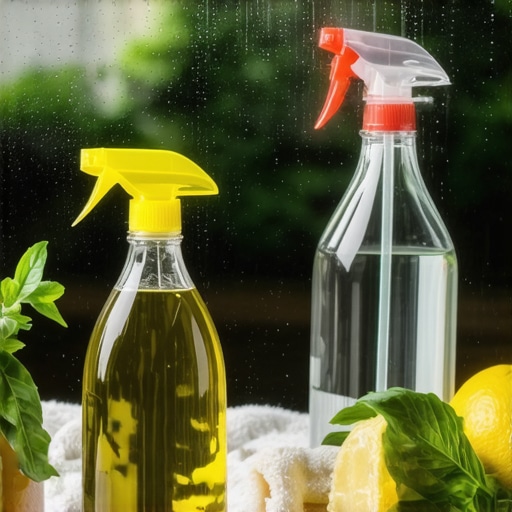
If you want to clean like a pro, you need to think like a chemist. The ultimate window cleaner consists of three simple components: distilled water, white vinegar, and a high-surfactant dish soap. Let’s zoom in on the physics here. Distilled water is crucial because it lacks the calcium and magnesium ions found in tap water, which create ‘hard water’ spots. The white vinegar (acetic acid) acts as a mild solvent to break down the hydrocarbon film deposited by car exhaust and pollen. Finally, a single drop of dish soap acts as a surfactant, breaking the surface tension of the water so it can lift dirt away from the glass rather than just moving it around.
[image placeholder]
Glazing Zooming: The Physics of Passive Solar and Dirt
A dirty window is more than an aesthetic problem; it is a performance bottleneck. When dirt accumulates on the exterior pane, it alters the Solar Heat Gain Coefficient (SHGC). In cold climates, we rely on a high SHGC to provide passive solar heating during the winter months. A layer of particulate matter reflects the very infrared radiation you want entering your home. If you are in a northern climate like Minneapolis or Chicago, U-Factor is your king. You want to keep the heat inside. A clean window ensures that the Low-E coating on Surface #3 can effectively reflect long-wave infrared radiation back into the room. If that glass is coated in a film of grime, the thermal exchange is disrupted. When we talk about window repair, people often think of broken glass, but ‘repairing’ the thermal performance often starts with restoring the Visible Transmittance (VT) through proper cleaning.
The Anatomy of a Clean Window: Don’t Forget the Weep Holes
When you are cleaning, you must look beyond the glass. The ‘Rough Opening’ of your window is surrounded by a complex system of Flashing Tape and Sill Pans designed to manage water. However, the window itself has a drainage system. Look at the bottom of your window frame on the outside; you will see small slots called Weep Holes. These are designed to allow water that enters the glazing channel to escape. If these are clogged with dirt, spider webs, or old cleaning residue, water will back up into the frame, rot the wood, or cause mold growth in the drywall. A true window cleaner uses a small brush or compressed air to ensure these holes are clear. This is the difference between a ‘caulk-and-walk’ amateur and a professional who understands the ‘Shingle Principle’ of water management.
“The performance of the fenestration system is dependent upon the integration of the window into the rough opening.” – ASTM E2112 Standard Practice
When to Stop Cleaning and Start Replacing
No amount of vinegar will fix a failed spacer. If you see moisture *between* the panes of glass, the desiccant inside the spacer bar has reached its saturation point, and the primary seal has breached. At this point, the Argon or Krypton gas fill has leaked out, and your R-value has plummeted. This is when you must decide to replace windows or perform a sash swap. In my experience, if the frames are high-quality fiberglass or thermally broken aluminum, a simple IGU replacement is sufficient. However, if you have old vinyl frames that have bowed or ‘smiled’ due to thermal expansion, a full-frame replacement is the only way to restore the integrity of the thermal envelope. Do not let a salesman talk you into triple-pane glass if you live in a mild climate; the ROI simply isn’t there. Focus on a high-quality double-pane with a warm-edge spacer to prevent that perimeter condensation we discussed earlier.
Technical Maintenance Checklist
- Inspect the Glazing Bead: Ensure it is tight against the glass and not cracked.
- Clear the Weep Holes: Use a pipe cleaner to ensure drainage.
- Lubricate the Hardware: Use a dry silicone spray on the tracks of operable windows.
- Check the Weatherstripping: Look for compressions or tears that allow air bypass.
By following this technical approach to window maintenance, you extend the life of your investment and ensure that the U-factor you paid for is actually working for you. Stop using blue water and start using science. Your windows, and your energy bill, will thank you.