The Physics of Fenestration Failure
When you look through your window, you are not just looking through a piece of glass; you are looking through a precision-engineered thermal barrier known as an Insulated Glass Unit (IGU). As a glazier with over two decades in the field, I have seen every possible failure mode of these units. Most homeowners assume that a cloudy window is just dirty and needs a professional window cleaner. However, when the fog is between the panes, no amount of scrubbing will solve the issue. You are witnessing the death of a seal, and often, you can diagnose this before the permanent mineral deposits set in by using a simple hairdryer.
A homeowner once called me in a panic because their brand-new, high-efficiency windows were sweating during a cold October morning in Chicago. I walked into their living room with my hygrometer and found the interior humidity was hovering at 60 percent. I had to explain that it was not a window failure; it was their lifestyle choices—too many houseplants and a broken bath fan. However, if that condensation had been inside the IGU, the story would have been different. That is where the hairdryer comes in as a diagnostic tool for window repair. By applying gentle, localized heat to the exterior of the glass, you can force the moisture trapped within the desiccant to evaporate and condense on the cooler interior pane, revealing a seal breach that is otherwise invisible to the naked eye.
“The service life of an IGU is fundamentally dependent on the integrity of the dual-seal system and the moisture vapor transmission rate of the primary sealant.” – ASTM E2112 Standard Practice
Understanding the IGU Architecture
To understand why a seal fails, you must understand the assembly. A standard double-pane window consists of two lites of glass separated by a spacer bar. This spacer is filled with a desiccant, a material designed to suck up any residual moisture from the manufacturing process. The edges are then sealed with a primary seal of polyisobutylene (PIB) and a secondary seal of silicone or polysulfide. In a cold climate like the North, the U-Factor is the most critical metric. We want to keep the heat inside. We often use argon gas in the cavity because it is denser than air and slows down convective currents. But when the seal fails, the argon escapes, and moisture-laden air rushes in.
This process is accelerated by solar pumping. During the day, the sun hits the glass, the gas inside expands, and the pressure pushes against the seals. At night, the unit cools and contracts. This constant rhythmic movement puts immense stress on the glazing bead and the sealant. Over time, the seal develops microscopic fissures. This is when you need to decide whether to perform a window repair by replacing just the glass or to replace windows entirely. If the frame is wood and has begun to rot at the sill, a simple glass swap won’t save you.
The Hairdryer Diagnostic Procedure
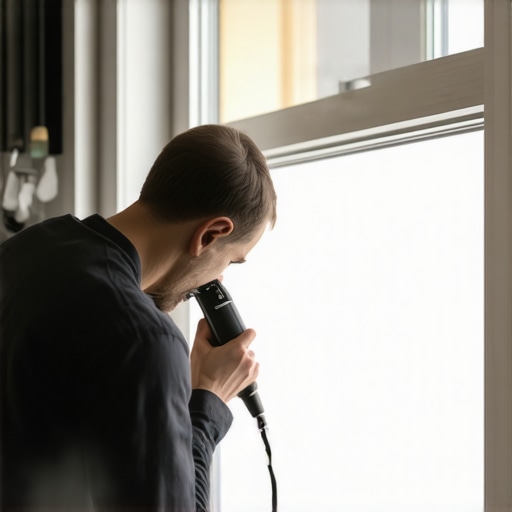
To perform this test, wait for a day with a clear temperature differential between the inside and outside. Set your hairdryer to a medium heat setting. Do not hold it too close to the glass, as extreme thermal shock can actually crack the pane—a phenomenon known as thermal stress breakage. Move the hairdryer in a slow, circular motion over a six-inch area of the sash near the corner. If there is a breach, the heat will agitate the moisture molecules trapped in the spacer’s saturated desiccant. Within minutes, you will see a localized fogging on the interior surface of the outer pane. This is the smoking gun of a failed seal.
If you see this, you are looking at a failed IGU. The thermal performance of that window has plummeted. The Low-E coating, which is usually located on Surface #3 in northern climates to reflect heat back into the room, may also begin to oxidize and turn a rusty or purple color once exposed to oxygen and moisture. [IMAGE_PLACEHOLDER] At this point, the window is no longer a thermal barrier; it is just two pieces of glass with a pocket of damp air between them.
Materials and Maintenance
When considering window repair, look at the frame material. Vinyl is popular because it is cheap, but it has a high coefficient of thermal expansion. It moves a lot more than the glass does, which puts more strain on the seals. Fiberglass is much more stable because it is made of glass fibers and resin, meaning it expands and contracts at a rate nearly identical to the IGU itself. If you are going to replace windows, I always recommend fiberglass for longevity. During installation, ensure the installer uses a proper sill pan and flashing tape. I have seen too many rough openings destroyed because someone relied on a bead of caulk rather than proper mechanical flashing.
“A window is only as good as its installation. Even an R-5 window will perform like an R-1 window if air leakage is not controlled at the rough opening interface.” – NFRC Performance Guidelines
The Myth of the Energy Savings ROI
Salesmen will tell you that new windows will pay for themselves in three years. That is a lie. The real reason to replace windows is comfort and structural integrity. A failing seal leads to drafts, and those drafts make you turn up the thermostat. Furthermore, once a seal is gone, moisture can drip down into the sash and frame, leading to mold and rot that can spread to your wall studs. You aren’t just buying glass; you are protecting the envelope of your home. Check your weep holes to make sure they aren’t clogged with debris, as standing water in the glazing channel is the fastest way to kill a secondary seal.