The Glazier’s Perspective on Glass Degradation
As a Master Glazier with over a quarter-century in the field, I have seen thousands of homeowners mistake a permanent chemical etching for a simple dirty window. Most people see a window as a transparent barrier, but to a specialist, it is a complex silicate structure that is surprisingly reactive to its environment. When you see those milky, white rings on your glass, you are not just looking at dirt. You are looking at mineral calcification. A homeowner called me in a panic because their new windows were ‘sweating’ and turning white. I walked in with my hygrometer and showed them the humidity was 60 percent, but more importantly, I pointed out the irrigation spray hitting the glass every morning. It was not the windows failing; it was their lifestyle and the local water chemistry. Those minerals were being baked into the glass surface by the intense southern sun, creating a bond that no standard window cleaner could ever hope to break.
The Chemistry of the Mineral Bond
To understand why a natural scrub is necessary, we must examine the molecular physics of the glass surface. Glass is an amorphous solid with a microscopic surface profile that is not perfectly smooth. When hard water containing high concentrations of calcium and magnesium carbonates evaporates on Surface #1 (the exterior face), it leaves behind mineral deposits. Under the radiant heat of the sun, these minerals undergo a process of dehydration and become chemically bonded to the silica. This is why standard ammonia-based cleaners fail. You need a reagent that can break the ionic bond of the calcium while providing enough mechanical agitation to lift the crystals without scratching the glass.
“The performance of the fenestration system is dependent upon the quality of the installation and the maintenance of the glass surface over its life cycle.” – AAMA Installation Masters Guide
[image_placeholder_1]
The Natural Scrub: A Scientific Approach to Cleaning
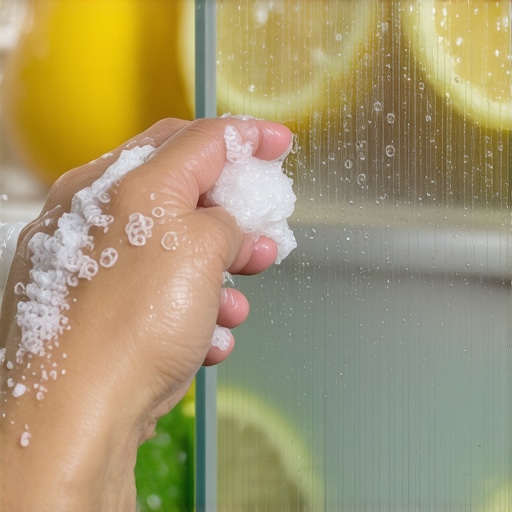
The solution is a balanced natural scrub that utilizes acetic acid and a mild abrasive. To create this, mix one part distilled white vinegar with one part baking soda to create a paste. The acetic acid acts as a descaling agent, reacting with the alkaline calcium carbonate to form calcium acetate, which is water-soluble. The baking soda provides a mechanical shim effect at a microscopic level, lifting the softened minerals. Apply the paste using a microfiber cloth, moving in circular motions. Avoid using steel wool or harsh scouring pads, as these can create micro-scratches that will only serve as future anchor points for more mineral deposits. If you are dealing with glass that has a specialized Low-E coating on Surface #1, be extremely cautious. However, most Low-E coatings are located on Surface #2 or #3 to protect them from environmental abrasion.
The Climate Factor: Solar Heat Gain and Glass Stress
In southern climates where the Solar Heat Gain Coefficient (SHGC) is the primary metric for performance, hard water spots are more than an aesthetic issue. These spots increase the absorption of solar radiation at the glass surface, leading to localized thermal stress. When one part of the glass pane is significantly hotter than the rest due to mineral buildup, it can lead to thermal cracks. For homes in Texas or Florida, maintaining clear glass is a matter of preserving the structural integrity of the sash.
“Understanding the Solar Heat Gain Coefficient is essential for determining how thermal stress affects the longevity of glass coatings and overall window performance.” – NFRC Technical Bulletin
If the spots have been left for years, the glass may have suffered from ‘alkali attack,’ a condition where the minerals have actually eaten into the silicate structure. At this stage, no amount of natural scrub will restore clarity, and you must begin considering a window repair or a total glass unit replacement.
When to Transition from Cleaning to Window Repair
If you have applied the scrub and the glass still feels rough to the touch or appears cloudy, the surface is likely etched. This is a common issue in older homes where the glazing bead has failed, allowing moisture and minerals to sit against the glass edge. In these cases, the cost of professional glass polishing often exceeds the cost to replace windows. When inspecting your windows, check the rough opening for signs of moisture intrusion. If the hard water has managed to penetrate the seal of an Insulated Glass Unit (IGU), you will see ‘fogging’ between the panes. This is a terminal failure. No cleaner can reach the interior surfaces of the glass. In such scenarios, the most cost-effective path is to remove the operable sash and install a new IGU. This ensures that you regain the thermal performance and the U-factor ratings that your home requires for energy efficiency.
Prevention and Professional Maintenance
Prevention is the only way to avoid the eventual need for a full frame replacement. Ensure that sprinklers are aimed away from the house and that the drip caps above your windows are functioning correctly to shed water away from the glass. Every time you clean, inspect the weep hole at the bottom of the frame to ensure it is not clogged with debris. A clogged weep hole can cause water to back up into the sill pan, leading to rot in the rough opening and accelerated mineral buildup on the lower portion of the glass. By treating glass maintenance as a technical necessity rather than a household chore, you extend the life of your investment and maintain the high-performance standards of your home’s thermal envelope. If the glass is beyond saving, look for replacement units that feature a Low-E coating on Surface #2 to help manage the intense solar heat typical of southern regions. This placement protects the coating while maximizing the rejection of long-wave infrared radiation, keeping your cooling costs low and your views clear. “”