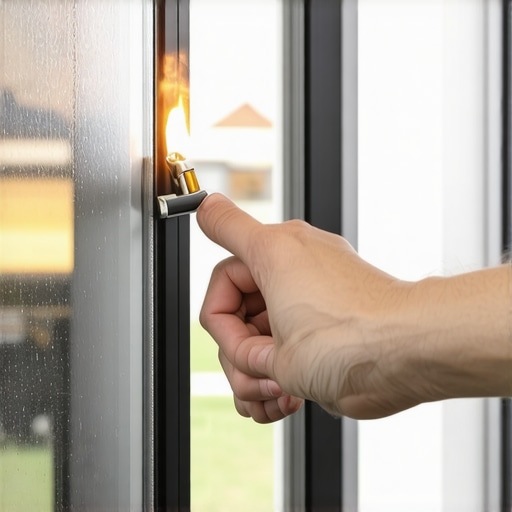
The Science Behind the Flame: Why Your Windows Need More Than Just a Cleaning
In the world of high-performance glazing, what you cannot see is often more important than what you can. As a master glazier with over two decades in the field, I have seen every shortcut in the book, from ‘caulk and walk’ installers to homeowners who think a bucket of window cleaner is all they need to maintain their thermal envelope. One of the most frequent questions I encounter involves Low-E (Low-Emissivity) coatings. Homeowners want to know if they actually have them, if they were installed on the correct surface, and why their rooms still feel like an ice box or a sauna. This is where the simple lighter trick comes into play, a diagnostic tool that reveals the molecular reality of your glass. Before we get into the mechanics of the test, we must understand the stakes of the thermal envelope.
A homeowner called me in a panic because their new windows were ‘sweating’ only three months after installation. I walked in with my hygrometer and showed them the humidity was 60 percent. It was not the windows; it was their lifestyle choices meeting a high-performance seal. They were boiling pasta and running humidifiers without any mechanical ventilation. The windows were doing exactly what they were supposed to do: acting as a thermal barrier. But it sparked a conversation about whether their glass was actually performing to spec. We used a simple flame to verify the presence of the silver oxide layers that define modern fenestration.
What is Low-E and Why Does the Surface Matter?
Low-emissivity is not a plastic film you buy at a hardware store. It is a microscopically thin, transparent coating of metallic oxides, typically silver, applied to the glass during the manufacturing process. The goal is to manage infrared light, which is heat. In a cold climate like Minneapolis or Chicago, the enemy is heat loss. We want the heat from your furnace to bounce off the glass and stay inside your living room. To achieve this, the Low-E coating is ideally placed on Surface #3. In an Insulated Glass Unit (IGU), we count the surfaces from the outside in. Surface 1 is the exterior face, Surface 2 is the inside of the outer pane, Surface 3 is the outside of the inner pane, and Surface 4 is the interior face you can touch from your couch.
“Installation is just as critical as the window performance itself. A high-performance window installed poorly will fail.” – AAMA Installation Masters Guide
When the coating is on Surface #3, it reflects the long-wave infrared radiation back into the house. If you live in the South, you want that coating on Surface #2 to bounce the sun’s heat back to the street. Identifying this is critical when you decide whether to replace windows or attempt a window repair. If a sash was replaced but the glass package was swapped for a standard clear unit, your energy bills will reflect that mistake immediately.
The Lighter Trick: A Step-by-Step Diagnostic
To perform this test, wait until it is dark or dim the interior lights. Hold a lighter or a small flashlight up to the glass. You will see a series of reflections. In a standard double-pane window, you will see four distinct flame reflections. If the glass is standard clear glass, all four flames will be the same yellowish-orange color. However, if the window has a Low-E coating, one of those reflections will be a noticeably different color, usually a pinkish, purple, or greenish tint. This color shift occurs because the metallic layers on the glass are reflecting a different spectrum of light than the glass itself.
If the second flame reflection is a different color, the coating is on Surface #2. If the third flame is the outlier, it is on Surface #3. If you see only two reflections, you are looking at a single-pane window, and no amount of window cleaner is going to fix your R-value. This is the moment where we move from casual observation to technical glazing zooming. The U-Factor, which measures the rate of heat loss, is heavily dependent on this coating. A clear double-pane window might have a U-Factor of 0.48, but add a Low-E coating and Argon gas, and you can drop that to 0.30 or lower. That is a 35 percent improvement in thermal resistance just from a few microns of silver.
The Technical Components of the Rough Opening
When we talk about windows, we have to talk about the Rough Opening. You can have the most advanced triple-pane glass in the world, but if the installer did not use proper shims or neglected the sill pan, the glass is irrelevant. Every operable sash needs to be perfectly square within the frame. If the frame is twisted because the installer forced it into a bowed rough opening, the weatherstripping will not compress correctly, and you will have air infiltration that bypasses the Low-E coating entirely. I have seen countless ‘window repair’ jobs that were actually just failed attempts to fix a poor initial installation. You must ensure the flashing tape is integrated with the house wrap in a weather-lapped fashion. Water management is a science, not an afterthought.
“The National Fenestration Rating Council provides a reliable way to determine the energy performance of windows, but field verification remains a necessity for existing installations.” – NFRC Field Guide
Furthermore, look at the spacers. If you see a cold-edge aluminum spacer between the panes, you are looking at a thermal bridge. Aluminum conducts heat, which is why you see condensation at the edges of the glass even on a Low-E unit. We prefer warm-edge spacers made of structural foam or stainless steel to break that thermal bridge. This prevents the dew point from being reached on the interior surface, which protects your woodwork from rot and mold.
When to Repair and When to Replace
If your lighter test reveals clear glass and your heating bills are sky-high, it might be time to replace windows. However, if you have Low-E glass but still feel a draft, the issue is likely the ‘Glazing Bead’ or the weatherstripping. Window repair is viable if the IGU is still sealed and the frame is structurally sound. If you see fogging between the panes, the seal has failed. Once the Argon gas has escaped and moist air has entered, the Low-E coating can actually begin to oxidize and disappear, leaving you with a cloudy mess that no window cleaner can remove. At that point, the ‘Insulated’ part of the Insulated Glass Unit is gone.
Ultimately, a window is a hole in your wall that is trying to kill your comfort. By using the lighter trick, you are taking the first step in auditing your home’s thermal performance. You are looking past the marketing and into the physics of the glass. Whether you are dealing with a muntin that is purely aesthetic or a structural mullion, the glass package is the heart of the system. Do not settle for installers who cannot explain the difference between SHGC and U-Factor. Demand precision, verify your coatings, and ensure your rough opening is flashed to the highest standards. Your comfort in January depends on the silver oxide you can only see with a flame.