In my twenty-five years as a master glazier, I have seen homeowners spend thousands on high-performance glass only to ruin the optical clarity within two seasons because they did not understand the physics of water management. Hard water stains are not just an aesthetic nuisance; they are a chemical challenge to the integrity of the silica structure. If you are noticing a milky haze that won’t budge with standard over-the-counter products, you are likely dealing with calcified mineral deposits that have begun an ion exchange with the glass surface. A homeowner called me in a panic because their new windows were ‘sweating.’ I walked in with my hygrometer and showed them the humidity was 60%. It wasn’t the windows; it was their lifestyle. They were running a humidifier in a sealed-tight house during a cold winter, and that moisture was carrying minerals from the air and depositing them as the condensate evaporated on the glass surface. This lead to a cycle of staining that required more than just a simple window cleaner to resolve. To understand how to get rid of hard water stains with a natural paste, we must first look at the anatomy of the window and why these minerals choose to bond there in the first place.
The Molecular Reality of Glass Surfaces
To the naked eye, a pane of glass looks like a smooth, non-porous barrier. In the glazing world, we know better. At a microscopic level, glass is an amorphous solid with a surface full of peaks and valleys. When water containing high concentrations of calcium and magnesium—common in many municipal supplies—hits the glass, it settles into these microscopic valleys. As the water evaporates, the minerals are left behind, forming a crystalline structure that is surprisingly resilient. This is why a quick wipe with a rag rarely works. You are trying to mechanicaly dislodge a mineral that has effectively ‘nested’ into the glass pores.
“Installation is just as critical as the window performance itself. A high-performance window installed poorly will fail.” AAMA Installation Masters Guide
This failure often starts at the frame. If the window was not installed with a proper sill pan or if the weep hole is clogged, water can pool against the glazing bead. This standing water creates a high-humidity microclimate right at the edge of the glass, leading to rapid mineral buildup that can eventually creep toward the center of the sash.
The Natural Paste Chemistry
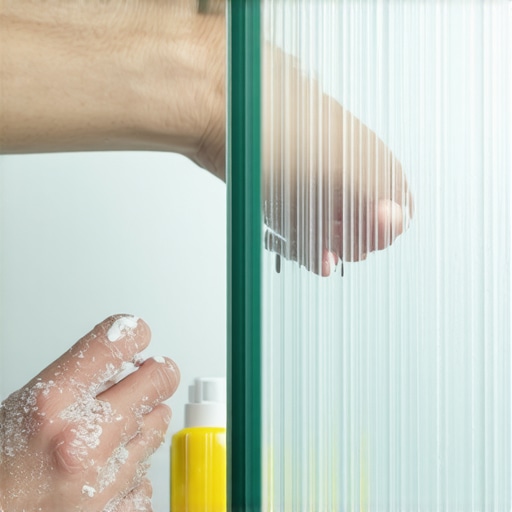
When professional intervention is required for window repair, I often recommend a natural paste before suggesting a full glass replacement. The recipe is simple but the chemistry is profound: combine one cup of sodium bicarbonate (baking soda) with just enough distilled water or white vinegar to create a thick slurry. Sodium bicarbonate serves as a mild mechanical abrasive. On the Mohs scale of mineral hardness, baking soda sits at about a 2.5, while glass is typically between 5.5 and 7. This means the paste can scrub away the 3.0-rated calcium deposits without scratching the substrate. If you use vinegar, you are adding acetic acid to the mix, which reacts with the alkaline calcium carbonate to create calcium acetate, a substance that is highly soluble in water and easily rinsed away. You must apply this paste in a circular motion, ensuring you cover the entire operable area of the window, paying special attention to the corners where the muntin meets the frame. This is where minerals often hide.
Water Management and the Shingle Principle
Hard water stains are often a symptom of poor water management in the rough opening. In a professional installation, we follow the shingle principle: every layer of the building envelope must overlap the one below it so that gravity carries water down and away. If the flashing tape was applied incorrectly or the shim was placed in a way that creates a back-slope on the sill, water will migrate toward the interior. This moisture often carries minerals from the building materials—like cement dust or wood tannins—directly onto the glass. When we talk about how to replace windows correctly, we focus on the integration of the sill pan and the drip cap. Without these, even the most expensive triple-pane unit will become a magnet for hard water deposits as exterior runoff is allowed to dwell on the glass surface. In colder climates like Chicago or Minneapolis, where the U-factor is the primary metric of success, the thermal bridge at the edge of the glass can cause localized condensation. This ‘sweat’ is the perfect vehicle for mineral transport.
Technical Specifications and Performance Metrics
When assessing whether you need a window cleaner or a full window repair, look at your NFRC label.
“The physical properties of the glazing system, including the spacer and gas fill, dictate the surface temperature of the glass, which directly impacts the rate of condensation and subsequent mineral deposition.” NFRC Technical Standards
If your U-factor is high, the glass stays colder, meaning more condensation and more hard water stains. Modern windows utilize warm-edge spacers to keep the perimeter of the glass warmer, which significantly reduces the ‘halo’ of minerals you often see around the edges. If your stains are between the two panes of an insulated glass unit (IGU), the seal has failed. This is a ‘blown’ window. At that point, no amount of natural paste will help because the minerals are depositing on surface #2 or surface #3, which are inaccessible. In this scenario, you must replace windows to restore your thermal envelope and visual clarity.
The Glazier’s Final Word on Maintenance
Do not wait until the glass is etched to take action. Etching is a permanent chemical change where the minerals have actually eaten into the silica. If the natural paste does not restore the shine after two applications, the glass is likely etched. For future prevention, ensure your weep hole system is clear of debris. These small gaps at the bottom of the exterior frame are designed to let water out. If they are blocked, your window frame becomes a bathtub, and that water will eventually find its way to your glass, leaving a trail of minerals behind. Proper maintenance of the glazing bead and the application of a hydrophobic coating can also help water bead up and roll off before the minerals can settle. Remember, a window is a complex system designed to manage heat, light, and water. Treat the glass with the same technical respect you would the engine of a car, and it will provide clarity for decades.
{“@context”:”https://schema.org”,”@type”:”HowTo”,”name”:”How to Get Rid of Hard Water Stains with a Natural Paste”,”description”:”A master glazier’s guide to removing mineral deposits using a natural sodium bicarbonate paste.”,”step”:[{“@type”:”HowToStep”,”text”:”Mix one cup of baking soda with a small amount of distilled water or white vinegar to form a thick, grit-like paste.”},{“@type”:”HowToStep”,”text”:”Apply the paste to the glass surface using a soft microfiber cloth, focusing on areas with visible scaling.”},{“@type”:”HowToStep”,”text”:”Scrub in a circular motion, applying moderate pressure to allow the mild abrasive to break down the calcium bonds.”},{“@type”:”HowToStep”,”text”:”Rinse thoroughly with distilled water to ensure no alkaline residue remains in the microscopic pores of the glass.”},{“@type”:”HowToStep”,”text”:”Inspect the glazing bead and weep holes for blockages to prevent future water pooling and mineral deposition.”}]}