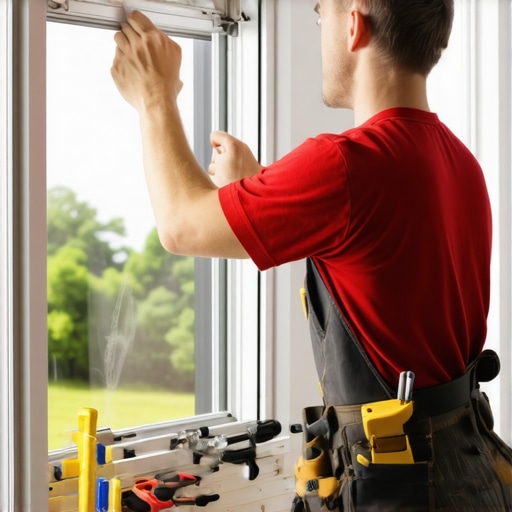
How to Fix a Window That Won’t Stay Propped Open: A Master Glazier’s Guide
A window that refuses to stay propped open is more than a minor annoyance; it is a mechanical failure that compromises the safety and functionality of your home’s thermal envelope. In my twenty-five years of experience as a master glazier, I have seen thousands of homeowners mistakenly believe they need to replace windows entirely when a targeted window repair would have solved the issue for a fraction of the cost. I recall sitting across from a couple in a drafty colonial who had been quoted fourteen thousand dollars by a high-pressure salesman for a full house of replacements simply because their double-hung units were sliding shut like guillotines. I had to explain to them that the issue was not the window itself, but the failure of the balance system, a relatively inexpensive part that manages the weight of the sash. This is a classic case of the ‘Tin Man’ sales tactic where mechanical fatigue is framed as a structural catastrophe.
Understanding the Physics of the Sash Balance
To understand why your window won’t stay open, you must first understand the counter-tension system. An operable sash, whether it is made of vinyl, wood, or fiberglass, is heavy. The glass, the glazing bead, and the frame material combine to create a weight that gravity wants to pull toward the sill. The balance system is the hidden engine within the jamb that provides an equal and opposite force. When these two forces are in equilibrium, the window stays where you put it. When they are not, you have a safety hazard.
“Installation is just as critical as the window performance itself. A high-performance window installed poorly will fail.” – AAMA Installation Masters Guide
Most modern windows utilize one of three primary balance types: constant force, block and tackle, or spiral balances. Each has a specific failure mode that leads to the ‘sliding sash’ syndrome.
The Constant Force Balance: Stainless Steel Strength
In many vinyl windows, you will find constant force balances. These consist of a stainless steel coil spring housed in a plastic carrier. The spring is designed to provide a specific amount of lift measured in pounds. If your window is ten pounds, you need a ten-pound balance. Over time, the plastic carrier can crack, or the stainless steel ribbon can lose its tension through repeated cycles of opening and closing. This is particularly common in cold climates where the PVC frame contracts, putting extra pressure on the balance shoe. When the shoe fails, the connection between the sash and the spring is severed, and the window falls. If you are a window cleaner or a frequent operator, you might notice the window becoming progressively harder to lock as the balance begins to sag.
The Block and Tackle: Pulleys and Cords
Older double-hung windows often use a block and tackle system. This is a more complex mechanical assembly involving a series of pulleys and a high-tension cord. The advantage is a smooth operation, but the disadvantage is that the cord can fray or the pulleys can jam. If the cord snaps, there is zero tension holding the sash up. I have often found that homeowners inadvertently damage these systems by using an aggressive window cleaner that contains ammonia or other solvents which degrade the nylon cords or the lubricant on the pulley axles. Once the lubrication is gone, friction increases, the cord wears, and eventually, the system fails.
The Spiral Balance: Precision Tensioning
Spiral balances are tubes that contain a twisted rod and a spring. These are common in both wood and aluminum windows. The benefit of a spiral balance is that the tension can be adjusted using a specialized tool to wind or unwind the spring. However, the internal components are susceptible to corrosion, especially if the window has been neglected. When the internal spring rusts or the plastic tip cracks, the tension is released.
“Window assemblies shall be designed and installed to provide for the safe and effective operation of the sash.” – NFRC Safety Guidelines
If your window is sliding, the first step is to identify which of these systems is present in your jamb.
Step-by-Step Diagnostic for a Falling Sash
Before you commit to a full window repair, you need to diagnose the specific point of failure. This requires removing the sash from the frame. For most modern tilt-in windows, this involves pulling the sash up a few inches, engaging the tilt latches, and lowering the top of the sash toward you until it is horizontal. From this position, you can see the pivot bars, which are the metal pins at the bottom of the sash that lock into the balance shoes. If a pivot bar is broken or has slipped out of the shoe, the window will not stay up. If the pivot bars are intact, the problem lies deeper in the jamb.
Inspecting the Balance Shoe
The balance shoe is the sliding component that moves up and down the jamb track. It has a ‘cam’ in the center where the pivot bar sits. If the cam is cracked or if the shoe has jammed in the track, the tension from the balance cannot be transferred to the sash. In many cases, debris like drywall dust or pet hair can accumulate in the track, creating enough resistance to prevent the shoe from moving properly. Cleaning the tracks is a critical part of window repair that is often overlooked. A thorough cleaning with a vacuum and a mild window cleaner followed by a dry silicone lubricant can sometimes restore functionality without replacing parts.
Thermal Stress and Frame Contraction
In northern climates, the U-Factor of your window is paramount for energy efficiency, but it also impacts mechanical tolerances. PVC has a high coefficient of thermal expansion. In the dead of winter, a vinyl frame can contract enough that the gap between the jambs widens. If the rough opening was not properly shimmed during installation, this contraction can cause the pivot bars to pull out of the balance shoes entirely. This is why proper shimming and the use of flashing tape to manage moisture are non-negotiable standards. If your windows only fall during the coldest months, your frames are likely bowing or contracting beyond their engineered tolerances.
The Math of Repair vs. Replacement
Many homeowners are told that a broken balance is a sign that the window is ‘shot’ and they should replace windows throughout the house. This is rarely the truth. A set of high-quality replacement balances usually costs between thirty and sixty dollars, whereas a new high-performance window can cost upwards of eight hundred dollars before labor. From an ROI perspective, repairing the hardware is almost always the superior choice unless the frames are rotted or the insulated glass units (IGUs) have failed seals. If you see fogging between the panes, that indicates a loss of the argon or krypton gas fill, and at that point, a more significant intervention is required. However, for a mechanical issue like a falling sash, a component-level repair is the most sustainable and cost-effective route.