The Clarity of Glass: Why Professional Maintenance Matters
When you look through a window, you should not be seeing the glass itself. You should be seeing the world beyond it. After twenty-five years in the glazing industry, I have seen every imaginable mistake made by homeowners and amateur cleaners alike. Most people assume that a gallon of blue-tinted chemical spray and a roll of paper towels is the gold standard. In reality, that is a recipe for static charge and streaks that act as a magnet for dust. True window maintenance is a science that respects the physical properties of the glass, the integrity of the glazing bead, and the functionality of the sash. If you are noticing a haze or a lack of clarity, it might not be dirt; it might be a sign that you need to repair windows or consider a full-frame replacement. But before we get to the structural issues, let us talk about the chemistry of cleaning.
“Regular maintenance of the glazing surface and frame components is essential to ensure the long-term performance and durability of the window assembly.” – AAMA 609 & 610-15
A homeowner called me in a panic because their new windows were ‘sweating’ and looked perpetually filthy. I walked in with my hygrometer and showed them the humidity was 60 percent. It was not the windows; it was their lifestyle. They were boiling pasta and taking long showers without using exhaust fans. That moisture was migrating to the coldest surface in the room: the glass. When that condensation evaporates, it leaves behind mineral deposits and indoor pollutants that bake onto the surface. This is why cleaning with pure water is not just a preference; it is a technical necessity. Tap water is loaded with calcium, magnesium, and silica. If you use tap water to clean your windows, you are essentially performing a mini-version of hard-water etching every time you spray the glass. To clean like a pro, you must use distilled or deionized water. This ‘hungry’ water has no mineral content, meaning it wants to bond with the dirt and oils on the glass, pulling them away without leaving a residue behind.
The Anatomy of the Window and Why Chemicals Fail
A window is a complex assembly. You have the rough opening, the shim space, the sill pan, and the operable sash. When you spray high-pH chemicals or ammonia-based cleaners, you are not just hitting the glass. Those chemicals can run down into the glazing bead and deteriorate the seals of your Insulated Glass Unit (IGU). Once those seals are compromised, the argon or krypton gas escapes, and you are left with a foggy window that no amount of cleaning can fix. This is a classic case where window repair becomes necessary because the desiccant inside the spacer bar has become saturated. By using only distilled water, you protect the vinyl, fiberglass, or wood components of your frame from chemical degradation.
In northern climates like Chicago or Minneapolis, we focus heavily on the U-factor. We want to keep the heat inside. Many modern windows have a Low-E coating on Surface 3, which is the interior-facing surface of the inner pane of glass. If you scrub this surface with abrasive cleaners or harsh chemicals, you risk damaging that microscopically thin metallic layer. Using a soft microfiber cloth and distilled water preserves the Solar Heat Gain Coefficient (SHGC) and the thermal performance of your glazing. You are not just cleaning; you are maintaining a thermal barrier.
The Professional Process: Squeegees and Microfibers
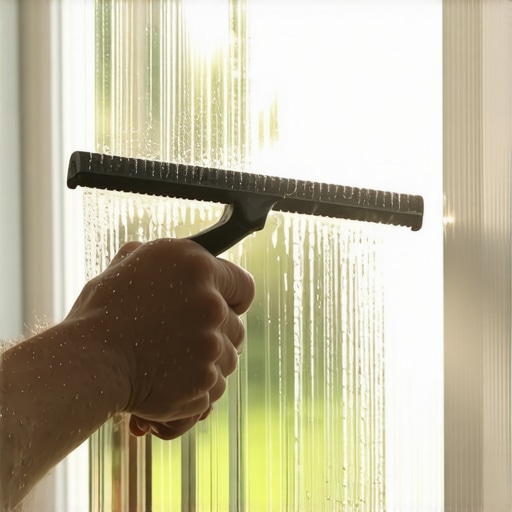
To achieve a professional finish, you need to understand the ‘S’ stroke. Professionals do not wipe in circles. We use a squeegee with a high-quality rubber blade. The durometer of the rubber allows it to conform to the glass, creating a seal that evacuates the water film entirely. Start by wetting the window with a microfiber applicator soaked in distilled water. If the window is particularly dirty, a single drop of biodegradable dish soap can be used to break the surface tension, but water alone is usually sufficient for maintenance. Run the squeegee in a continuous motion, wiping the blade with a lint-free cloth after every pass. This prevents ‘ghosting’ or trail marks.
“Visible Transmittance (VT) measures how much light comes through a product. While dirt impacts this, the integrity of the Low-E coating remains the primary factor for light and heat regulation.” – NFRC Performance Standards
Do not forget the weep holes. These are small openings in the bottom of the frame designed to allow water to escape the sill pan. During a cleaning, these often get clogged with debris. If water cannot escape, it will eventually rot the subfloor or cause mold growth inside the wall cavity. A professional window cleaner always checks the weep holes to ensure the water management system is functioning. If you find that your windows are still drafty or difficult to operate after a thorough cleaning, it might be time to replace windows rather than just maintain them. Look for gaps in the weatherstripping or signs that the frame has warped beyond its original tolerances.
When Cleaning Reveals Structural Failures
Often, a deep clean is what finally alerts a homeowner to the need for window repair. While you are at eye-level with the glass, inspect the muntins and the glazing bead. If you see ‘creeping’ or if the glass seems to be shifting within the sash, the structural integrity is failing. In our cold northern climate, the constant expansion and contraction of frame materials can stress the seals. If you see a rainbow-like oily sheen between the panes, that is a sign of a collapsed IGU. No amount of water, distilled or otherwise, will fix a seal failure. At that point, you are looking at either a glass replacement or a full-frame installation to restore your home’s energy efficiency. Clean windows are the first step in a healthy home, but they are also your early warning system for the envelope of your house.