The Thermal Reality of Winter Fenestration
You wake up in the middle of January and instead of seeing the sunrise through your bedroom sash, you are greeted by a crystalline forest of frost. As a master glazier with over 25 years in the field, I can tell you that frost is not just an aesthetic nuisance. It is a diagnostic signal. Most homeowners immediately assume they need to replace windows, but the reality is often found in the delicate balance of interior humidity and the center-of-glass temperature. I once walked into a home in suburban Chicago where the owner was in a panic because their brand new double-pane units were covered in ice. I pulled out my hygrometer and showed them the indoor humidity was at 55 percent while it was 5 degrees outside. It was not a window failure; it was a physics problem. The windows were fine, but the lifestyle was creating a tropical microclimate inside a freezer. The frost they were seeing on the glazing bead was simply the dew point being reached on a cold surface.
“The thermal performance of a window system is determined by the heat transfer through the glazing, the frame, and the spacer. In cold climates, minimizing the U-factor is the primary defense against condensation and frost formation.” – NFRC Fenestration Guide
The Science of the Rubbing Alcohol Solution
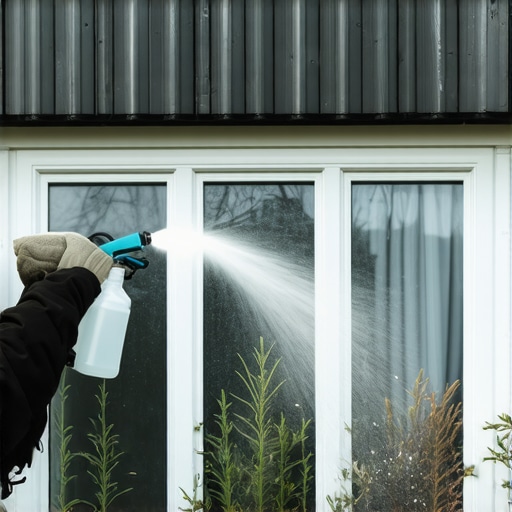
Before we discuss long-term window repair or glass replacement, let us talk about the tactical fix: the rubbing alcohol spray bottle. Why does this work? It comes down to the freezing point of the liquid on your glass. Pure water freezes at 32 degrees Fahrenheit. However, 70 percent isopropyl alcohol has a freezing point of roughly -20 degrees Fahrenheit. When you mix rubbing alcohol with water in a spray bottle, usually in a two-to-one ratio, you are creating a solution with a significantly lower freezing point than pure water. This acts as a surfactant and a de-icer. When applied to the interior of the glass, it prevents the moisture in your indoor air from bonding to the cold surface of the pane. As a window cleaner, this mixture is also superior because it evaporates rapidly, leaving fewer streaks and reducing the amount of time moisture sits against the glazing bead or the sash wood. This is a temporary measure, but it is a highly effective one for those mornings when you cannot see out of your operable windows.
The Glass Class: Understanding U-Factor and Thermal Bridging
If you are constantly reaching for that spray bottle, it is time to look at the NFRC label on your units. In northern climates, the U-Factor is the most critical metric. Unlike the R-value used for insulation, which measures resistance to heat flow, the U-Factor measures the rate of heat loss. A lower number is better. If your windows have a U-Factor above 0.35, the center of the glass will remain cold enough to reach the dew point easily. This is where the physics of the IGU (Insulated Glass Unit) comes into play. Modern high-performance windows utilize Argon gas between the panes. Argon is denser than air and reduces the convective loop inside the glass unit, which keeps the interior pane warmer. Furthermore, the placement of the Low-E coating is vital. In a cold climate, we want the Low-E coating on Surface #3, which is the exterior-facing side of the interior pane of glass. This position allows the coating to reflect long-wave infrared radiation back into your room, keeping the glass surface temperature above the frost point.
[IMAGE_PLACEHOLDER]
The Role of the Spacer and the Glazing Bead
Frost often starts at the edges of the glass, right where it meets the sash. This is because of thermal bridging through the spacer. Old-school aluminum spacers act like a thermal highway, conducting the cold from the outside directly to the inside edge of the glass. This is why you see frost lines perfectly tracing the perimeter of your window. When we perform a window repair or a full replacement, we look for “warm-edge” spacers. These are made of stainless steel or structural foam which significantly reduces heat transfer. If your glazing bead is brittle or cracked, it can also allow cold air to bypass the seal and hit the edge of the glass unit directly, causing localized freezing. A proper window cleaner should be used to keep these vinyl components supple, as ammonia-based cleaners can cause them to degrade over time, leading to more significant drafts and moisture infiltration.
“Installation is just as critical as the window performance itself. A high-performance window installed poorly will fail.” – AAMA Installation Masters Guide
Installation Matters: Rough Openings and Shims
A window is only as good as its installation. If your rough opening was not properly prepped, even the most expensive triple-pane unit will underperform. When I am on a job site, I insist on a proper sill pan and flashing tape. The sill pan ensures that any water that bypasses the primary seals is directed back to the exterior through weep holes. If an installer just shoves a window into the hole and relies on the nailing fin, you are asking for rot. Proper shimming is also essential. Shims should be placed at the corners and under the meeting rails of a sash to ensure the frame remains square. If the frame bows, the weatherstripping will not engage correctly, allowing cold air to whistle past the sash and drop the glass temperature, leading to that frost we are trying to avoid. If you are considering a window repair to stop drafts, check the alignment of your sash in the frame first. Sometimes a simple adjustment of the hardware can pull the sash tighter against the weatherstripping, eliminating the need for a full replacement.
Conclusion: Physics vs. Hype
Do not be fooled by high-pressure sales tactics that promise a 100 percent return on investment through energy savings. Replacing windows is about comfort, curb appeal, and protecting your home from water damage. The rubbing alcohol trick is a great way to manage frost in the short term, but if your glass is consistently freezing, it is a sign that your home’s thermal envelope is compromised. Whether it is high indoor humidity or low-performance glazing, understanding the science behind the frost will help you make an informed decision on whether to repair or replace. Always look for the NFRC certification and ensure your installer understands the importance of a shimmed, flashed, and square installation. Water and heat management is a science, not a guessing game.