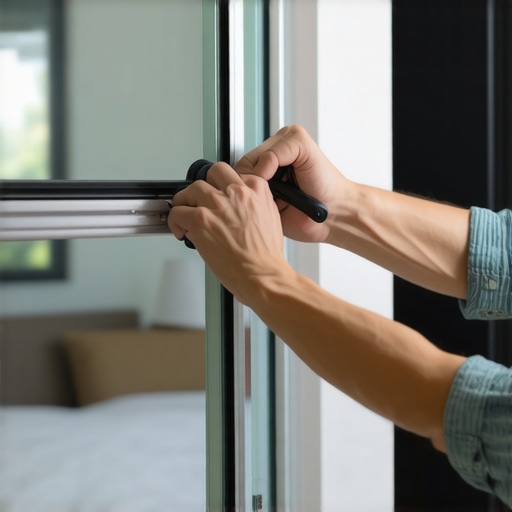
A sliding glass door that sticks, grinds, or refuses to budge is more than a minor annoyance; it is a structural vulnerability in your building envelope. As a glazier with over two decades in the field, I have seen homeowners struggle with doors that they assume are destined for the scrap heap when, in reality, the issue lies in the basic physics of the roller-to-track interface. When an operable sash is out of square within its frame, you are not just fighting friction; you are compromising the thermal integrity of your home. A misaligned door creates gaps in the weatherstripping, allowing for massive air infiltration that renders even the highest-rated Low-E glass useless.
The Ghost of Installations Past: A Lesson in Moisture
I once pulled a vinyl sliding door out of a residence in a rainy coastal climate where the homeowner complained of a ‘drafty’ track. Upon removal, the reality was much worse. The header was completely black with rot, and the subfloor was saturated. Why? The previous installer had relied on a bead of cheap silicone and a nailing fin rather than a proper sill pan and integrated flashing tape. Water had bypassed the primary seal, collected in the track, and because the weep hole was clogged with debris, it backed up into the rough opening. This is why I tell every client: window repair and maintenance are not optional. If that homeowner had hired a professional window cleaner or inspector five years earlier, the debris in the weep holes would have been cleared, and the rot could have been avoided. Instead, they were looking at a full-frame replacement that cost five times the price of a simple repair.
“Installation is just as critical as the window performance itself. A high-performance window installed poorly will fail.” – AAMA Installation Masters Guide
The Physics of the Tandem Roller Assembly
To understand how to align your door in under five minutes, you must first understand the tandem bogie assembly. Most modern sliding doors do not simply slide; they roll on a pair of adjustable wheels housed within the bottom rail of the sash. These wheels are often made of nylon for quiet operation or stainless steel for heavy, triple-pane units. Over time, the house settles, or the rollers wear down, causing the sash to drop. When this happens, the sash no longer sits square in the frame, and the interlock—the vertical section where the moving panel meets the fixed panel—cannot engage properly. This leads to a massive spike in heat loss. In northern climates, this is the primary cause of ‘ice on the track’ during January. The U-factor of your door might be a stellar 0.28, but if the air is leaking through a 1/8-inch gap at the top of the interlock, your effective R-value drops to nearly zero.
The Five-Minute Alignment Protocol
Before you begin, ensure the track is pristine. A professional window cleaner doesn’t just wash the glass; they vacuum the track to remove abrasive particulates that can flat-spot the rollers. Once the track is clear, locate the adjustment holes at the bottom of the moving sash. These are often covered by small plastic caps. Using a screwdriver—usually a Phillips #2—you will engage the adjustment screw. Turning the screw clockwise will typically raise the sash, while counter-clockwise will lower it. The goal is to achieve a perfectly uniform gap between the vertical edge of the sash and the frame jamb. I use a plastic shim to check for consistency from top to bottom. If the gap is wider at the top, you need to raise the roller on the side furthest from the jamb. If it is wider at the bottom, lower it. This is a game of millimeters. A properly aligned door should move with the touch of a single finger, even if it is a massive 200-pound tempered glass unit.
“Standard Practice for Installation of Exterior Windows, Doors and Skylights requires that the fenestration product be installed level, plumb, and square within the rough opening to ensure designed performance.” – ASTM E2112
Thermal Dynamics and Climate Specifics
In colder regions, alignment is about preventing condensation. When warm, humid indoor air hits a cold surface caused by a drafty misaligned door, you get liquid water. This water eventually ruins the glazing bead and can lead to mold growth. For my clients in the North, I ensure that the Low-E coating is on Surface #3 to reflect heat back into the room, but no coating can compensate for a physical gap in the door’s seal. Conversely, in the South, a misaligned door allows the Solar Heat Gain (SHGC) to become an unmanageable burden as hot air bypasses the thermal breaks in the frame. If you are considering the choice to replace windows or doors, look for units with thermally broken aluminum or fiberglass frames, which offer much higher dimensional stability than cheap vinyl. Vinyl expands and contracts significantly with temperature swings, which often causes the alignment to shift seasonally.
When Alignment Isn’t Enough: Signs You Need to Replace Windows
If you have adjusted the rollers to their maximum height and the door still drags, you likely have a collapsed roller housing or a track that has been ‘scored’ or flattened. At this point, window repair might involve replacing the entire roller kit or installing a stainless steel track cover. However, if the frame itself is bowed—a common issue with undersized headers that have sagged over time—it may be time to replace the unit entirely. When selecting a replacement, pay attention to the NFRC label. You want a low U-factor for thermal retention and a high VT (Visible Transmittance) if you want to maximize natural light without the heat gain. But remember, the most expensive door on the market is only as good as the technician who shims it into place. Ensure your installer understands the ‘shingle principle’ of water management and uses high-quality flashing tape to seal the rough opening before the new unit is set.