The Invisible Failure: Why Your Commercial Glazing is Costing You a Fortune
Commercial glazing systems are not merely windows; they are complex thermal barriers designed to manage the massive pressure differentials and temperature swings of a tall building. When a seal fails in a curtain wall or a storefront system, it is rarely as obvious as a shattered pane. It starts with a microscopic breach in the primary seal of the Insulated Glass Unit (IGU). I remember a specific case in a high-rise in Chicago where a homeowner called me in a panic because their new windows were sweating. I walked in with my hygrometer and showed them the humidity was 60 percent. It was not just the windows; it was their lifestyle combined with a failing perimeter sealant that allowed cold air to drop the interior glass temperature below the dew point. This is the reality of modern glazing: physics does not care about your aesthetics.
“Installation is just as critical as the window performance itself. A high-performance window installed poorly will fail.” – AAMA Installation Masters Guide
To understand how to detect these failures, you must understand the construction of the IGU. An IGU consists of two or more panes of glass separated by a spacer bar, usually filled with a desiccant-filled molecular sieve to adsorb any residual moisture. The edges are sealed with Polyisobutylene (PIB) as the primary seal and a structural secondary seal like silicone or polysulfide. When these seals degrade, Argon gas escapes and water vapor enters. In northern climates like Chicago or Minneapolis, heat loss is the primary enemy. You want a low U-Factor, which measures the rate of non-solar heat loss. A failed seal turns your expensive double-pane window into a glorified single-pane unit, causing the inner surface to become a magnet for condensation. This is where the laser pointer becomes your most valuable diagnostic tool.
The Physics of the Laser Reflection Test
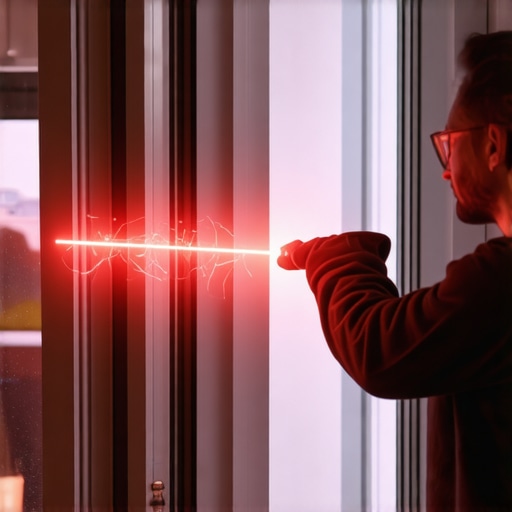
When you shine a laser pointer at a piece of glass at a 45-degree angle, you are not just seeing one dot. Because an IGU has multiple surfaces, you will see multiple reflections. A standard double-pane window has four surfaces: Surface 1 (exterior), Surface 2 (inside the gap on the outer pane), Surface 3 (inside the gap on the inner pane), and Surface 4 (the interior face). By analyzing the specular reflection of the laser, you can determine if the glass is bowing. If the seal has failed and the Argon gas has leaked out, the pressure change often causes the glass to collapse inward, becoming concave. If you point the laser and the dots appear to merge or spread significantly as you move the laser across the pane, you are witnessing glass deflection that indicates a loss of seal integrity.
Using a laser pointer is also effective for finding gaps in the glazing bead and the structural sealant. By shining the laser along the edge of the frame from the outside while an observer stays inside, you can look for light scatter. In a properly sealed commercial system, there should be zero light penetration through the rough opening or the glazing pocket. If the laser light bleeds through, you have an air infiltration point that is likely also a water entry point. This is crucial because water management is the most misunderstood part of window repair. A window is designed to weep. If the weep hole is blocked by an over-zealous window cleaner or a bad caulk job, the water backs up into the building. The laser helps identify where the path of least resistance has been compromised.
Thermal Performance and Surface Coatings
In cold climates, we rely on Low-E coatings, typically on Surface 3, to reflect long-wave infrared radiation back into the room. This keeps the heat inside. When a seal fails and the internal environment of the IGU is compromised, the Low-E coating can actually begin to oxidize. This is known as edge deletion failure. If you use your laser pointer and notice the reflection on Surface 3 is hazy or shifted in color, it is a sign that the metallic oxides in the coating are reacting with moisture. This means the window is no longer performing its thermal duty. You are no longer just looking at a window repair; you are looking at a full IGU replacement.
“The fenestration system must be designed to withstand the design wind loads and provide a continuous air and water barrier.” – ASTM E2112 Standard Practice for Installation
The choice between to replace windows or attempt a repair often comes down to the condition of the frame and the sill pan. If the frame is a thermally broken aluminum system and is still structurally sound, you can often just replace the glass units. However, if the thermal break (the plastic or resin strip that separates the inner and outer aluminum frames) has degraded, the frame itself will conduct cold from the outside, leading to frost on the interior muntin or sash. No amount of glass replacement will fix a conductive frame. You must ensure the rough opening is still square and that the shim placement has not caused the frame to twist over time, which puts uneven pressure on the seals.
The Role of Maintenance and Detection
A professional window cleaner is often the first person to notice seal failure. They see the mineral deposits left behind when moisture evaporates inside an IGU. If you are managing a commercial property, do not ignore these reports. Early detection using a laser pointer can save thousands in energy costs. When you detect a gap, the fix must be precise. Do not just use a tube of cheap caulk. You need to verify the flashing tape is intact and that the drip cap is still shedding water away from the header. Water flows down, and any breach in the shingle principle of installation will lead to rot or mold behind the facade.
Ultimately, a window is a hole in the wall that must be managed for heat, light, and water. Whether you are dealing with a fixed storefront or an operable sash, the seal is the only thing standing between a comfortable interior and a maintenance nightmare. Use the laser test to verify the integrity of your glazing. If the reflections are distorted, the gas is gone, and the performance is lost. In the world of commercial glazing, precision is not an option; it is a requirement for survival in harsh climates.
Comments are closed.