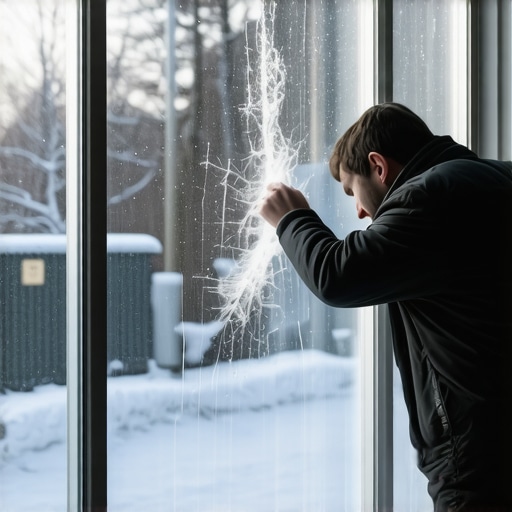
The Invisible Pressure Under Your Glazing Bead
In twenty five years of hanging sash and leveling frames, I have seen every form of fenestration failure imaginable. But few things signal an impending structural disaster quite like glass deflection, commonly known as bowing glass. If you look at your windows from an angle and the reflections appear warped, as if you are looking into a funhouse mirror, you are not just seeing an aesthetic quirk. You are witnessing a physics battle that your window is currently losing. As we approach the extreme thermal shifts predicted for the 2025 and 2026 seasons, understanding why that glass is curving is the difference between a controlled upgrade and an emergency plywood board up in the middle of a blizzard.
I remember a call I took three winters ago in a high wind zone. A homeowner called me in a panic because their new windows were ‘sweating’ and making loud popping sounds. I walked in with my hygrometer and a digital caliper. I showed them that the humidity was nearly sixty percent inside, but more importantly, the center of their double-pane units had sucked inward by nearly a quarter of an inch. It wasn’t the windows failing initially; it was a massive barometric imbalance coupled with a failed primary seal. The glass was under so much tension that it eventually imploded inward. That is the reality of bowing glass when it is ignored.
“Installation is just as critical as the window performance itself. A high-performance window installed poorly will fail.” AAMA Installation Masters Guide
The Science of Deflection: Why Glass Bows
An Insulated Glass Unit or IGU is a hermetically sealed environment. Most modern high performance windows are filled with argon gas because it is denser than air and provides superior thermal resistance. However, gas is subject to the laws of thermal expansion and contraction. When the temperature drops as we head into winter, the gas volume inside that IGU decreases. This creates a partial vacuum. If the window was manufactured at a low altitude and installed at a higher one, or if the secondary seal has begun to allow moisture vapor to permeate the spacer, the glass will bow inward to compensate for the pressure drop. This is called concave deflection.
Conversely, in the heat of summer, the gas expands, causing convex bowing. Why is this a problem for winter 2026? Because every time that glass flexes, it puts immense stress on the Glazing Bead and the primary polyisobutylene seal. Eventually, the seal snaps. Once the seal is gone, your argon escapes and is replaced by moisture laden air. This leads to the ‘foggy window’ syndrome, but more critically, it destroys your U-Factor. When you hire a window cleaner and they cannot get the glass clear, it is often because the dirt is inside the unit, not on the surface. At that point, window repair is often a temporary patch for a terminal illness.
The Cold Climate Logic: Why U-Factor is King
For those of us living in northern latitudes, the enemy is conductive heat loss. We need to analyze the U-Factor, which measures the rate of heat transfer. The lower the number, the better the insulation. When your glass is bowed, the distance between the two panes decreases at the center. This creates a thermal bridge. The argon layer, which is supposed to be a consistent half inch or three quarters of an inch thick, is suddenly compressed. This effectively short circuits the thermal break.
To combat this before the 2026 deep freeze, you must replace windows with units that utilize Surface #3 Low-E coatings. In a cold climate, the Low-E coating is applied to the outward facing surface of the inner pane of glass. This allows the short wave solar radiation to enter your home but reflects the long wave infrared heat from your furnace back into the room. If your glass is already bowing, that coating is likely being abraded or the gas fill is already gone, meaning you are literally heating the neighborhood.
The Frame Matters: Rough Openings and Thermal Stability
It is not just about the glass. When we perform a full frame tear out, we look at the Rough Opening. If your previous installer used cheap vinyl, that frame is expanding and contracting at a rate significantly different than the glass. This is why I often advocate for fiberglass or composite frames in extreme climates. Fiberglass is essentially glass fibers and resin; it moves at the same rate as the glazing itself, which preserves the integrity of the Flashing Tape and the Sill Pan.
“The National Fenestration Rating Council provides consistent ratings on window, door, and skylight energy performance to help consumers compare products.” NFRC Performance Standards
When you are looking at a window repair vs a full replacement, consider the Sash. Is the sash still square? If you take a tape measure and find the diagonals are off by more than an eighth of an inch, your bowing glass is likely a symptom of a settling frame. No amount of window cleaner or new caulking will fix a structural deflection. You need to replace windows to reset the thermal envelope of your home.
Technical Specifications for the 2026 Upgrade
If you are planning an installation before the 2026 winter season, you need to be specific about your components. Do not just ask for ‘double pane.’ You want a warm edge spacer system. Old fashioned aluminum spacers are a disaster; they act like a radiator fin, pulling cold from the outside straight to the inner pane. Look for stainless steel or structural foam spacers that reduce condensation at the edge of the glass. Ensure your Operable windows have multi-point locking systems. A single latch in the middle of a tall double hung sash will not provide the compression needed to stop air infiltration when the wind is gusting at forty miles per hour.
Check your Weep Hole health. Many homeowners inadvertently clog these during DIY painting or window repair. If the water cannot exit the frame, it will back up over the sill and rot your subfloor. This is why the ‘caulk and walk’ crews are so dangerous. They fill the gaps that were designed to breathe, trapping moisture inside the wall cavity where it can feast on your studs for years before you see a single soft spot in the drywall.
Final Verdict: Don’t Wait for the Implosion
Bowing glass is a warning light on your home’s dashboard. It tells you that the structural integrity of the IGU is compromised and the thermal performance is non existent. As we look toward the winter of 2026, the cost of energy and the severity of weather patterns suggest that ‘waiting another year’ is a high stakes gamble. Proper window repair has its place for historic single pane glass, but for modern insulated units, a bow means the clock has run out. Invest in a high quality replacement with a verified U-Factor, ensure the installer uses a proper Sill Pan and high quality Shim techniques, and you will find that the comfort of your home is worth far more than the sticker price.