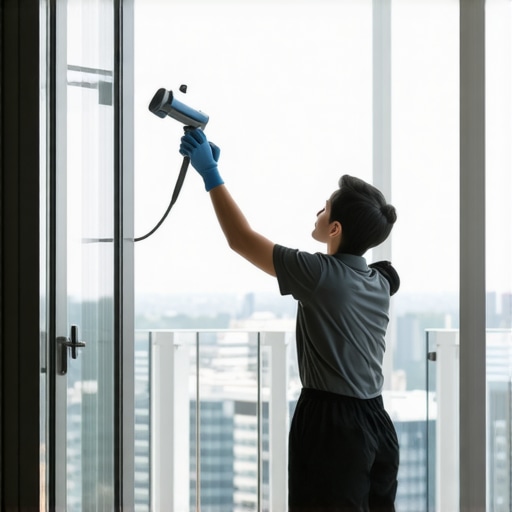
The Optical Illusion of the ‘Clean’ Window
For twenty-five years, I have heard the same complaint from homeowners: “I just cleaned these, and they still look like a mess when the sun hits them.” Most people view glass as a solid, impenetrable sheet, but as a master glazier, I see it for what it truly is—a porous, microscopic landscape of peaks and valleys created during the float glass process. When you use paper towels or old cotton rags, you are not just cleaning; you are depositing thousands of microscopic fibers, or lint, into the surface profile of the glazing. By the time 2026 rolls around, the standard for residential clarity will have shifted away from chemical-heavy sprays toward a more scientific, physics-based approach to surface tension. The goal isn’t just to remove dirt; it is to eliminate the residue that creates the streaks in the first place.
The Condensation Crisis: A Master Glazier’s Diagnostic
A homeowner called me in a panic because their new windows were ‘sweating’ and looked constantly smeared regardless of how often they wiped them down. I walked in with my hygrometer and showed them the humidity was 60%. It wasn’t the windows; it was their lifestyle combined with an improper understanding of how moisture interacts with the Glazing Bead and the glass surface. They were using a heavy ammonia-based cleaner that was actually stripping the microscopic integrity of the seals over time. They were ready to replace windows that were perfectly functional, simply because they couldn’t see through the haze of their own cleaning products. This is where the $3 hack comes into play—a solution that costs less than a latte but outperforms every ‘professional’ aerosol on the market.
“Installation is just as critical as the window performance itself. A high-performance window installed poorly will fail, and a poorly maintained window will never reach its rated U-Factor efficiency.” – AAMA Installation Masters Guide
The Science of the $3 Hack: Distilled Water and Isopropyl Logic
The secret to the 2026 streak-free standard is the elimination of Total Dissolved Solids (TDS). Tap water contains minerals—calcium, magnesium, and sodium—that remain on the glass after the liquid evaporates. These minerals are the foundation of your streaks. The $3 hack involves a mixture of 70% distilled water (roughly $1.20 a gallon) and 30% isopropyl alcohol (roughly $1.50 a bottle). Total investment? Under three dollars. Why does this work? The alcohol acts as a fast-evaporating solvent that breaks down organic oils from fingerprints, while the distilled water ensures that once the liquid is gone, there is literally nothing left on the Sash or the glass pane. No minerals, no soap residue, and zero streaks.
The Glass Class: Understanding U-Factor and Surface Coatings
When we talk about window repair or replacement, we have to talk about the physics of the glass itself. In northern, cold climates like Minneapolis or Chicago, the U-Factor is the king of metrics. This number represents the rate of heat loss. A lower U-Factor means your window is better at keeping the furnace heat inside. However, the cleaning process changes when you have high-performance coatings. Most modern windows use a Low-E (Low-Emissivity) coating. In cold climates, this is often applied to Surface #3 (the indoor-facing surface of the outer pane) to reflect long-wave infrared radiation back into the room. If you use abrasive materials or acidic cleaners, you risk microscopic scratching that permanently affects the Visible Transmittance (VT) of the unit. This is why lint-free microfibers are mandatory; paper towels are effectively made of wood pulp, and wood pulp is abrasive.
Managing the Rough Opening and Thermal Integrity
Beyond the glass, the structural health of your window depends on the Rough Opening and how the Shim was used during installation. If a window is not level and square, the Operable parts of the window—the moving sashes—will rub against the frame, creating tiny gaps where air can infiltrate. This air carries dust and pollutants that settle on the interior glass surface, necessitating more frequent cleaning. If you see dirt accumulating specifically in the corners of your Muntin bars, you likely have a pressure differential issue pulling outside air through the Weep Hole system and into the living space. Proper cleaning isn’t just about aesthetics; it is a diagnostic tool for the health of your home’s envelope.
“The performance of a fenestration product is dependent upon the quality of the glass, the integrity of the seal, and the maintenance of the surface transparency.” – NFRC Performance Standards
The Proper Technique: The Squeegee vs. The Wipe
If you want to avoid window repair due to seal failure caused by moisture pooling, you must master the squeegee. Start by applying your $3 solution with a dedicated scrubber. Then, using a professional-grade squeegee with a fresh rubber blade, pull the liquid off in a single, continuous motion. This prevents the liquid from seeping into the Glazing Bead, which can eventually lead to the breakdown of the secondary seal in an Insulated Glass Unit (IGU). Always finish by wiping the perimeter with a waffle-weave microfiber cloth. Unlike standard cotton, the waffle-weave is designed to trap moisture in its pockets rather than pushing it across the glass, ensuring that no lint remains behind. This method is the only way to achieve the optical clarity required for high-end architectural glass.
Conclusion: The Installer’s Final Word
At the end of the day, a window is a complex thermal barrier. Whether you are performing a window repair on a drafty old double-hung or maintaining a brand-new triple-pane system, the materials you use matter. Stop reaching for the blue spray and the roll of paper towels. Switch to the $3 distilled water hack, respect the Sill Pan drainage requirements, and treat your glass with the technical precision it deserves. Your HVAC bill—and your view—will reflect the difference. High-performance glass is an investment; don’t ruin it with 20th-century cleaning habits. Transition to the 2026 standard today and see what you’ve been missing.