The Anatomy of a Fracture: Why Your Window Chip is a Ticking Time Bomb
Most homeowners look at a small chip in their glass and see a minor cosmetic blemish. As someone who has spent twenty-five years staring through lites and measuring rough opening tolerances down to the thirty-second of an inch, I see a structural failure in progress. A window is not a static object; it is a dynamic barrier managing intense pressure differentials. When you have a chip, you have a concentrated point of stress that is subject to the unforgiving laws of thermal expansion. I remember a call in the dead of a Chicago winter—a homeowner had a tiny ‘star-break’ from a pebble. I walked in with my hygrometer and found the indoor humidity at 55%. The temperature delta between the -5°F exterior and the 72°F interior created such a massive thermal gradient that, as I stood there, the chip migrated six inches across the sash with a sound like a pistol shot. It wasn’t the glass’s fault; it was the physics of the dew point and thermal stress hitting a compromised surface.
“Field repairs of glazing shall be performed in a manner that restores the structural integrity and weather-tightness of the assembly. Failure to address surface discontinuities can lead to catastrophic crack propagation under wind load.” – ASTM E2112 Standard Practice
The 2026 Resin Window Repair Kit: Molecular Engineering vs. ‘Caulk-and-Walk’ Hacks
In the old days, we used basic cyanoacrylates that would yellow and brittle within a single season of UV exposure. The 2026 Resin Window Repair Kit is a different animal entirely. It utilizes a low-viscosity, high-refractive-index anaerobic resin designed to mimic the optical density of soda-lime glass. This isn’t just about filling a hole; it is about restoring the structural continuity of the glazing. When we talk about window repair, we are looking at the ‘U-Factor’—the rate of heat loss. A chip, especially one that penetrates the outer lite of an Insulated Glass Unit (IGU), can eventually lead to a seal failure. Once that seal goes, your argon or krypton gas escapes, and you are left with a foggy, useless piece of trash that no window cleaner on earth can fix. You have to understand the chemistry: this 2026 resin is designed to bond at the molecular level with the silica in the glass, effectively ‘welding’ the fracture shut under UV light.
Step-By-Step Technical Execution: The Professional Method
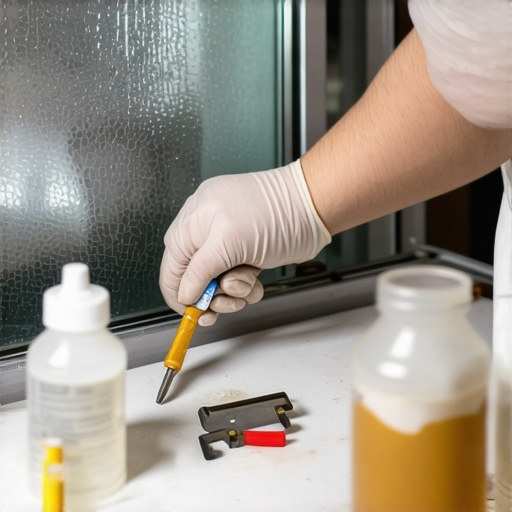
First, you need to clear the area using an industrial-grade, non-ammoniated window cleaner. Any residual oils or dust will prevent the resin from wetting the surface of the crack. Next, inspect the glazing bead and the sash for any signs of movement. If the window is operable, lock it down to minimize vibration. Using the vacuum injector provided in the 2026 kit, you must create a pressure-tight seal over the chip. This is the ‘Glazing Zooming’ moment: the vacuum isn’t just for show; it pulls the air out of the microscopic fissures of the break so the resin can flow in via capillary action. If you leave air trapped inside, you’re not fixing the window; you’re just hiding the problem. Once the resin is injected, you apply the curing film. In a North/Cold climate like ours, the glass temperature must be stabilized. If the glass is too cold, the resin won’t flow; if it is too hot, it cures prematurely. Aim for a surface temp between 50°F and 75°F. Use a UV lamp to trigger the polymerization. This creates a bond that can withstand the positive and negative wind pressures that regularly batter your building envelope.
“Installation and repair integrity is just as critical as the window performance itself. A high-performance window, or a repaired one, that cannot maintain its seal will fail the building’s energy audit.” – AAMA Installation Masters Guide
When to Repair and When to Replace Windows
I am often asked if a chip repair is a permanent fix. If the chip is smaller than a quarter and hasn’t reached the edge of the glass near the muntin or the frame, the 2026 kit is a viable solution. However, if the crack is near the spacer bar or if you see moisture between the panes, the IGU is compromised. At that point, you aren’t looking at a repair; you’re looking at the need to replace windows. Don’t let a ‘Tin Man’ salesman talk you into a full-frame replacement if only the glass is damaged, but don’t be foolish enough to think resin can fix a rotted sill pan or a warped rough opening. If the frame is solid—whether it is vinyl, fiberglass, or thermally broken aluminum—a glass repair or a simple lite replacement is the surgical choice. We focus on the ‘Shingle Principle’: water must always flow down and out. Ensure your weep holes are clear during the repair process; a blocked weep hole leads to standing water in the sash, which is the primary cause of seal failure in the first place.
The Physics of Comfort: SHGC and Thermal Barriers
In our northern climate, the ‘Enemy’ is heat loss. We want a low U-factor. By repairing a chip with the 2026 kit, you are maintaining the integrity of the Low-E coating on Surface #3. This coating is what reflects long-wave infrared radiation back into your living room, keeping you warm while the snow piles up against the exterior. If you leave a chip untreated, the localized cooling at that spot can cause interior condensation. That condensation drips onto your wood sash or gets behind the flashing tape, leading to the kind of rot that requires a chainsaw to fix. Precision is everything. Don’t just slap resin on and walk away. Level it with a fresh razor blade at a 45-degree angle to ensure the glazing bead remains unencumbered and the window remains fully operable. In the world of high-end glazing, there is no room for ‘close enough.’ You either manage the hole in the wall, or the hole manages you.