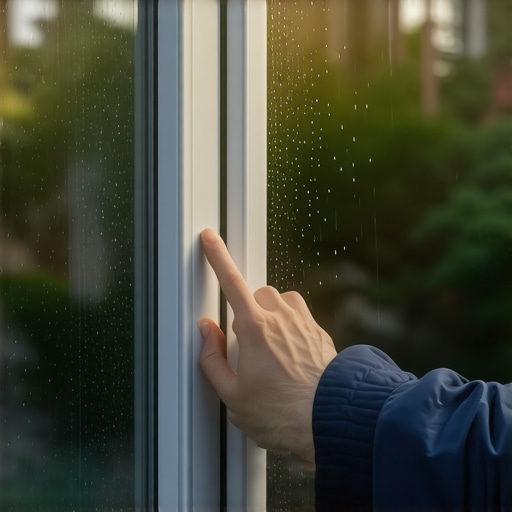
The Science of the Draft: Why the Wet Finger Test Works
Before you spend ten thousand dollars on a full-frame replacement, you need to understand the physics of your home’s envelope. The ‘Wet Finger’ test isn’t just a handyman’s tale; it is a rudimentary application of evaporative cooling. By licking your index finger and moving it slowly along the perimeter of the sash where it meets the glazing bead, you are creating a sensitive thermal sensor. When air moves across the moisture on your skin, it accelerates evaporation, pulling heat away and signaling exactly where the air infiltration is occurring. In 2026, as energy costs fluctuate, identifying whether you need a simple window repair or a total haul-away is the first step toward building science literacy.
“Installation is just as critical as the window performance itself. A high-performance window installed poorly will fail.” – AAMA Installation Masters Guide
The Narrative Matrix: A Case of Ghost Condensation
A homeowner called me in a panic because their new windows were ‘sweating.’ I walked in with my hygrometer and showed them the humidity was 60%. It wasn’t the windows; it was their lifestyle. They had thirty-four houseplants and a humidifier running in the basement. I had to explain that even the highest-performing IGU (Insulated Glass Unit) cannot defy the laws of thermodynamics. When warm, moist air hits a surface at the dew point, you get water. This is why we look at the U-Factor—the rate at which a window, door, or skylight conducts non-solar heat flow. In our northern climate, a lower U-Factor is your only defense against the creeping chill of January. We look for warm-edge spacers that separate the glass panes, specifically those made of structural foam rather than highly conductive aluminum, to keep the edge of the glass warm and the condensation at bay.
The Installation Autopsy: What Lies Beneath the Trim
Most window repair calls are actually installation failures. When I perform a forensic teardown, I often find that the rough opening was never properly prepared. A window is essentially a controlled hole in your wall. If the sill pan is missing or the flashing tape wasn’t lapped according to the ‘shingle principle’—where the higher layer always overlaps the lower layer—water will eventually find the header. I have seen shims made of cedar shakes that have rotted into mulch because they were exposed to constant moisture behind a ‘caulk-and-walk’ installation. Proper installation requires ASTM E2112 compliance, ensuring that every drop of water that hits the drip cap is directed away from the building’s structural components.
“The rough opening shall be flashed in a manner to direct water to the exterior or to a sill pan for drainage to the exterior.” – ASTM E2112
The Anatomy of Performance: Low-E and Gas Fills
To truly replace windows effectively, you must understand the coatings. In a cold climate, we want a Low-E (Low Emissivity) coating on Surface #3. This is the indoor-facing surface of the outdoor pane or the outdoor-facing surface of the indoor pane. By placing the coating here, we reflect long-wave infrared radiation—the heat from your furnace—back into the room. We also utilize Argon or Krypton gas between the panes. These gases are denser than air, slowing down the convective loops that occur inside the IGU. When you see a window that looks foggy, that is ‘seal failure.’ The desiccant inside the spacer has become saturated, and the window cleaner can no longer help you; the unit must be replaced.
Maintenance and the Role of the Professional Window Cleaner
A professional window cleaner is often the first person to spot a weep hole that has been painted shut. These small exits at the bottom of the frame are designed to allow water to escape the track. When a DIYer or an uneducated painter covers them, the frame fills with water like a bathtub, eventually overflowing into the rough opening and rotting the subfloor. Regular cleaning isn’t just about aesthetics; it is an inspection. You are looking for cracks in the glazing bead, checking the operable hardware for smooth movement, and ensuring that the weatherstripping hasn’t lost its compression set.
Choosing Your Path: Repair or Replace?
If your frames are solid—whether they are high-quality vinyl, pultruded fiberglass, or old-growth heartwood—you might only need to replace windows in terms of the glass units themselves. This is a ‘pocket replacement.’ However, if the sash is sagging or the frame is out of square, a full-frame tear-out is the only way to ensure the new unit is leveled and plumbed correctly. Don’t be swayed by marketing jargon; look for the NFRC label. That label tells you the SHGC (Solar Heat Gain Coefficient) and the U-Factor. In our cold region, you want a high SHGC to allow the sun to help heat your home in the winter, paired with a very low U-Factor to keep that heat inside at night.