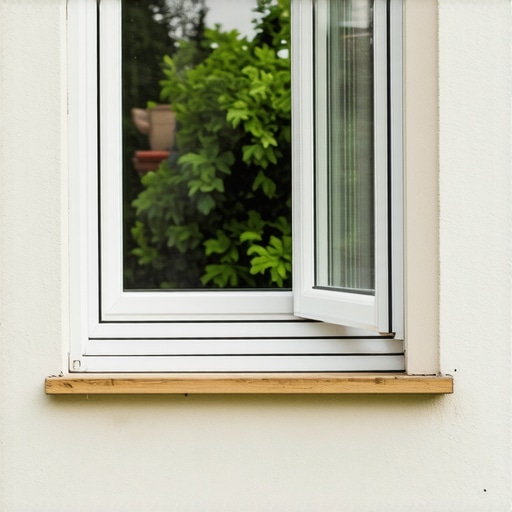
The Physics of the High-Pitch Howl: Why Your Windows Sing in the Cold
That shrill, haunting whistle echoing through your living room isn’t a ghost; it is the sound of atmospheric pressure equalizing through a failure in your thermal envelope. As a glazier with over two decades on the glass-line, I have seen homeowners try to silence that whistle with everything from duct tape to folded-up napkins. Neither works. To stop a window from whistling, you have to understand the Venturi effect: air is being forced through a narrow aperture—a gap in your weatherstripping or a failed sealant bead—at high velocity. In 2026, with energy costs and building envelope standards tighter than ever, a whistling window is a flashing red light for structural heat loss.
“Installation is just as critical as the window performance itself. A high-performance window installed poorly will fail.” – AAMA Installation Masters Guide
The Condensation Crisis: A Master Glazier’s Narrative
I recall a specific call-out to a high-rise unit in a windy corridor where the homeowner was convinced their new double-pane units were defective because of a constant ‘moaning’ sound. I walked in with my hygrometer and a smoke pen. The hygrometer showed 55% humidity, but the smoke pen revealed the culprit: a hairline gap where the sash met the jamb. It wasn’t the windows; it was a microscopic misalignment during the original installation that had worsened as the building settled. We didn’t need to replace windows; we needed to re-index the hardware to compress the bulb seal properly. This is the reality of modern window repair: it is a game of millimeters, not a bucket of caulk.
Fix 1: The Pile and Bulb Seal Restoration
Most whistling occurs at the meeting rail or the sill. On an operable sash, the weatherstripping is your primary defense. Over time, ultraviolet radiation and friction degrade the EPDM (Ethylene Propylene Diene Monomer) or the TPE (Thermoplastic Elastomer) materials. If your weatherstripping has flattened, it no longer creates a compression seal. To fix this, you must identify the kerf—the small groove in the frame that holds the seal. Replace worn pile weatherstripping with a high-fin variety, which includes a plastic barrier in the center of the brush to block air more effectively than standard fuzz. This is the technical difference between a ‘cheap’ repair and a professional glazing restoration.
Fix 2: Squaring the Rough Opening with Precision Shimming
Gravity is the enemy of a quiet window. If your house has settled, the frame may no longer be square, even if it looks fine to the naked eye. When the frame goes out of ‘plumb’ or ‘square,’ the sash cannot sit flush against the stops. This creates a gap—the ‘whistle’ zone. A quick fix involves removing the interior trim to access the rough opening. By strategically placing a shim near the hinge or the locking point, you can subtly shift the frame back into alignment. This ensures the sash makes full contact with the primary seal across the entire perimeter. Remember, a window that doesn’t close square is essentially a permanent air vent.
“Air leakage is a major contributor to thermal discomfort. The NFRC rating for air infiltration is as important as the U-factor in windy climates.” – NFRC Performance Standards
Fix 3: De-clogging the Weep Hole System
Many homeowners think the holes at the bottom of their vinyl frames are defects. They are actually weep holes, designed to allow water to exit the frame. However, they also play a role in pressure equalization. If a window cleaner has accidentally pushed debris into these holes, or if they are clogged with exterior grit, it creates a pressure imbalance. In high-wind scenarios, this imbalance forces air through the internal drainage channels, resulting in a distinct whistling sound. Using a thin wire or compressed air to clear these channels is a 2026-essential maintenance task that prevents both noise and internal frame rot.
Fix 4: Perimeter Sealant and ASTM E2112 Compliance
If the whistle is coming from the edge of the frame where it meets the siding, your exterior sealant has failed. This isn’t a job for cheap hardware-store silicone. To properly perform a window repair, you must follow ASTM E2112 standards. This involves removing the old, cracked sealant, installing a backer rod if the gap is deep, and applying a high-performance tri-polymer or polyurethane sealant. These materials remain flexible during the extreme contraction cycles of winter, ensuring that the seal doesn’t ‘zipper’ open the following year. A proper bead of sealant should be tooled to a concave shape to shed water effectively and maintain the airtight integrity of the rough opening.
Thermal Logic: Why Whistling is Worse in the North
In cold climates, the U-Factor (the rate of heat loss) is the metric that matters most. When a window whistles, it is bypassing the Low-E coatings and the Argon gas fills that you paid for. You are essentially heating the outdoors. For my clients in frigid zones, I emphasize that the ‘whistle’ is actually the sound of money leaving their wallets. While a window cleaner can make the glass sparkle, only a technical understanding of the sash-to-frame interface can restore the thermal performance of a failing unit. If your repairs don’t solve the issue, it may be time to replace windows with units that feature warm-edge spacers and triple-fin weatherstripping to handle the structural loads of modern weather patterns.