The Invisible Enemy Behind Your Drywall
When a homeowner notices a dark speck on their window sill, the immediate reaction is often to grab a spray bottle of window cleaner and wipe it away. They assume the problem is solved. As a glazier with over 25 years of experience, I can tell you that what you see on the surface is rarely the full extent of the damage. Mold is not just a cleaning issue; it is a structural warning sign that your window system is failing to manage the physics of heat and moisture. A window is essentially a controlled hole in your wall. When that control breaks down, the rough opening becomes a breeding ground for spores that can compromise your home’s air quality and structural integrity.
The Condensation Crisis: A Real-World Case Study
I recall a specific call from a homeowner in a high-humidity region who was in a panic because their relatively new windows were ‘sweating’ every morning. I walked into the room with my hygrometer and thermal imaging camera. While they were blaming the glass, I showed them that the interior humidity was over 60 percent. The windows were not the problem; their lifestyle and the home’s lack of ventilation were. However, because that condensation had been ignored for two seasons, the water had migrated behind the glazing bead and into the sash. When we pulled the trim, the insulation was a sodden, black mess. It was a classic case where a simple window repair would no longer suffice. We had to replace windows entirely because the mold had moved from the glass to the actual framing of the house.
“Water penetration through the window assembly is one of the leading causes of structural degradation and mold growth in the building envelope.” – ASTM E2112 Standard Practice
The Physics of the Dew Point and Thermal Bridging
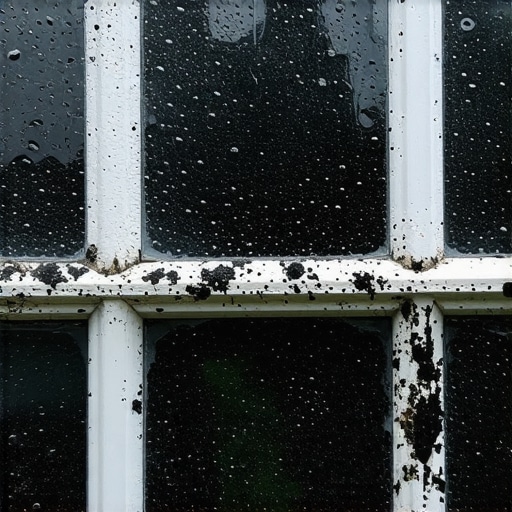
To understand why mold forms, we have to look at the U-Factor and the dew point. In colder climates, the window frame acts as a thermal bridge. If you have a poorly insulated frame, such as an old aluminum unit without a thermal break, the cold from the outside travels directly through the material. When the warm, moist air inside your home hits that cold surface, it reaches its dew point and transforms into liquid water. This is not just ‘fog.’ This is the fuel for mold. We look for the Condensation Resistance (CR) rating on the NFRC label. A higher CR means the window is better at resisting moisture formation. If your window has a low CR, you are essentially inviting mold to live on your muntin and sash.
[IMAGE_PLACEHOLDER]
The Installation Autopsy: Why Flashing Matters
The majority of mold issues I see during a window repair job are not caused by the glass but by the installation. I am a firm believer in the ‘Shingle Principle.’ This means every layer of the window’s exterior must lap over the one below it so that water always flows down and out. Many ‘caulk and walk’ installers skip the sill pan. A sill pan is a piece of flashing that sits at the bottom of the rough opening, sloped toward the exterior. If water bypasses the primary seals, the sill pan catches it and directs it out through the weep hole. Without it, that water sits on your wooden header or jack studs, leading to rot and mold that you will not see until the drywall starts to crumble.
Frame Material Science: Vinyl vs. Wood vs. Fiberglass
Choosing the right material is critical when you decide to replace windows. Vinyl is popular because it is affordable, but it has a high coefficient of thermal expansion. It moves significantly as temperatures change. If the installer did not use the proper shim technique or left inadequate space for expansion, the seals can fail within years. Wood is beautiful but high maintenance. If the exterior cladding is breached and water gets behind it, the wood will rot from the inside out, often hidden by a perfect-looking coat of paint. Fiberglass is my preferred recommendation. It is made of glass fibers and resin, meaning it expands and contracts at the same rate as the glass panes themselves. This stability keeps the seals intact and the mold at bay.
“Installation is just as critical as the window performance itself. A high-performance window installed poorly will fail.” – AAMA Installation Masters Guide
The Myth of the Quick Fix
Can you perform a window repair on a moldy frame? Only if the mold is superficial. If the mold has penetrated the substrate of the window or the rough opening, you are looking at a full-frame replacement. A pocket replacement, where a new window is slid into the old frame, is a common shortcut. However, if the old frame has mold or rot, you are just burying the problem. I always advocate for a full-frame tear-out when moisture is detected. This allows us to inspect the flashing tape, replace any rotted wood, and ensure the new unit is integrated perfectly into the home’s weather barrier.
Technical Zooming: Low-E Coatings and Gas Fills
For those in cold environments, we focus on the Low-E coating on Surface #3. This coating reflects long-wave infrared radiation back into the room, keeping the glass warmer. A warmer glass surface is less likely to reach the dew point. Furthermore, the use of Argon or Krypton gas between the panes reduces convective heat transfer. If a seal fails and the gas escapes, you will often see a ‘collapsing’ of the panes or a hazy appearance. This is a sign that the window’s thermal performance has dropped significantly, and the risk of condensation and subsequent mold growth has skyrocketed.
Practical Steps for Homeowners
First, stop relying on a window cleaner to mask the problem. If you see persistent moisture, check your home’s humidity. Use a dehumidifier to keep levels below 40 percent in the winter. Second, inspect your weep hole. These are small gaps in the exterior of the frame designed to let water out. If they are clogged with debris or painted shut, water will back up into the house. Third, look for daylight or feel for drafts around the operable parts of the window. If the weatherstripping is compressed or missing, it needs immediate window repair to prevent air infiltration that carries moisture.