The Grime-Streaked Reality of DIY Maintenance
For twenty-five years, I have stepped onto job sites where homeowners take immense pride in their properties, yet they unknowingly sabotage their most expensive structural assets: their windows. I have seen countless individuals standing on ladders with a bucket of soapy water and a pile of old cotton t-shirts or grease-stained rags, thinking they are doing their glass a favor. From the perspective of a master glazier, this is the equivalent of cleaning a fine mahogany table with a wire brush. You are not just cleaning; you are performing a slow-motion abrasive assault on the glazing surface and the critical seals that keep your home thermally isolated. When you use a rag, you are merely relocating particulates and trapping grit against the glass, which leads to microscopic etching that eventually ruins the clarity and performance of the unit.
The Condensation Crisis: A Lesson in Physics
A homeowner in a suburb north of the city once called me in a total panic. They had just spent twenty thousand dollars to replace windows throughout their house, and three months later, they claimed the units were ‘sweating’ and failing. I walked into the living room with my hygrometer and a thermal imaging camera. The humidity in the room was spiking at 65 percent, and the glass was covered in a thick layer of moisture. It was not a seal failure. It was the homeowner’s habit of using soaking wet rags to ‘wash’ the glass without proper drying, combined with a lack of ventilation. They were literally adding gallons of moisture to their interior environment, which then condensed on the cold glass surface. I had to explain that the windows were performing perfectly by providing a cold surface for that moisture to find, but their cleaning method was creating a localized humidity event that threatened the wooden sash and the surrounding drywall. It was a lifestyle and maintenance error, not a manufacturing defect.
“Installation is just as critical as the window performance itself. A high-performance window installed poorly will fail.” – AAMA Installation Masters Guide
The Physics of Surface #1 and Low-E Integrity
To understand why a rag is your enemy, you must understand the architecture of a modern Insulated Glass Unit (IGU). In our northern climate, we prioritize the U-Factor, which measures the rate of non-solar heat loss. To achieve those low numbers, manufacturers apply a Low-E coating. While most coatings are on Surface #2 (the inner face of the outer pane), some high-efficiency units have a hard-coat Low-E on Surface #4 or even Surface #1. When you rub an old rag across the glass, the friction generates static and the coarse fibers catch tiny grains of silica or atmospheric soot. This creates ‘hairline’ scratches. Over time, these scratches compromise the visible transmittance and can even degrade the metallic oxides in the coating if they are exposed to the elements. This is why a professional window cleaner never ‘scrubs’ with dry fabric; they use a lubricated solution and a squeegee to lift the debris away from the glass entirely.
The Danger to the Glazing Bead and Weep Holes
Window maintenance involves more than just the glass. Every time you slosh water around with a rag, you are pushing liquid into the glazing bead, the strip of vinyl or wood that holds the glass in the sash. If excess water sits in that channel, it can bypass the primary seal. This is where the ‘weep hole’ system comes into play. Most modern windows are designed with internal drainage paths. When you use a rag, you often push lint, threads, and household dust into these tiny weep holes located at the bottom of the frame. Once those holes are plugged, water has nowhere to go but back into your rough opening. This is a primary cause of frame rot and mold growth that eventually necessitates a total window repair or even an early need to replace windows. A professional approach ensures that the drainage system remains clear, allowing the window to manage water as the engineers intended.
NFRC Labeling and Thermal Performance
When we look at the NFRC (National Fenestration Rating Council) labels, we see ratings for U-Factor and Solar Heat Gain Coefficient (SHGC). In cold environments, we want a low U-Factor to keep the heat inside. However, if your glass is covered in a film of lint and grease from improper cleaning, you are actually affecting the glass’s ability to admit visible light (VT). While it might seem negligible, the cumulative effect of dirty, scratched glass reduces the aesthetic value and the passive solar benefits of your glazing. Furthermore, the chemicals often found in ‘home remedy’ cleaners used with rags can attack the warm-edge spacers between the panes. These spacers are designed to prevent condensation at the edges of the IGU, but harsh surfactants can cause the primary polyisobutylene seal to migrate or ‘creep,’ leading to a premature seal failure and that dreaded foggy look between the panes.
“The integrity of the seal in an IGU is paramount to maintaining the thermal barrier required by modern building codes.” – NFRC Performance Standards
The Professional Toolset vs. The Rag
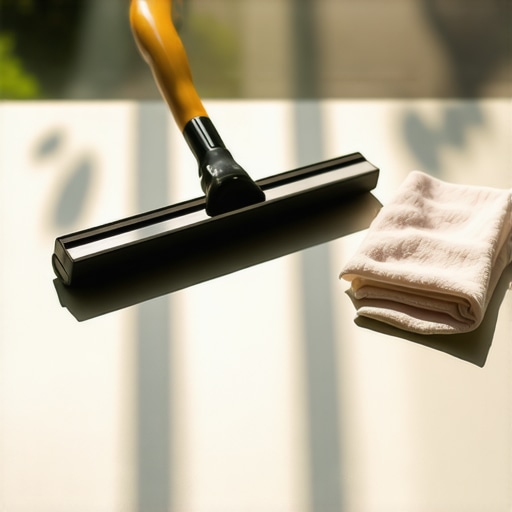
If you want your windows to last thirty years instead of ten, you must adopt the tools of the trade. A professional window cleaner uses a t-bar scrubber with a microfiber sleeve and a high-quality rubber squeegee. The logic is simple: the scrubber saturates the dirt, suspending it in a solution, and the squeegee removes it completely without ever rubbing the debris back into the glass. This protects the integrity of the sash and prevents the ‘burnishing’ effect that rags cause on vinyl frames. When you see someone ‘buffing’ a window with a dry cloth, you are watching the destruction of the glass’s optical clarity. If the glass has become so damaged that cleaning no longer helps, you aren’t looking at a cleaning problem anymore; you are looking at a window repair situation where the glass needs to be polished or replaced entirely.
When to Stop Cleaning and Start Replacing
There comes a point where no amount of professional cleaning can save a window. If you see permanent ‘rainbow’ effects on the glass (iridescence) or if there is moisture trapped between the panes that won’t go away, the desiccant in the spacer is saturated and the seal is gone. At this stage, you need to replace windows to restore your home’s thermal envelope. Choosing the right replacement involves looking at the rough opening to ensure it is square, level, and plumb, and then selecting a frame material like fiberglass or thermally broken aluminum that matches your climate’s demands. In our region, triple-pane glass with an argon gas fill is the gold standard for stopping the ‘ice-cube’ effect where you feel a chill just standing near the glass in January. Remember, the window is a precision instrument. Treat it with the respect a precision instrument deserves, and stop reaching for those old rags.