In twenty-five years of being a Master Glazier, I have seen more sliding doors destroyed by well-intentioned homeowners with a can of WD-40 than by actual structural failure. A sliding door is not just a piece of glass in a frame; it is a sophisticated Operable assembly that must manage thermal expansion, water drainage, and mechanical friction simultaneously. When that Sash starts to grind or becomes difficult to move, most people reach for the nearest spray lubricant. This is where the disaster begins. A homeowner called me in a panic because their massive, multi-slide patio system was essentially fused shut. I walked in with my hygrometer and a borescope, and I didn’t find a mechanical break. Instead, I found a decade of ‘home-remedy’ lubricants that had polymerized with coastal dust and salt into a substance resembling hardened epoxy. It wasn’t the door that had failed; it was the maintenance logic. They didn’t need to replace windows or doors yet, but they had nearly reached that point through improper care.
The Physics of the Track: Why Gunk Accumulates
To understand how to lubricate a track, you must first understand the Sill Pan and the drainage system. Most sliding doors are designed with a Weep Hole system that allows water to exit the track. When you apply a wet, petroleum-based lubricant, you are essentially creating a flypaper trap for every bit of dust, pet hair, and skin cell that floats through the air. This mixture eventually blocks the Weep Hole, leading to water backup, which can rot out the Rough Opening and the subfloor.
“Installation is just as critical as the window performance itself. A high-performance window installed poorly will fail.” AAMA Installation Masters Guide
This principle extends to maintenance. If you use the wrong lubricant, you are essentially un-installing the efficiency of the unit. In hot, southern climates like Phoenix or Miami, where the Solar Heat Gain Coefficient (SHGC) is a primary concern, the frame of the door can reach temperatures exceeding 140 degrees Fahrenheit. At these temperatures, cheap oils break down and become even stickier, attracting more debris and increasing the friction on the rollers.
The Anatomy of an Operable Sash
Every sliding door consists of several key components: the Sash, the frame, the Glazing Bead, and the rollers. The Glazing Bead holds the insulated glass unit (IGU) in place. If the track is gunked up, you end up pulling harder on the handle, which puts undue stress on the Sash joints and the Glazing Bead. This can eventually lead to a seal failure in the glass. When we talk about a window repair, we are often looking at the rollers first. Most modern rollers are made of either nylon or stainless steel. Nylon rollers are quieter but can flat-spot if they sit in gunk for too long. Stainless steel rollers are more durable but will grind the track if they aren’t allowed to spin freely. This is why a clean track is more important than a lubricated one.
The Step-by-Step Professional Cleaning Protocol
Before you even think about a lubricant, you must perform a deep clean. Use a high-quality window cleaner that is non-ammoniated to wipe down the glass and the Muntin bars if your door has them. For the track, start with a shop vacuum to remove the heavy grit. Then, use a stiff nylon brush to loosen the compacted dirt in the corners of the track. If the dirt is stubborn, a small amount of denatured alcohol on a rag is the best way to dissolve old grease without leaving a residue.
“Standard Practice for Installation of Exterior Windows, Doors and Skylights requires that all drainage paths remain unobstructed to prevent moisture intrusion into the building envelope.” ASTM E2112
This means that while you are cleaning, you must ensure the Weep Hole is clear. Use a small wire or a pipe cleaner to poke through the holes and ensure water can flow out. If water stays in the track because of gunk, it will eventually find its way under the Sill Pan and into your flooring.
Choosing the Right Lubricant: PTFE vs. Silicone
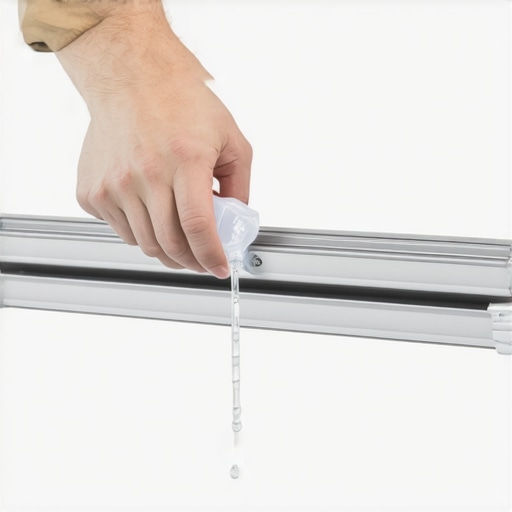
In my professional opinion, there is only one type of lubricant suitable for a sliding door: a dry-film lubricant, specifically one containing PTFE (Polytetrafluoroethylene). Unlike wet lubricants, PTFE goes on wet but dries into a hard, slippery film that does not attract dust. Silicone sprays are a secondary option, but they can still remain slightly tacky. In southern climates where the sun’s radiant heat is intense, a dry PTFE film will not melt or become gummy. This is crucial for maintaining the Operable status of the door without requiring a full window repair every six months. Apply the lubricant sparingly to the track itself and the roller housings. Move the door back and forth several times to distribute the film, then wipe away any excess. You want the surface to feel slippery to the touch, not wet.
When Maintenance Isn’t Enough: Signs You Need to Replace
Sometimes, no amount of cleaning will fix the issue. If you see that the Rough Opening has settled, you might notice that the door is no longer square. You can check this by looking at the gap between the Sash and the frame when the door is almost closed. If the gap is wider at the top than the bottom, you may need to adjust the rollers using the Shim screws at the base. However, if the frame itself is bowed or the Sill Pan is cracked, it is time to replace windows and doors. In high-heat regions, look for replacement units with a low SHGC and Low-E coatings on Surface #2 to reflect heat outward. This not only makes the home more comfortable but reduces the thermal expansion stress on the tracks, making your maintenance efforts last much longer.