The Immediate Crisis: Managing a Breached Envelope
The sound of shattering glass at 2 AM is a sound no homeowner ever forgets. It is not just the loss of property that stings; it is the sudden, violent compromise of your home’s thermal and structural envelope. As a glazier with over 25 years in the field, I have seen the aftermath of countless break-ins, and the most common mistake people make is a ‘caulk-and-walk’ mentality when trying to secure the opening. You are not just blocking a hole; you are managing air pressure, moisture ingress, and the structural integrity of the Rough Opening.
I once pulled a vinyl window out of a house in a freezing Chicago suburb after a botched break-in attempt, and the header was completely black with rot. Why? The previous installer had relied solely on the nailing fin instead of proper Flashing Tape, and when the homeowner tried to secure the damage with a piece of plywood, they accidentally channeled three weeks of rain directly into the wall cavity. This is the reality of poor water management: a small security breach can lead to a multi-thousand dollar structural failure if the Sill Pan and drainage planes are ignored during the emergency repair. When you deal with window repair after a burglary, you must think like a hydrologist as much as a security expert.
Anatomy of the Breach: Why the Glass Failed
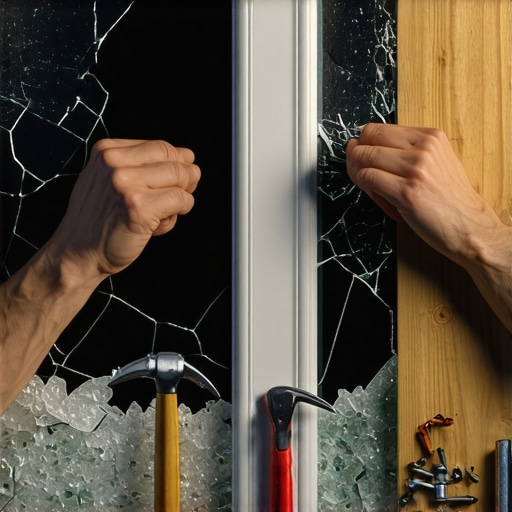
To understand how to secure the opening, you have to understand what was broken. Most residential windows utilize an IGU (Insulated Glass Unit). This is a sandwich of two or more panes of glass separated by a spacer and filled with an inert gas like Argon. When a burglar smashes an operable sash, they aren’t just breaking glass; they are venting that Argon gas and destroying the window’s U-Factor. In a cold northern climate, this is a thermal emergency. The U-Factor measures the rate of heat loss: the lower the number, the better the window stays warm. A broken pane sends that number skyrocketing, leading to rapid heat loss and potential pipe bursts in extreme cold. [IMAGE_PLACEHOLDER]
“The primary goal of a window installation is to maintain the continuity of the water-resistive barrier and the air barrier across the window-to-wall interface.” – ASTM E2112 Standard Practice
The type of glass matters for your next steps. If the glass broke into large, jagged shards, it is annealed glass. If it crumbled into small cubes, it is tempered glass. Tempered glass is required in operable units near floor levels or doors, but it offers very little resistance to a determined intruder. If you are looking to replace windows after a hit, you should be asking about laminated glass: two sheets of glass bonded to a middle layer of polyvinyl butyral (PVB). It is the same tech used in car windshields; even when it breaks, the PVB holds the glass in the frame, making entry nearly impossible without a sledgehammer and ten minutes of noisy work.
The Emergency Board-Up: A Technical Approach
The goal is to secure the Rough Opening without destroying the remaining frame components like the Glazing Bead or the Muntin bars. First, clear the remaining shards. Wear cut-resistant gloves. If the frame is wood, do not just nail plywood into the sash. This will split the grain and make a simple window repair impossible, forcing a full-frame replacement. Instead, use a ‘sandwich’ method. Cut two pieces of 7/16-inch OSB or plywood slightly larger than the opening. Place one on the inside and one on the outside, then bolt them together through the breach. This creates a secure barrier without drilling a single hole into your expensive operable frame.
Pay close attention to the Weep Hole. These are small outlets at the bottom of the frame designed to let water escape from the internal tracks. If you tape over these during your emergency securement, any condensation or rain that hits the window will be trapped, eventually overflowing the Sill Pan and rotting your subfloor. A professional glazier knows that water always finds a way in; the trick is giving it a clear path out. Even in an emergency, the ‘Shingle Principle’ applies: every layer of protection must overlap the one below it to shed water away from the structure.
Long-Term Restoration: Repair vs. Replace
Once the immediate threat is gone, you face a choice: window repair or a total unit swap. If the sash frame is intact, a glazier can often perform a ‘reglaze.’ This involves removing the Glazing Bead (the strip that holds the glass in place), cleaning the Rough Opening, and dropping in a new IGU. However, if the burglar pried the frame, the structural integrity of the shim points might be compromised. A window that is out of square by even an eighth of an inch will never seal correctly, leading to drafts that no window cleaner can fix with a squeegee.
“Installation is just as critical as the window performance itself. A high-performance window installed poorly will fail.” – AAMA Installation Masters Guide
In northern climates, where heat loss is the enemy, a breach is the perfect time to upgrade to a Low-E coating on Surface #3. Low-E (low emissivity) is a microscopically thin, transparent layer of silver that reflects long-wave infrared radiation. By placing it on Surface #3 (the indoor side of the outer pane), we keep the heat inside the house during the winter. If you lived in the south, we would put it on Surface #2 to reflect the sun’s heat back outside. This is the level of detail that separates a master glazier from a handyman. We don’t just fill holes; we calibrate the home’s performance.
Structural Integrity and Security Upgrades
When you finally replace windows, do not just look at the glass. Look at the hardware. Burglars love double-hung windows because the meeting rail is often a weak point. A simple pry bar can snap the cheap zinc locks found on ‘contractor grade’ units. Look for windows with multi-point locking systems and reinforced muntin bars. If you prefer a casement window, the ‘worm gear’ operator actually provides a much higher level of security because it cannot be easily forced open from the outside without total mechanical failure.
Finally, consider the Rough Opening tolerances. A window should be held in place with high-quality shims and secured with fasteners that penetrate the structural framing, not just the trim. If your installer just sprays some foam and calls it a day, they have failed you. Proper Flashing Tape should be integrated with the house wrap, creating a continuous barrier. This prevents the kind of hidden rot I mentioned earlier, ensuring that your new window remains a solid part of your home’s defense for another thirty years. Security is a system, not a single pane of glass. It involves the glass chemistry, the frame physics, and the installation geometry. Anything less is just a temporary fix.
{“@context”:”https://schema.org”,”@type”:”HowTo”,”name”:”How to Secure a Burglary-Damaged Window”,”step”:[{“@type”:”HowToStep”,”text”:”Clear all broken glass from the frame and rough opening using cut-resistant gloves.”},{“@type”:”HowToStep”,”text”:”Assess the damage to the sash and glazing beads to determine if a repair is possible.”},{“@type”:”HowToStep”,”text”:”Measure the opening and cut two pieces of plywood for a sandwich-style board-up.”},{“@type”:”HowToStep”,”text”:”Secure the plywood using carriage bolts through the breach to avoid damaging the frame.”},{“@type”:”HowToStep”,”text”:”Ensure weep holes are not blocked to allow for proper moisture drainage.”}]}