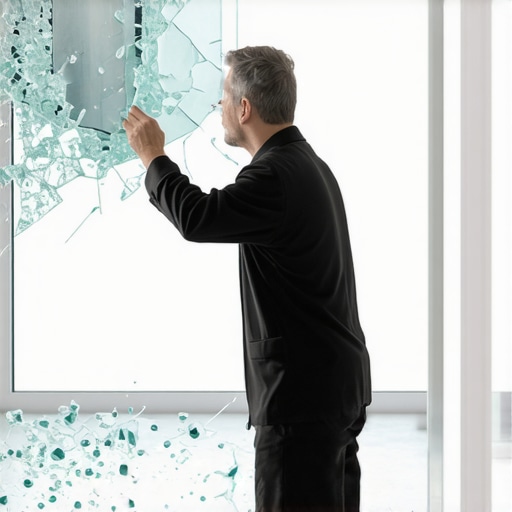
The Gunshot in the Living Room: Understanding Spontaneous Glass Failure
You are sitting on your sofa when a sound like a 9mm round discharging echoes through the house. You jump up, expecting a break-in, only to find your patio door or a large picture window transformed into a spiderweb of a thousand tiny cubes. There is no rock on the floor, no baseball in the garden, and no sign of forced entry. This is what we in the trade call spontaneous breakage, and it is the ultimate test of a homeowner’s patience. As someone who has spent over two decades in the glazing industry, I have seen every iteration of this phenomenon. It is not magic, and it is rarely a ghost. It is a matter of physics, chemistry, and often, poor installation practices. When you call a window cleaner to wipe down your glass, they might be the first to notice the tiny ‘clamshell’ chips that precede a catastrophic failure, but by the time the glass ‘explodes,’ you are looking at a serious window repair or a complete mandate to replace windows.
The Narrative Matrix: The Mystery of the Midnight Detonation
A homeowner called me in a panic because their new floor-to-ceiling units were ‘sweating’ and one had seemingly ‘detonated’ during a cold snap in January. I walked in with my hygrometer and a thermal imaging camera. They were convinced the glass was defective. I showed them that their indoor humidity was spiking at 65% because of a faulty humidifier setting, but more importantly, I found the culprit for the break. The previous installer had used a metal shim directly against the glass edge instead of a proper setting block. The glass had expanded against that rigid point during a sunny afternoon, and when the temperature plummeted at night, the stress concentrations reached a breaking point. It was a physics experiment gone wrong, not a manufacturer defect.
“Installation is just as critical as the window performance itself. A high-performance window installed poorly will fail.” – AAMA Installation Masters Guide
The Physics of the Break: Why Tempering Matters
To understand why a window shatters into tiny pieces instead of large shards, we have to ‘Glazing Zoom’ into the tempering process. Tempered glass is created by heating a standard lite of annealed glass to roughly 1,148 degrees Fahrenheit and then rapidly cooling the surfaces with high-pressure air nozzles, a process known as quenching. This creates a permanent state of high compression on the exterior surfaces while the core remains in a state of high tension. It makes the glass four to five times stronger than regular glass. However, this internal tension is like a coiled spring. If that surface compression layer is ever penetrated—by a chip, a deep scratch, or an internal impurity—the internal energy is released all at once. This is why you cannot cut tempered glass after it has been processed; it will simply disintegrate. When we talk about spontaneous failure, we are usually talking about the release of this tension due to a catalyst that isn’t immediately obvious to the naked eye.
The Enemy Within: Nickel Sulfide Inclusions
One of the most common causes of spontaneous breakage is a microscopic impurity known as a Nickel Sulfide (NiS) inclusion. During the glass manufacturing process, tiny fragments of nickel-rich contaminants can find their way into the molten glass batch. These inclusions are so small—often less than 0.2mm—that they are virtually impossible to detect during quality control. In the tempering furnace, these NiS stones change their molecular structure. Once the glass cools, they want to revert to their original, larger size. This expansion happens slowly, sometimes taking years. When the inclusion is located in the ‘tension zone’ (the center of the glass thickness), its expansion creates a localized stress point. Eventually, the glass can no longer contain the pressure, and it shatters. You can often identify this by looking for the ‘butterfly’ pattern at the origin of the break: two hexagonal cells that meet at a central point where the inclusion was located.
Thermal Stress: The Silent Killer in Cold Climates
In colder regions like Minneapolis or Chicago, thermal stress is the primary driver of glass failure. When we analyze a double-glazed unit, we have to look at the U-Factor, which measures the rate of heat transfer. In these climates, we want a low U-Factor to keep the heat inside. We achieve this by using Low-E coatings on Surface #3—the inward-facing side of the internal pane. This reflects long-wave infrared radiation back into the room. However, this creates a significant temperature gradient across the glass lite. If you have heavy drapes closed or a heating vent blowing directly onto the center of the glass while the edges are buried in a cold, uninsulated rough opening, the center of the glass expands while the edges remain cool. This differential expansion creates tensile stress at the edges. If the installer didn’t leave proper tolerances or used the wrong type of glazing bead, the glass has nowhere to go. The edge of the lite, which is the most vulnerable part of the window, will develop a crack that quickly propagates into a full shatter.
“The NFRC rating system provides a reliable way to determine the energy performance and solar heat gain characteristics of a fenestration product.” – NFRC 100 Procedure
Installation Failures: The Rough Opening and the Shim
Too many installers are what I call ‘caulk-and-walk’ contractors. They slap a window into a rough opening, drive a few screws through the nailing fin, and call it a day. But a window is a dynamic component. It expands and contracts. If the rough opening is too tight and the installer forced the window in without leaving room for shimming and expansion, the building’s structural loads are transferred directly to the window frame. I have seen sashes that were so compressed by a settling header that the glass was literally under a constant load. When the temperature fluctuates, that load becomes unbearable. Proper use of a plastic shim and ensuring the sill pan is level are not optional steps; they are the foundation of glass longevity. If your window fails because of frame compression, a simple window repair is just a temporary fix. You will likely need to replace windows entirely to correct the structural defect in the opening.
The Role of the Window Cleaner and Maintenance
While a window cleaner can’t prevent an NiS inclusion, they are your first line of defense against edge damage. Scratches from abrasive cleaning or chips from metal tools can create the ‘start point’ for a thermal stress fracture. When you are looking for window repair, always ask if they check the weep holes. If water is trapped in the glazing pocket because the weep holes are clogged, it can lead to seal failure and ‘wet’ edges. Water sitting against the edge of a laminated or tempered unit can cause delamination or promote the growth of edge cracks that lead to spontaneous shattering. Maintenance isn’t just about aesthetics; it is about pressure equalization within the IGU (Insulated Glass Unit).
The Decision: Repair vs. Replace
When a double-glazed unit shatters, you are faced with a choice. A window repair typically involves measuring the failed IGU and ordering a new glass ‘sandwich’ to be dropped into the existing sash. This is cost-effective if the frame is still in good condition—especially if it is a high-quality fiberglass or thermally broken aluminum frame. However, if the failure was caused by frame warping, wood rot in the sash, or poor original installation, putting new glass into a failing system is throwing good money after bad. You have to look at the Solar Heat Gain Coefficient (SHGC) and the U-Factor of your current units. If your windows are twenty years old, the technology has changed so much that the ROI on energy savings alone might justify the decision to replace windows. New units with argon or krypton gas fills and warm-edge spacers significantly reduce the risk of the thermal gradients that cause shattering in the first place.
Final Verdict: Don’t Buy the Hype, Buy the Science
Spontaneous shattering is a reminder that glass is a high-performance building material that requires respect. It is not just a transparent filler. Whether it is managing the dew point to prevent interior rot or ensuring the glazing bead is not putting undue pressure on the lite, the details matter. If your window explodes, don’t just call the first person who shows up with a tube of silicone. Find a specialist who understands ASTM E2112 standards and knows how to diagnose the ‘why’ behind the break. Because if you don’t fix the underlying cause, you’ll just be waiting for the next gunshot sound in your living room.
{“@context”:”https://schema.org”,”@type”:”HowTo”,”name”:”How to Handle a Spontaneous Glass Breakage”,”step”:[{“@type”:”HowToStep”,”text”:”Secure the area to prevent injury from falling glass fragments.”},{“@type”:”HowToStep”,”text”:”Identify the origin point of the break and look for a ‘butterfly’ pattern indicative of a nickel sulfide inclusion.”},{“@type”:”HowToStep”,”text”:”Measure the width, height, and overall thickness of the Insulated Glass Unit (IGU).”},{“@type”:”HowToStep”,”text”:”Consult a master glazier to determine if the cause was thermal stress, edge damage, or frame compression.”},{“@type”:”HowToStep”,”text”:”Decide between an IGU replacement or a full window replacement based on the condition of the sash and frame.”}]}