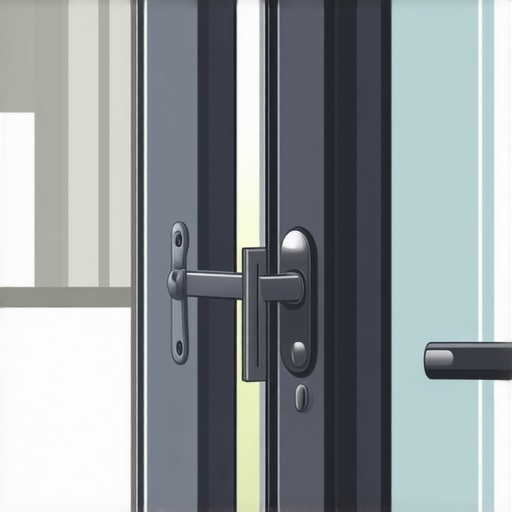
The Vulnerability of the Sliding Threshold
I once pulled a sliding door out of a residence where the entire subfloor was pulpy and black from moisture. Why? The installer had relied on the nailing fin instead of a proper sill pan and flashing tape. But the real shocker was the security. Because the frame had settled into the rot, the locking bolt was only engaging the strike plate by less than two millimeters. One firm pull and that door would have popped open. This is the reality of the residential threshold. A sliding glass door is essentially a giant hole in your building envelope that relies on a tiny piece of metal to keep the world out. As a glazier with over two decades in the field, I have seen every failure imaginable, from sagging headers to sheared-off keepers. If you are worried about your security, you need to look beyond the handle and into the physics of the rough opening.
The Anatomy of the Mechanical Lock
Most homeowners assume their sliding door is secure because the handle feels tight. That is a dangerous assumption. Most sliding doors utilize a mortise lock assembly. This is a mechanism recessed into the sash of the door. When you flip the lever, a hook or a pair of hooks emerges to grab a keeper mounted on the side jamb. The security risk arises when the alignment between these two components fails. This alignment is governed by the tandem rollers located at the bottom of the sash. If those rollers are worn or if the track is obstructed, the sash sits lower in the frame. This causes the hook to strike the top of the keeper instead of seating fully inside it. You might feel a click, but the engagement is superficial. You must check the glazing bead and the sash alignment every season. If you see daylight between the sash and the jamb when the door is closed, your lock is not fully engaged, and your home is a target.
“Installation is just as critical as the window performance itself. A high-performance window installed poorly will fail.” – AAMA Installation Masters Guide
The Physics of Impact and Structural Integrity
In coastal environments, the enemy is not just a thief but the wind. We spec impact-rated glass (Missile Level D) for a reason. This laminated glass consists of a polyvinyl butyral (PVB) interlayer sandwiched between two sheets of glass. If a burglar tries to smash the glass, the pane cracks but remains adhered to the interlayer, much like a car windshield. However, even the strongest glass is useless if the frame is weak. In many window repair scenarios, I find that the stainless steel hardware has been replaced with cheap zinc-plated components. Zinc corrodes in salt air, and a corroded lock is a brittle lock. A single blow from a hammer can shatter a corroded latch. If you are looking to replace windows or doors, you must insist on stainless steel mortise sets and reinforced strike plates that are screwed directly into the structural house framing, not just the thin aluminum or vinyl of the door frame.
The Critical Role of the Anti-Lift Block
The most common security bypass for a sliding door does not involve the lock at all. It involves a crowbar. An experienced intruder will place a bar under the sash and lift the entire door upward. If there is enough play in the head track, the bottom of the door will clear the track, and the intruder can swing the door outward, bypassing the lock entirely. To prevent this, your door needs anti-lift blocks. These are small plastic or metal spacers installed in the upper track. When the door is closed, these blocks fill the gap between the top of the sash and the head of the frame, making it impossible to lift the door high enough to clear the track. If you are performing a window cleaner service and you notice that your door can be lifted more than a quarter inch while closed, you have a major security gap that needs immediate window repair.
“Properly specified and installed fenestration products are essential to the safety and security of the building envelope.” – ASTM E2112 Standard Practice
Thermal Logic and Security Intersect
You might wonder what the U-Factor has to do with security. In my world, everything is connected. A door that does not lock tightly is also a door that leaks air. In southern climates where the Solar Heat Gain Coefficient (SHGC) is the primary concern, we use Low-E coatings on Surface 2 to reflect heat back outside. If your door lock is failing to pull the sash tight against the weatherstripping, you are losing that thermal efficiency. You are also creating a leverage point. A loose seal allows an intruder to insert a tool to manipulate the lock. When I perform a window repair, I always check the weep hole covers. If they are missing, it is not just a drainage issue; it is a sign of neglect that suggests the entire opening is compromised. A well-maintained door with a low U-Factor and a high-security rating is the result of precision shimming during the initial installation. We use shim stacks to ensure the jambs are perfectly plumb and the header is perfectly level. Without this, the lock will never engage with the mathematical precision required to thwart a forced entry attempt.
The Secondary Defense: Beyond the Primary Latch
Because I have seen so many primary locks fail due to house settling, I always recommend a secondary locking mechanism. This could be a foot-bolt at the bottom or a pin lock at the meeting rail. These devices are separate from the handle and provide a second point of contact that an intruder cannot see from the outside. When you replace windows, look for units that offer integrated multi-point locking systems. These systems engage at the top, middle, and bottom of the sash with a single turn of the handle. This distributes the load of a forced entry attempt across the entire rough opening, making it nearly impossible to breach. Remember, a window is a hole in your wall. If you treat it like a simple piece of furniture, you are ignoring the technical requirements of home defense. Maintain your sash, check your muntin bars for integrity, and never accept a lock that requires a jiggle to close. If it does not click with authority, it is not secure.