The Midnight Fracture: A Master Glazier’s Guide to Thermal Stress and Glass Failure
The sound is unmistakable. It is a sharp, crystalline snap that pierces the silence of a 2 AM house. For a homeowner, it is the sound of an unexpected expense; for a Master Glazier, it is the sound of physics in action. When a window pane cracks in the middle of the night, your first instinct is security, but your second must be a technical assessment of why the failure occurred. A window is not merely a piece of glass; it is a complex assembly designed to manage the pressure, temperature, and moisture differentials between your sanctuary and the external environment. Understanding why that glass failed is the first step in determining if you need a simple window repair or if it is time to replace windows entirely.
A homeowner called me in a panic because their new windows were sweating and then one literally exploded with a loud bang at 3 AM. I walked in with my hygrometer and showed them the humidity was 60 percent. It wasn’t the windows; it was their lifestyle choices. They had heavy, thermal-lined blackout curtains pulled tight against the glass, trapping a massive heat pocket. The temperature at the center of the glass was nearly 100 degrees Fahrenheit, while the edges, shielded by the sash and the glazing bead, were sitting at 40 degrees. That 60-degree delta is the textbook definition of thermal stress. The glass expanded at the center while the edges remained cold and constricted, leading to a catastrophic stress fracture. This is not a manufacturing defect; it is a failure to understand the thermal envelope.
“Installation is just as critical as the window performance itself. A high-performance window installed poorly will fail.” AAMA Installation Masters Guide
Immediate Action: Stabilizing the Breach
When you encounter a cracked pane at night, the immediate goal is to preserve the integrity of the thermal barrier and ensure safety. Do not attempt to remove the glass immediately if it is a double-pane Insulated Glass Unit (IGU). The two panes are often held in place by a secondary seal of silicone or polysulfide, and the structural integrity of the sash may rely on that glass remaining seated. Start by applying heavy-duty clear packing tape over the crack on both sides of the pane. This prevents the crack from migrating and keeps shards from falling. If the crack is large, a piece of cardboard or a heavy plastic sheet taped over the entire frame will provide a temporary buffer against the wind. [image_placeholder_1]
Technical Autopsy: Identifying the Crack Pattern
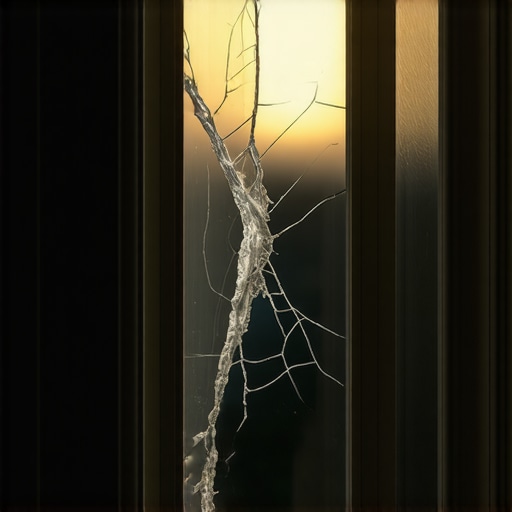
As a glazier, I look at the ‘geometry of failure’ to diagnose the issue. If the crack starts from the edge of the glass and meanders across the center in a wavy, irregular path, you are looking at a thermal stress crack. This is common in the North where the U-Factor (the rate of non-solar heat transfer) is critical. In cold climates, we prioritize a low U-Factor to keep heat inside. However, if the coating is on surface number 3 (the inward-facing side of the inner pane) and heat is trapped by drapes, the glass absorbs more energy than it can dissipate. Conversely, an impact crack will usually have a clear point of origin with ‘spider-web’ lines radiating outward. This is often caused by debris or even a bird strike that occurred earlier in the day, with the glass finally failing as the temperature dropped at night.
The Science of the IGU: Why You Cannot Just ‘Fix’ It
Modern windows are not like the single-pane wood sashes of the 1920s. You cannot simply scrape out some old putty and drop in a new piece of glass. Most operable windows today use an IGU consisting of two or three panes of glass separated by a spacer bar. This spacer bar contains a desiccant, a material designed to absorb any residual moisture within the unit. The space is then filled with an inert gas like Argon, which is denser than air and provides superior thermal resistance. When one pane cracks, the hermetic seal is breached. The Argon escapes, and moisture-laden air enters. This leads to ‘fogging’ or permanent calcium deposits on the interior surfaces. This is why window repair for a cracked IGU almost always requires a full unit replacement rather than a simple glass patch.
The Role of the Window Cleaner and Maintenance
Regular maintenance is your early warning system. A professional window cleaner does more than just remove dirt; they are often the first to notice a ‘haze’ or ‘creeping’ at the edges of the glazing bead. This haze indicates that the primary seal (usually polyisobutylene) is beginning to fail. If the seal fails, moisture infiltrates the spacer, and the glass becomes susceptible to the very thermal stress that caused your midnight crack. If you see ‘rainbowing’ or oil-slick patterns on your glass, the panes may be collapsing toward each other, a sign of pressure failure that makes the glass incredibly fragile.
“The performance of a fenestration product is dependent upon the quality of the glass, the integrity of the seal, and the precision of the installation.” NFRC Performance Standards
Choosing the Right Replacement: Climate Logic
If you find that your windows are frequently failing or that the ‘comfort gap’ near your windows is too wide, it may be time to replace windows. In a Northern climate, you must prioritize the U-Factor. Look for triple-pane units with warm-edge spacers. These spacers are made of composite materials rather than aluminum, which reduces the conductivity at the edge of the glass, significantly lowering the risk of thermal stress cracks. Ensure the Low-E coating is optimized for your latitude. In cold regions, we want the coating on the second or third surface to reflect heat back into the room. If you are in the South, the Solar Heat Gain Coefficient (SHGC) is your primary metric. You want a low SHGC to block the sun’s infrared radiation before it even enters the home.
Professional Installation: The Rough Opening and Beyond
When the new unit arrives, the installation is where most ‘Tin Man’ contractors fail. A Master Glazier ensures the rough opening is properly prepared. We use a sill pan, a critical component that directs any water that bypasses the primary seals back to the exterior. We check the tolerances of the opening; if the window is forced into a space that is too small without proper shims, the frame can twist. This ‘racking’ puts permanent pressure on the glass, making it much more likely to crack during a minor temperature shift. We use flashing tape in a ‘shingle’ fashion, starting from the bottom and working up, to ensure that water always flows over the laps, never under them.
Conclusion for the Homeowner
A cracked window at night is a stressful event, but it is also an opportunity to evaluate the health of your home’s exterior. Temporary stabilization with tape and plastic is your first move. Your second move is to call a specialist who understands the difference between a simple glass replacement and a structural failure. Do not settle for a ‘caulk-and-walk’ fix. Demand to know the U-Factor of the replacement unit and ensure that the installer is following ASTM E2112 standards. Your windows are the only thing standing between you and the elements; make sure they are up to the task.