Understanding the Molecular Surface of Modern Glazing
As a master glazier with over 25 years in the field, I have seen thousands of homeowners spend tens of thousands of dollars to replace windows, only to ruin the optical clarity within the first six months through improper maintenance. Most people view glass as a solid, impenetrable barrier. In reality, at a microscopic level, glass is an amorphous solid with a surface that is highly susceptible to mechanical abrasion and chemical etching. When you reach for a roll of paper towels to clean your high-performance sash, you are essentially rubbing wood by-products across a precision-engineered surface. This is the first step toward a window repair bill that could have been avoided.
The Condensation Crisis: A Narrative of Interior Environments
I recall a specific instance where a homeowner called me in a panic because their new high-efficiency units were sweating and looked perpetually dirty. I walked into the residence with my hygrometer in hand and measured the relative humidity at a staggering 60 percent. I explained that the moisture on the glass was not a seal failure but a result of their internal environment. However, the streaks they were seeing were a different story. They had been using heavy-duty paper towels and a generic window cleaner. I had to show them, using a jeweler’s loupe, how the wood fibers in the paper towels were leaving microscopic scratches that trapped oils and moisture, making the condensation look far worse than it was. It was not a product defect; it was a maintenance error that was degrading the Low-E coating on the interior surface.
“Installation is just as critical as the window performance itself. A high-performance window installed poorly will fail.” – AAMA Installation Masters Guide
The Physics of Paper Towels: Why Wood Pulp Fails Glass
Paper towels are manufactured from wood pulp. Even the softest brands contain lignin and relatively coarse cellulose fibers. When you apply pressure to a glass pane with these fibers, you are engaging in a process of mechanical abrasion. Over time, this creates a ‘haze’ that no window cleaner can remove. This is especially dangerous for modern windows with soft-coat Low-E layers on Surface #4 (the interior side). If you scratch that coating, you are effectively reducing the thermal efficiency of the unit because you are disrupting the thin-film deposition that reflects long-wave infrared radiation back into your home during the cold Minneapolis winters.
The Microfiber Advantage: Capillary Action and Polyamide Science
Microfiber is not just a cloth; it is a precision tool. A true professional-grade microfiber cloth is a blend of polyester and polyamide, where the fibers are split to be less than one denier in thickness. This splitting process creates a massive increase in surface area. While a paper towel simply pushes dirt and oils around, a microfiber cloth utilizes capillary action to lift and trap particulates deep within its wedge-shaped channels. This means you are actually removing the contaminants from the glass rather than relocating them into the corners of the glazing bead.
NFRC Ratings and the Importance of Surface Clarity
When we look at the NFRC (National Fenestration Rating Council) labels during a consultation to replace windows, we focus on the U-Factor and the Visible Transmittance (VT). VT is a measure of how much light comes through the window. If you are cleaning your windows with abrasive paper towels, you are effectively lowering your VT over time by creating a diffuse surface. This scattering of light reduces the crispness of your view and can even affect the Solar Heat Gain Coefficient (SHGC) if the surface becomes sufficiently occluded by micro-scratches and residue.
“The performance of a fenestration system is dependent upon the integrity of its components and the maintenance of its surfaces over the life of the product.” – NFRC Maintenance Guidelines
The Technical Cleaning Protocol for High-Performance Glass
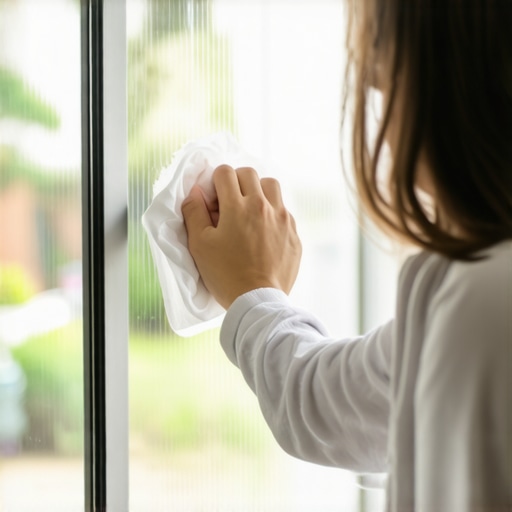
To maintain the integrity of your glazing, you must avoid any cleaner containing ammonia, which can degrade the spacers and the primary seal of an Insulated Glass Unit (IGU). Instead, use a dedicated window cleaner formulated for professional use, paired with a two-cloth microfiber system. The first cloth, a high-pile microfiber, is used to agitate and lift the dirt. The second cloth, a flat-weave or ‘waffle-weave’ microfiber, is used for the final buffing. This ensures that no lint is left behind and that the surface remains streak-free without the need for excessive mechanical pressure. This is the same method we use when we perform a window repair that involves replacing a cracked pane in an operable sash.
Thermal Stress and Cleaning: A Glazier’s Warning
In cold climates, the temperature differential between the interior and exterior of a window can be extreme. If you are cleaning your windows on a sub-zero day, the application of even lukewarm liquid can induce thermal stress. When you combine this stress with the friction of a coarse paper towel, you increase the risk of a stress crack. A microfiber cloth requires less liquid and less friction to achieve a clean surface, which is safer for the glass. Always check your weep holes to ensure they are clear of any debris or cleaning residue, as blocked weep holes are a primary cause of sill pan overflow and subsequent frame rot.
When Cleaning Is Not Enough: Identifying Seal Failure
Sometimes, no amount of cleaning with microfiber will fix the problem. If you see fogging or ‘calcium deposits’ between the two panes of glass, you are looking at a catastrophic seal failure. The desiccant in the spacer bar has become saturated, and the argon gas has escaped. At this point, you are no longer looking for a window cleaner; you are looking to replace windows. A professional glazier will measure the rough opening and determine if a full-frame replacement or a pocket insert is the correct path, ensuring that the new unit is shimmed correctly and the flashing tape is integrated into the drainage plane to prevent any future moisture intrusion.