The Physics of the Canine Smudge: More Than Just a Mess
As a master glazier with a quarter-century in the field, I have seen every type of window failure imaginable. From failed desiccant in an insulated glass unit (IGU) to catastrophic structural sagging because some ‘caulk-and-walk’ installer forgot to use a single shim under a heavy sash. But for many homeowners, the most persistent struggle is not mechanical; it is the constant battle against the ‘nose art’ left behind by their four-legged companions on low-level glazing. These dog nose prints are more than just an aesthetic nuisance. They represent an accumulation of sebaceous oils, moisture, and organic proteins that, if left untreated, can actually interact with certain interior-side Low-E coatings.
A homeowner called me in a panic because their new windows were ‘sweating.’ I walked in with my hygrometer and showed them the humidity was 60 percent. It was not the windows; it was their lifestyle, specifically their three large dogs and a lack of proper ventilation. Those same dogs were leaving heavy prints on the glass, which acted as a catalyst for condensation to pool. You see, the oils in those prints change the surface tension of the glass. While clean glass is relatively hydrophilic, the lipid-heavy residue from a dog’s snout creates a hydrophobic patch that traps moisture unevenly. This is not just a cleaning job; it is a maintenance routine that protects the longevity of your window repair and replacement investment.
“Installation is just as critical as the window performance itself. A high-performance window installed poorly will fail, and a failure to maintain the glass surface can compromise the intended thermal performance over time.” – AAMA Installation Masters Guide
The Chemistry of Effective Window Cleaning
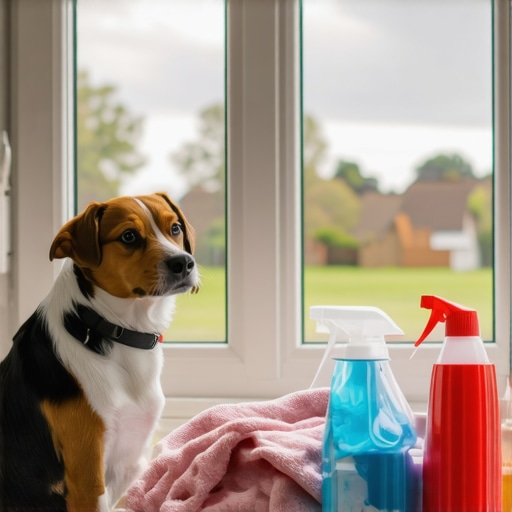
To understand the fastest way to remove these prints, we must look at the molecular level. Glass, though it feels smooth to your fingertip, contains microscopic pits and valleys. When a dog presses against the sash, it forces oils into these pores. Using a cheap, ammonia-based window cleaner often just smears these lipids across the surface, creating a hazy ‘blue’ sheen that is visible whenever the sun hits at an oblique angle. [image_placeholder_1]
For a professional-grade clean, you need a surfactant that breaks down organic proteins without leaving a residue. I recommend a mixture of distilled water and a small amount of pH-neutral dish soap, or a dedicated professional glass concentrate. Avoid any cleaner that claims to be ‘streak-free’ but contains waxes. If you are dealing with a North/Cold climate, you likely have a Low-E coating on Surface #4 (the side you touch). These coatings are designed to reflect long-wave infrared radiation back into your home to lower your U-Factor. However, they are thinner and more sensitive than the glass itself. If you scrub these coatings with an abrasive pad, you are not just cleaning; you are destroying the thermal efficiency of your window. You should always use a clean microfiber cloth or, better yet, a professional squeegee with a fresh rubber blade to ensure the oils are physically removed from the pane rather than redistributed.
Why Low Windows Require Special Attention
When we talk about ‘low windows’ in the context of building codes, we are often talking about tempered safety glass. Any glass within 18 inches of the floor must be tempered to prevent injury during an impact. This glass is heated and then cooled rapidly to create internal tension. While it is incredibly strong, the surface of tempered glass can sometimes have ‘fabrication debris’ or ‘pick-up’ from the tempering oven. If you use a razor blade to scrape off dried dog slobber, you risk catching these microscopic glass particles and dragging them across the pane, creating permanent scratches. This is why a chemical-first approach is vital for any low-level glazing maintenance.
“The performance of a fenestration product is dependent on the integrity of the glass surface and the maintenance of its coatings. Failure to use approved cleaning agents can void manufacturer warranties.” – NFRC Performance Standards
If the prints are particularly stubborn, it might be an indication that the ‘window cleaner’ you used previously has built up a film. In this case, a 50/50 mix of isopropyl alcohol and distilled water can help strip the wax and return the glass to its original state. This is especially important in colder climates like Minneapolis or Chicago, where the U-Factor is king. You want that Surface #4 coating to be pristine so it can perform its job of keeping your furnace heat inside where it belongs. If you find that the prints are actually appearing between the panes of glass, you are no longer looking at a cleaning issue. You are looking at a seal failure. When the seal of an IGU fails, moisture and oils can get trapped inside. At that point, the only solution is to replace windows or at least the glass units themselves.
The Glazier’s Guide to Long-Term Maintenance
When I perform a full frame tear-out, I always look at the rough opening. If I see signs of moisture around the base of the sill, it is often because the homeowner was over-zealous with liquid cleaners that seeped past the glazing bead and into the sash. When you clean those dog prints, do not spray the window cleaner directly onto the glass. Spray it onto your cloth. This prevents the liquid from running down into the weep holes or, worse, getting trapped against the wooden muntins or the vinyl frame where it can cause rot or mold growth. Water management is a science, and it starts with how you handle a spray bottle.
In southern climates where Solar Heat Gain Coefficient (SHGC) is the primary concern, your Low-E coating is likely on Surface #2. This means it is protected inside the IGU. You have more leeway with cleaning agents, but the heat of the sun in places like Phoenix or Texas can ‘bake’ dog prints onto the glass if they aren’t removed regularly. The radiant heat makes the organic matter more difficult to dissolve the longer it sits. If you are planning to replace windows soon, consider fiberglass frames. They have the lowest expansion and contraction rates, which means the seals around your glass stay tighter longer, making your frequent cleaning less likely to result in a seal breach. Remember, the installer and the maintenance routine matter just as much as the sticker on the glass. A window is a high-performance engine for your home’s envelope; treat it with the technical respect it deserves.