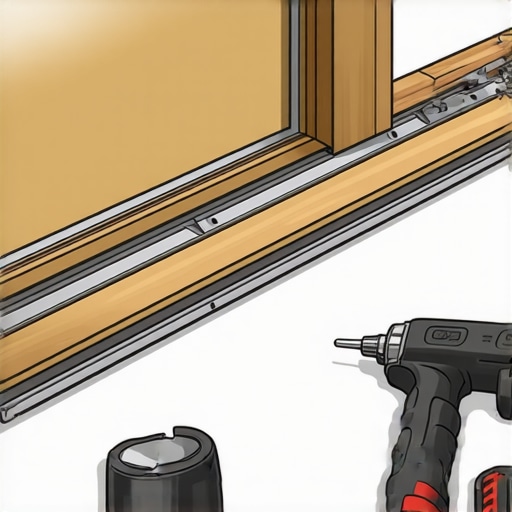
The Friction of Failure: Why Your Sliding Door is Fighting You
There is a specific, guttural vibration that travels up your arm when a 200-pound sliding glass door hits a dent in its track. It is the sound of mechanical resistance meeting architectural necessity. As a glazier with over two decades in the field, I have seen homeowners attempt to muscle these doors open, only to further deform the aluminum extrusion or, worse, shatter the tempered glass unit. A sliding door is a marvel of physics, balancing immense weight on two small tandem rollers. When that track is compromised, the entire system fails. This is not merely a nuisance; it is a breach of the building envelope’s efficiency. In this technical deep dive, we will dismantle the anatomy of a dented track and provide a professional-grade path to restoration.
The Narrative Matrix: A Lesson in Structural Rot
I recall a call out to a coastal property in Savannah where the homeowner complained that their massive impact-rated sliding door was sticking. I pulled the operable panel out of the frame and what I found was a case study in why installation details matter. The previous installer had failed to use a proper sill pan, relying instead on a bead of cheap caulk under the nailing fin. Over five years, water had infiltrated the rough opening, rotting the subfloor beneath the track. The track hadn’t just ‘dented’ from impact; it had sagged into the soft wood, creating a permanent dip that the rollers couldn’t overcome. This is the reality of the industry: most track issues are symptoms of deeper installation failures. If your track is dented, we must first determine if the substrate is stable before we ever pick up a hammer.
“Installation is just as critical as the window performance itself. A high-performance window installed poorly will fail.” — AAMA Installation Masters Guide
The Anatomy of an Extruded Aluminum Track
To understand the repair, you must understand the material. Most modern sliding doors use an extruded aluminum sill. Aluminum is chosen for its strength-to-weight ratio and corrosion resistance, but it is a soft metal compared to the stainless steel rollers that traverse it. When a heavy object is dropped on the rail, or when the door is forced over a pebble, the metal undergoes plastic deformation. It doesn’t just bend; the molecular structure of the aluminum is displaced. Glazing zooming into this process reveals that the ‘bump’ you feel is often a combination of a depression (the dent) and a corresponding bulge (the displaced metal) on the sides of the rail. Repairing this requires a fundamental understanding of metallurgy and the Shingle Principle.
The Installation Autopsy: Why Tracks Fail in High-Stress Environments
In coastal or high-wind regions, sliding doors are often the largest ‘holes’ in the wall. They are subject to immense positive and negative wind pressures. For an operable door to function, it must maintain a precise tolerance within the rough opening. When a track is dented, it creates a point of friction that can lead to the failure of the weatherstripping. This allows air infiltration and, more critically, water bypass. Water management is a science. The sill is designed to collect water and channel it out through weep holes. If a dent is deep enough to puncture the aluminum or crack the thermal break, you are no longer just looking at a mechanical issue; you are looking at a potential leak that can destroy your flooring and headers.
The Technical Repair Protocol: Realigning the Rail
Before you consider a window repair or a full replace windows project, we attempt the ‘Block and Bridge’ method. This requires a sacrificial block of hardwood (maple or oak) and a 16-ounce dead-blow hammer. We do not strike the track directly. The goal is to redistribute the stress. By placing the wood block over the dented section and applying controlled kinetic energy, we move the aluminum back into its original profile. If the dent has caused the rail to ‘mushroom’ outwards, we use a pair of specialized track pliers with padded jaws to gently compress the sides back to the vertical. We are looking for a tolerance of less than 1/32 of an inch. Anything more, and the tandem rollers will continue to jump, leading to premature bearing failure.
“Standard practice for the installation of exterior windows, doors, and skylights requires that the sill be level and the track be free of obstructions or deformations that impede the movement of the sash or the drainage of water.” — ASTM E2112
The Coastal Context: SHGC and Heavy Glass Management
In hot, coastal climates like Florida or Texas, the glass in these doors is often a heavy, double-pane insulated unit with a Low-E coating on Surface #2 to manage the Solar Heat Gain Coefficient (SHGC). This glass is heavy. The sheer mass puts constant pressure on the rollers. When you have a dented track in these environments, the heat causes the metal to expand, often exacerbating the friction. This is why we often recommend a stainless steel track cover. A track cover is a thin sleeve of high-grade stainless steel that snaps over the existing aluminum rail. It provides a smooth, hard surface that is far more resistant to future denting and corrosion than the original aluminum. This is the professional’s secret to extending the life of a sliding door without a full tear-out.
Maintenance as Prevention: The Role of the Window Cleaner
It may seem trivial, but the role of a window cleaner is vital in preventing track damage. Grit and sand act as abrasives. When sand sits in the track, the rollers grind it into the aluminum, creating micro-pitting that eventually leads to larger deformations. A regular vacuuming of the track and cleaning of the weep holes is the only way to ensure the longevity of the system. If you ignore the ‘crunching’ sound of dirt in your track, you are effectively sanding down your door’s lifespan. I tell my clients: a clean track is a functional track. Use a silicone-based lubricant—never WD-40, which attracts dust—to keep the rollers moving freely across the repaired surface.
When Repair is Futile: The Decision to Replace Windows
There comes a point where the structural integrity of the sill is compromised beyond the help of a hammer and a track cover. If the dent has resulted in a crack in the aluminum extrusion, the ‘weep’ system of the door is likely compromised. Water will no longer stay in the channel; it will migrate into the subfloor. In these cases, a pocket replacement or a full-frame tear-out is necessary. We look at the Rough Opening and the Shim placement. If the original installer didn’t level the sill properly, no amount of track repair will make that door slide like new. We must address the root cause, which is often a lack of support under the sill pan.