The Chemistry of Debris: Why Bird Droppings are a Glazier’s Nightmare
Most homeowners look at a bird dropping on their window and see a simple aesthetic nuisance. As a master glazier with over two decades in the trade, I see a concentrated delivery system of uric acid and abrasive particulates. Bird droppings typically have a pH level between 3.0 and 4.5. When that acidity sits on a glass surface, especially one baked by the southern sun, it begins a process of chemical etching that can permanently alter the silica lattice of your window. If you approach this with a dry paper towel or a scraper without understanding the physics of the glass-air interface, you are not just cleaning; you are performing an accidental window repair that will eventually require a full replacement.
I remember a specific case where a homeowner in Miami called me in a panic. Their brand new, high-SHGC (Solar Heat Gain Coefficient) windows looked like they were ‘sweating’ or failing internally. I walked in with my hygrometer and a high-magnification jeweler’s loupe. The windows weren’t failing; the seals were tight. The problem was that the homeowner had been using a dry nylon brush to scrub off sun-baked droppings. They had micro-scratched the Low-E coating on Surface #2 of the glass because the heat had essentially fused the organic matter to the substrate. It wasn’t a manufacturing defect; it was a maintenance disaster. This is why understanding the ‘Glass Class’ of your home is vital before you ever pick up a bucket of window cleaner.
“Installation is just as critical as the window performance itself. A high-performance window installed poorly will fail.” – AAMA Installation Masters Guide
The Science of the Surface: Glass and Solar Heat
In hot, southern climates where the goal is to block the sun’s radiant heat, we prioritize a low SHGC. This is often achieved through sophisticated Low-E coatings applied to the internal surfaces of the glass. However, the outer pane still bears the brunt of the thermal load. When a bird dropping lands on that outer pane, the glass temperature can easily exceed 140 degrees Fahrenheit in mid-afternoon. This heat accelerates the chemical reaction of the uric acid. The droppings don’t just sit on top; they undergo a phase change, hardening into a ceramic-like bond with the glass. This is why ‘dissolving’ the matter is the only safe path, rather than mechanical removal.
If you live in a coastal area, the situation is even more precarious. You likely have impact-rated glass, which involves a thick sacrificial layer of laminated glass or tempered panes designed to withstand high wind pressures. These panes are often under internal tension. Applying localized pressure or using a metal blade to scrape off debris can create microscopic stress fractures. If you have an operable sash, the movement of the window within the rough opening can exacerbate these small scratches, leading to a catastrophic crack during the next major temperature shift or storm. You must treat the glass as a precision-engineered component, not a piece of transparent rock.
“Cleaning and maintenance of glazing should be performed with care to avoid damage to the glass surface or the surrounding frame components.” – ASTM E2112 Standard Practice
The Dissolution Protocol: Step-by-Step Technical Guide
To safely remove these acidic deposits, you must use the principle of saturation and enzymatic breakdown. You are not scrubbing; you are hydrating. Start by creating a solution of warm water and a non-ionic surfactant. Professional window cleaner solutions are designed to lower the surface tension of the water, allowing it to penetrate the porous structure of the dried dropping. If you don’t have a professional grade surfactant, a pH-neutral dish soap will suffice. Avoid any cleaner with ammonia if you have tinted films or certain high-performance coatings, as ammonia can degrade the glazing bead or the perimeter seals over time.
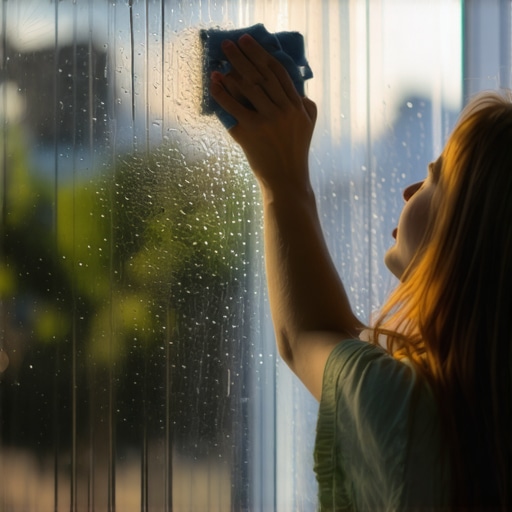
Soak a microfiber cloth in the solution and gently press it against the dropping. Do not rub. You want to hold the cloth there for at least three to five minutes. This is the ‘Glazing Zooming’ phase of cleaning: you are allowing the water molecules to migrate into the uric acid crystals, softening them back into a liquid state. For particularly stubborn spots, you can use a mixture of white vinegar and water (50/50 ratio), but only if your frame material is vinyl or fiberglass. If you have wood windows, be extremely careful; the acidity of vinegar can damage the finish or the muntin bars. Once the matter is soft, it should slide off with zero resistance. If you feel any grit, stop. That grit is likely undissolved seed or sand from the bird’s digestive tract, which will act like a diamond-tipped scribe on your glass if you apply pressure.
Frame Material Science: Beyond the Glass
When you are cleaning, you must also inspect the surrounding architecture. A window is a hole in the wall that manages heat and water. While you are at the glass, look at the weep holes in the bottom of the sash. If bird droppings or cleaning runoff clog these holes, water will back up into the frame. In a vinyl window, this leads to stagnant water that can grow algae. In a wood window, it leads to the dreaded black rot I’ve seen in countless headers and sills. If you see water pooling or if the glazing bead is starting to pull away from the glass, you aren’t looking at a cleaning job anymore; you are looking at a window repair situation.
Many ‘Tin Man’ salesmen will tell you that you need to replace windows the moment a seal fails or a scratch appears. That is rarely the case. Most high-quality IGU (Insulated Glass Units) can have the glass replaced within the existing sash if the frame is still structurally sound. This is where the ROI of high-end materials like fiberglass comes into play. Fiberglass is incredibly stable and doesn’t expand and contract at the same rate as vinyl. This stability means the shim and flashing tape remain undisturbed for decades, making glass-only repairs a viable and cost-effective option compared to a full-frame tear-out. Always check the rough opening for squareness before deciding to replace. If the frame is plumb and the sill pan is doing its job, a simple glass swap is all you need.
The Professional’s Kit for Maintenance
To avoid the need to replace windows prematurely, keep a dedicated kit. This should include a high-quality squeegee with a fresh rubber blade, microfiber towels, and a non-abrasive enzymatic cleaner. Never use steel wool, even the fine 0000 grade, on modern coated glass. While it was a trick of the trade for old single-pane windows, it will ruin the specialized coatings on a modern NFRC-rated unit. The goal is to maintain the visible transmittance (VT) while protecting the U-Factor. Every scratch you add to the glass reduces its clarity and can even slightly affect its thermal performance by creating points of heat concentration.