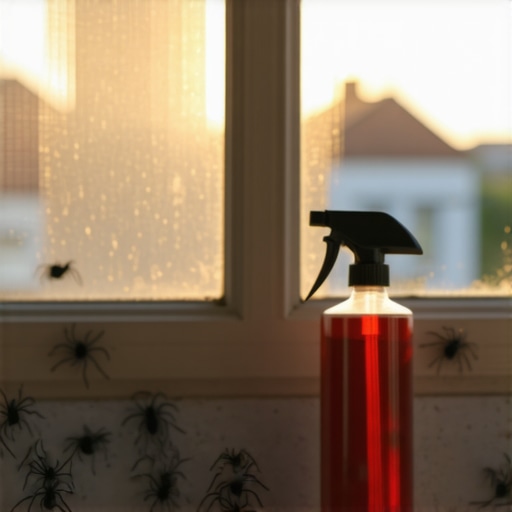
The Glazier’s Perspective on the Arachnid Infestation
In my twenty-five years of handling glass, from heavy-duty tempered panels in commercial storefronts to delicate historical restorations, I have learned one fundamental truth: a window is never just a window. It is a thermal boundary, a structural challenge, and, unfortunately, a primary access point for the local ecosystem. I have walked onto job sites where a homeowner is complaining about a draft, only to find that the draft isn’t coming from a failed seal, but from a colony of spiders that has literally excavated the decaying organic debris inside a poorly maintained weep hole. This is the reality of the ‘hole in the wall’ we call a window. If you don’t manage the heat, the light, and the water, the biology of the outdoors will manage it for you. We are going to talk about a specific essential oil spray that stops spiders from nesting in your window sills, but first, we need to understand the physics of why they are there in the first place.
“Installation is just as critical as the window performance itself. A high-performance window installed poorly will fail.” AAMA Installation Masters Guide
The Condensation Crisis: A Narrative of Neglect
A few years back, a homeowner called me in a total panic because their brand-new, high-efficiency vinyl windows were ‘sweating’ and covered in webs. I walked into that house with my hygrometer and a thermal imaging camera, ready to perform a forensic audit. I showed them that their indoor humidity was hovering at 60 percent. It wasn’t that the windows were failing; it was their lifestyle and their lack of a proper ventilation strategy. That moisture was settling on the cold glass surface, specifically at the bottom edge near the spacer, creating a micro-climate of high humidity. This humidity attracted gnats and flies, which in turn invited the spiders to set up shop. The spiders weren’t the problem; they were a symptom of a thermal bridge. Once we addressed the dew point and cleared the moisture, the spiders had no reason to stay. But while you’re fixing those structural issues, a targeted essential oil spray can be your frontline defense.
The Science of the Spray: Why Essential Oils Work
Spiders are hypersensitive to scent. They don’t have noses in the traditional sense, but they possess chemo-sensitive hairs on their legs that allow them to ‘smell’ their environment. When you apply a concentrated solution of peppermint or tea tree oil to a window sill, you are essentially creating a chemical barrier that is overwhelming to their sensory systems. This isn’t just folk medicine; it is an olfactory deterrent. To make this spray, you need to combine fifteen drops of pure peppermint oil with a teaspoon of dish soap and two cups of distilled water. The dish soap is critical because it acts as a surfactant, breaking the surface tension of the water so the oil can stay in suspension rather than just floating on top. If you just spray oil and water, the oil stays at the surface of the bottle and you get an uneven application. This spray needs to be applied to the sash, the glazing bead, and especially the corners of the rough opening where the frame meets the drywall or casing.
The Technical Anatomy of the Sill: Where Spiders Hide
If you look at a cross-section of a standard double-hung window, you will see several prime real estate locations for spiders. The first is the weep hole. These are small apertures at the bottom of the frame designed to allow water that bypasses the primary seals to drain out. If these get clogged with dust or old window cleaner residue, they become moist, dark tunnels. A master glazier knows that a clogged weep hole is a recipe for frame rot and insect nesting. Then there is the meeting rail where the two sashes overlap. If your window repair involves replacing worn-out weatherstripping, you are also closing the door on spiders. I’ve seen countless cases where a missing piece of bulb seal or a worn-out pile weatherstrip created a 3mm gap. In the world of glazing, 3mm is a highway. You need to ensure that the shim used during the initial installation hasn’t compressed or shifted, which could bow the frame and create these gaps.
Climate Context: The North/Cold Battle
For those of you in climates like Minneapolis or Chicago, the enemy is heat loss and condensation. In these regions, the U-Factor is the king of metrics. A lower U-Factor means the window is better at resisting non-solar heat flow. When you have a single-pane window or an older double-pane with a failed seal, the interior glass temperature drops significantly during the winter. This brings us back to the dew point. If the glass temperature is below the dew point of the indoor air, you get water. Spiders love this water. To prevent this, your next window replacement should focus on triple-pane glass with an argon or krypton gas fill. You want the Low-E coating on Surface #3. In glazier terms, we count surfaces from the outside in. Surface #1 is the exterior face of the glass; Surface #4 is the interior face. Putting the coating on Surface #3 reflects the heat from your furnace back into the room, keeping the glass warmer and reducing the condensation that attracts the pests in the first place.
Window Cleaner Ethics and Maintenance
Many homeowners think they are doing a good job by dousing their windows in ammonia-based cleaners. As a professional, I tell you to stop. Ammonia can degrade the glazing bead and some of the more sensitive coatings on the glass. When you want to clean your windows before applying your essential oil spray, use a mixture of distilled water and a tiny drop of pH-neutral soap. This ensures that the surface is clean without leaving a film that the oils can’t penetrate. A clean surface allows the peppermint oil to bond more effectively to the vinyl or wood substrate. If you are looking to replace windows because they are beyond cleaning, look for frames made of fiberglass. Fiberglass is incredibly stable; it doesn’t expand and contract like vinyl, meaning the seals stay tighter and there are fewer gaps for spiders to exploit as the seasons change.
“Standard Practice for Installation of Exterior Windows, Doors and Skylights requires a continuous air barrier and a water-resistant barrier that is integrated with the sill pan.” ASTM E2112
Structural Integrity: The Sill Pan and Flashing
Let’s talk about the ‘Shingle Principle.’ In glazing, we always want the higher material to overlap the lower material so that water flows down and away from the building envelope. This applies to your spider problem too. If your flashing tape was applied incorrectly during the installation of the rough opening, water can get behind the frame. This damp wood is like a siren song for wood-boring insects and the spiders that eat them. A proper sill pan is a piece of flashing that sits under the window, sloped toward the exterior. If your installer didn’t use a sill pan, you are relying entirely on caulk. I have no time for ‘caulk-and-walk’ installers. Caulk is a secondary defense, not a primary one. If you see cracks in your caulking, that is where you need to spray your oil until you can get a professional window repair specialist to do a proper full-frame tear-out and fix the flashing.
Summary of the Glazier’s Protocol
To truly stop spiders, you must combine the chemical deterrent of essential oils with the physical integrity of a well-maintained window. Spray the peppermint solution every two weeks during the spring and fall when spider activity is at its peak. But while you’re there with your spray bottle, look at the sash. Is it square? Is the muntin tight? Are the weep holes clear? If you find that you can feel a breeze or see light through the corners, no amount of peppermint oil will save you. You are looking at a structural failure that requires a professional. Whether you need a simple window cleaner to clear the glass or a full replacement to upgrade your U-Factor, remember that the goal is a tight, dry, and thermally efficient opening. That is how you win the war against the elements and the eight-legged invaders alike.