A homeowner called me in a panic because their new windows were ‘sweating’ and the skylights looked like a swamp. I walked in with my hygrometer and showed them the humidity was 60 percent. It wasn’t the windows; it was their lifestyle. They had a humidifier running in a house with a tight envelope and no mechanical ventilation. In my 25 years as a glazier, I have seen it all. People mistake condensation for a leak, and they mistake dirt for a failed seal. But when you are looking up at a vaulted ceiling and seeing streaks of pollen and grime, you don’t care about the physics; you just want to see the sky again. The problem is that most people think cleaning a skylight requires a death-defying act on a ladder. I am here to tell you that if you are climbing onto your shingles to reach a skylight, you are risking your neck and your roof’s integrity for no reason. There is a professional way to handle this from the ground that preserves the glazing bead and the frame.
The Physics of the Overhead Glazing Unit
Before we talk about tools, we have to talk about the glass. A skylight is not a window. It is a hole in your roof, and it is subjected to much harsher conditions than any vertical sash in your home. While a standard window repair usually involves fixing a balancer or a latch, skylight issues often stem from the fact that gravity works against the seals. Debris, bird droppings, and industrial pollutants sit directly on the glass, absorbing ultraviolet radiation and baking into the surface. This creates a chemical bond that is much harder to break than the dust on your living room window. If you live in a cold climate, the U-Factor of your skylight is under constant attack. Dirt acts as a microscopic thermal bridge, and if your skylight is operable, that dirt can migrate into the weep hole system, causing water to back up and rot the rough opening. We see this all the time. A homeowner ignores a dirty skylight, the drainage path clogs, and suddenly they are calling me for a full frame replacement because the header is soft.
“Installation is just as critical as the window performance itself. A high-performance window installed poorly will fail.” – AAMA Installation Masters Guide
The Gear: Professionalism Over Hacks
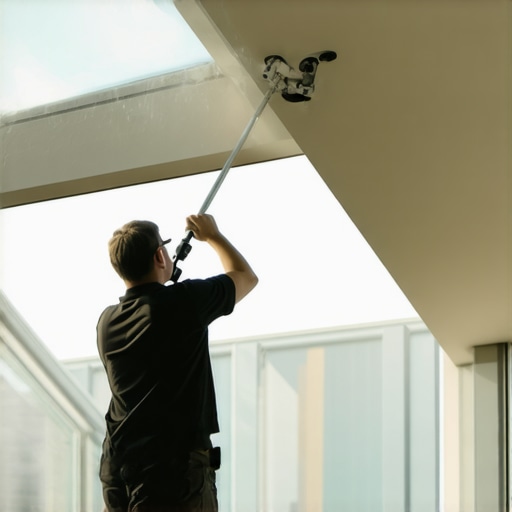
Forget the vinegar and newspaper myths. If you want to clean glass that is fifteen feet in the air without a ladder, you need to understand the mechanical advantage of a telescopic pole. A professional window cleaner doesn’t use a cheap plastic stick; they use a carbon-fiber or high-grade aluminum extension pole that can reach the peak of the roof without flexing. Flex is your enemy because it prevents you from applying even pressure to the glazing bead. You also need a high-quality squeegee and a microfiber washer sleeve. The goal is to lift the particulates off the glass using a surfactant, not to scrub them into the coating. If your skylight has a Low-E coating on Surface #1 (the exterior), you must be extremely careful. Some modern units have a permanent hydrophobic coating that helps shed water, and using the wrong chemicals can strip that layer, leaving the glass permanently hazy.
Step-by-Step No-Climb Cleaning Protocol
1. Pre-Rinse: Use a garden hose with a specialized nozzle to reach the skylight. Do not use a pressure washer. High-pressure water can bypass the flashing tape or the sill pan, forcing moisture into the interior of the wall cavity. You just want to saturate the debris. 2. The Soap Solution: Use a dedicated glass cleaner that is ammonia-free. Ammonia can degrade the rubber gaskets and the glazing bead over time. 3. Application: Use your telescopic pole and microfiber sleeve to apply the solution. Start at the highest point. Because skylights are angled, the dirty water will naturally flow down. Use a circular motion to agitate the grime. 4. The Squeegee Pull: This is where the skill comes in. You need to angle the squeegee so that the water is directed toward the side of the frame. This ensures that the dirty runoff doesn’t pool at the bottom of the sash. 5. The Detail: Attach a dry microfiber cloth to the pole to wipe the edges of the frame. If water sits on the weep hole covers, it can attract more dirt, leading to a clog.
“Condensation resistance is a critical metric for any fenestration product. A window’s ability to remain clear in high humidity environments depends on both the spacer technology and the installation integrity.” – NFRC Performance Standards
When to Stop Cleaning and Start Repairing
If you clean the exterior and the skylight still looks foggy, you are likely looking at a seal failure. This is when the Argon or Krypton gas between the panes has leaked out and been replaced by moist air. No amount of cleaning will fix this. At this point, you aren’t looking for a window cleaner; you are looking to replace windows or at least the insulated glass unit (IGU). I have seen many people try to drill holes in their skylights to ‘vent’ the fog. This is a disaster. It ruins the thermal performance and allows mold to grow inside the unit. If the shim has shifted or the frame is warped, the glass will eventually crack under the thermal stress. A skylight in a Southern climate has it even harder. The Solar Heat Gain Coefficient (SHGC) is paramount there. If your skylight is making the room feel like an oven, it doesn’t matter how clean the glass is. You may need to upgrade to a unit with a Low-E coating on Surface #2 to reflect that radiant heat back into the atmosphere.
The Long-Term Value of Window Maintenance
Maintaining your skylights is about more than just a clear view. It is about protecting the structural integrity of your home. A clean skylight allows you to inspect the flashing and the condition of the seals from the ground. If you see the glazing bead starting to pull away or dry rot on a wood-framed unit, you can address it before it becomes a five-figure window repair. Water is patient. It will find the smallest gap in your defense. By keeping the glass clean and the drainage paths open, you ensure that the ‘shingle principle’—where water flows down and away—is always functioning. Don’t be the homeowner who waits until there is a drip on the carpet to look up at their roof. Invest in the right tools, keep your feet on the ground, and treat your skylights with the technical respect they deserve. A well-maintained skylight can last 20 to 30 years, but a neglected one will fail in ten. The choice is yours, but as someone who has spent decades replacing rotted headers, I can tell you that a little bit of maintenance goes a long way in preserving your peace of mind.
{“@context”: “https://schema.org”, “@type”: “HowTo”, “name”: “How to Clean a Skylight from the Ground”, “step”: [{“@type”: “HowToStep”, “text”: “Rinse the skylight with a garden hose to remove loose debris.”}, {“@type”: “HowToStep”, “text”: “Apply an ammonia-free cleaning solution using a telescopic pole and microfiber sleeve.”}, {“@type”: “HowToStep”, “text”: “Agitate the grime using a circular motion with the microfiber tool.”}, {“@type”: “HowToStep”, “text”: “Squeegee the water off the glass, pulling from top to bottom and angling toward the frame.”}, {“@type”: “HowToStep”, “text”: “Dry the frame edges with a clean microfiber cloth attached to the extension pole.”}]}