The Frustration of the Etched View
You spend thousands of dollars on high-performance fenestration units, ensuring the Rough Opening is square and the Sill Pan is perfectly sloped, only to have your view obscured by a stubborn, white haze. As a glazier who has spent decades in the field, I have seen homeowners mistake hard water spots for seal failure. They see a foggy pane and immediately think they need to replace windows, but often, the issue is not the Argon gas leaking out; it is the mineral content of the water leaking in from the outside or condensing on the inside. Hard water spots are essentially a geological event happening on your Sash. When water high in calcium and magnesium evaporates, it leaves behind a crystalline structure that bonds to the microscopic pores of the glass. If left untreated, these minerals can actually etch the surface, leading to permanent damage that no window cleaner can fix. In this guide, we will look at the chemical reality of glass maintenance using household items like lemon and baking soda, and why understanding the physics of your glass surface is the first step toward a clear view.
The Condensation Crisis: A Master Glazier’s Perspective
A homeowner called me in a panic because their new windows were ‘sweating’ and developing thick white crusts along the Glazing Bead. I walked in with my hygrometer and showed them the humidity was 60 percent. It wasn’t the windows; it was their lifestyle. They were running a humidifier in a sealed, tight house during a Minneapolis winter. The moisture was hitting the cold glass, condensing, and because they had a high mineral content in their local water supply which they used for the humidifier, the glass was being ‘plated’ with calcium every single night. They thought they needed a window repair or a total replacement. I had to explain that even the most expensive triple-pane unit will collect minerals if the environmental conditions are not managed. This wasn’t a product failure; it was a chemistry problem. This is where the application of citric acid and sodium bicarbonate becomes a technical necessity rather than just a ‘life hack.’
“Installation and subsequent maintenance are just as critical as the initial window performance ratings. A high-performance window that is neglected or subjected to improper cleaning agents will eventually fail to meet its aesthetic and functional goals.” – AAMA Installation Masters Guide
The Chemistry of Citric Acid and Sodium Bicarbonate
To understand why a lemon and baking soda work, we have to look at the pH scale. Hard water spots are alkaline. Calcium carbonate and magnesium are basic. To neutralize them, you need an acid. A lemon provides citric acid, which is mild enough not to damage the Glazing Bead or the Muntin finish, but strong enough to break the ionic bond between the mineral and the glass. Baking soda, or sodium bicarbonate, acts as a buffering agent and a mild abrasive. Unlike industrial window cleaner products that might contain harsh hydrofluoric acid, baking soda has a Mohs hardness rating of about 2.5. Glass, being a silicate, sits at a 6 or 7. This means you can use baking soda to mechanically agitate the mineral deposits without scratching the actual glass surface. It is a precise mechanical-chemical interaction that removes the ‘scale’ without compromising the structural integrity of the pane.
Step-by-Step Glass Restoration Technique
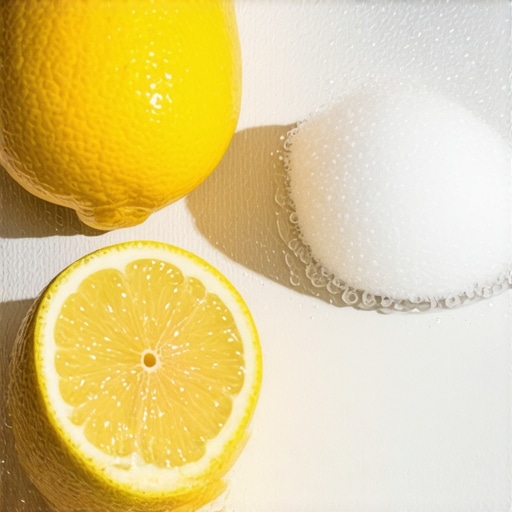
First, you must clean the Operable sash of any loose grit or dust. If you rub baking soda over a pane covered in sand or dirt, you will create micro-scratches. Once the surface is clear, cut a fresh lemon in half. Dip the cut end directly into a bowl of baking soda. This creates a chemical reaction on the face of the lemon, forming a carbonated paste. Apply this directly to the hard water spots using circular motions. You are looking for a ‘slurry’ consistency. Glazing Zooming: The citric acid is currently working to dissolve the calcium (converting it to calcium citrate, which is water-soluble), while the baking soda crystals provide the ‘grit’ needed to lift the mineral shelf away from the glass pores. Let the mixture sit for no more than three to five minutes. Do not allow it to dry in direct sunlight, as this can cause the dissolved minerals to re-precipitate into the glass. Rinse the area thoroughly with distilled water. Using tap water to rinse often defeats the purpose, as you are simply introducing more minerals back onto the Sash.
The Cold Climate Context: U-Factor and Surface Energy
In northern climates like Chicago or Toronto, the U-Factor is the most important metric on your NFRC label. A lower U-Factor means better insulation. However, a highly insulated window can sometimes have a lower exterior glass temperature, leading to more frequent dew cycles. When dew forms on the exterior, it grabs pollutants and minerals from the air or from the Flashing Tape and Weep Hole drainage path. This is why you often see ‘run-down’ lines on the glass. If your windows have a Low-E coating on Surface #4 (the interior surface), you must be extremely careful. Most modern high-efficiency windows place the Low-E coating on Surface #2 or #3 (inside the insulated glass unit), which protects it. If you have an aftermarket film or an exposed coating, the lemon and baking soda method should be tested in a small corner first. You do not want to strip a microscopic metallic layer while trying to remove a water spot.
“Standard practice for the installation and maintenance of exterior windows requires that surfaces be kept free of deleterious materials that can cause long-term etching or glass corrosion.” – ASTM E2112 Standard Practice
When Cleaning Is Not Enough: Identifying Glass Corrosion
There is a point where no amount of lemon or baking soda will help. This is called ‘Stage 2’ corrosion. At this stage, the minerals have not just sat on top of the glass; they have actually leached the sodium ions out of the glass structure, leaving a permanent white stain that is physically part of the glass. You can feel this with a fingernail; if the spot feels like a pit rather than a bump, the glass is etched. In this scenario, you are no longer looking at a cleaning job; you are looking at a window repair that involves professional glass polishing with cerium oxide, or more likely, you will need to replace windows entirely. This is why routine maintenance is not just about aesthetics; it is about preserving the lifespan of the building envelope. A Shim that is slightly off can cause water to pool in the Sill Pan, which then splashes back onto the glass, accelerating this corrosion. Proper water management is a holistic system, starting from the Rough Opening and ending with the lemon in your hand.
Maintenance of the Weep Hole System
A common reason for hard water buildup is a clogged Weep Hole. These small openings at the bottom of your window frame are designed to allow water to exit the track. If they are blocked by debris, the water sits against the bottom of the glass and the Glazing Bead. As that water evaporates, it leaves its mineral load behind. Part of your window cleaner routine should always include vacuuming out the tracks and ensuring the weep valves move freely. If you see water standing in your tracks 24 hours after a rain, your system is failing, and hard water spots are just the beginning of your problems. You are looking at potential rot in the subfloor or mold growth within the wall cavity.
Final Professional Advice
Don’t buy into the hype of expensive ‘miracle’ sprays that promise to keep glass clean forever. The physics of glass doesn’t work that way. Glass is a high-energy surface that wants to bond with water. Your best defense is a clean surface and a properly functioning installation. If you choose to use the lemon and baking soda method, you are using time-tested chemistry to maintain your home. It is a cost-effective way to ensure your high-performance windows continue to provide the clarity you paid for. If the spots persist after three applications, call a professional glazier to assess if the seal is intact or if the glass has reached a state of permanent molecular degradation. A window is a precision instrument; treat it like one.