The Physics of the Chill: Why Your Windows are Stealing Your Heat
You feel it before you see it. It is that invisible finger of ice-cold air reaching across your living room in the dead of January. As a glazier with over two decades in the field, I can tell you that a drafty window is not just a nuisance; it is a structural failure of the building envelope. Most homeowners assume they need to replace windows the moment they feel a breeze, but often the culprit is a simple failure of the weatherstripping within the operable sash channels. Before you drop ten thousand dollars on a full-frame replacement, we need to talk about the mechanics of air infiltration and why a five-dollar roll of foam tape might be your best window repair strategy.
The Condensation Crisis: A Master Glazier Narrative
I remember a call I took last February in a suburb where the wind whips off the lake like a razor. A homeowner was convinced her three-year-old double-hung windows were ‘leaking’ because she saw water pooling on the sill and felt a constant draft. She was ready to sue the manufacturer. I walked in with my hygrometer and a thermal leak detector. Within five minutes, I showed her that the humidity in her home was hovering at 65 percent while the outside temp was near zero. The windows weren’t ‘leaking’ water; they were ‘sweating’ because the warm, moist indoor air was hitting the cold glazing bead. However, the draft was real. I pulled the sash and found that the factory pile weatherstripping had flattened to the point of uselessness. We didn’t need new windows; we needed to restore the compression seal. I spent ten minutes applying high-density foam tape to the rough opening stops, and the draft vanished instantly. It was a lesson in understanding the difference between a product failure and a maintenance requirement.
“Installation is just as critical as the window performance itself. A high-performance window installed poorly will fail.” – AAMA Installation Masters Guide
The Anatomy of the Leak: Where Air Invades
To fix a leak, you have to understand the Rough Opening. When a window is installed, there is a gap between the window frame and the house framing. This is usually filled with low-expansion foam or fiberglass batts, then covered by trim. But the most common ‘draft’ people feel comes from the sash channels. These are the tracks that allow the window to slide up and down. Over time, the house settles, the window frame expands and contracts with thermal cycling, and the gap between the sash and the jamb increases. This is where the Bernoulli Principle comes into play. As wind hits the exterior of your home, it creates a high-pressure zone. The air inside your home is at a lower pressure. That pressure differential forces outside air through any microscopic gap in your window assembly. This is measured as ‘Air Infiltration’ in cubic feet per minute per square foot of window area. A standard window repair aims to reduce this number back to the original factory specifications.
Glazing Zooming: The Science of Foam Tape Selection
Not all foam tape is created equal. If you go to a big-box store, you will see rolls of open-cell and closed-cell foam. Open-cell foam is like a sponge; it is great for cushioning but terrible for stopping air because the cells are interconnected, allowing air to pass through the material itself. You want closed-cell EPDM or PVC foam tape. This material consists of millions of tiny, independent bubbles that do not share walls. When you compress this tape, it creates a true airtight barrier. It also has a better ‘compression set’ resistance, meaning it will bounce back to its original shape after the window is closed for months. When you are looking at window cleaner products to prep the area, avoid anything with silicone. You need a clean, de-greased surface, usually prepped with isopropyl alcohol, to ensure the adhesive bond of the tape stays permanent against the vinyl or wood sash.
Thermal Logic in the Cold North
In a cold climate like Chicago or Minneapolis, the goal is to keep the U-Factor as low as possible. The U-factor measures the rate of heat loss. While the glass itself usually has a Low-E coating on Surface #3 to reflect heat back into the room, a draft in the channel bypasses all that technology. It is like wearing a high-tech parka but leaving the zipper open. By applying foam tape to the meeting rail (where the two sashes touch) and the bottom rail, you are effectively closing that zipper. You are ensuring that the warm-edge spacer between the glass panes can actually do its job by maintaining a static layer of air against the interior pane.
“Proper sealing of the window-to-wall interface is paramount to preventing both air leakage and moisture intrusion.” – ASTM E2112 Standard Practice
The Step-by-Step Foam Tape Restoration
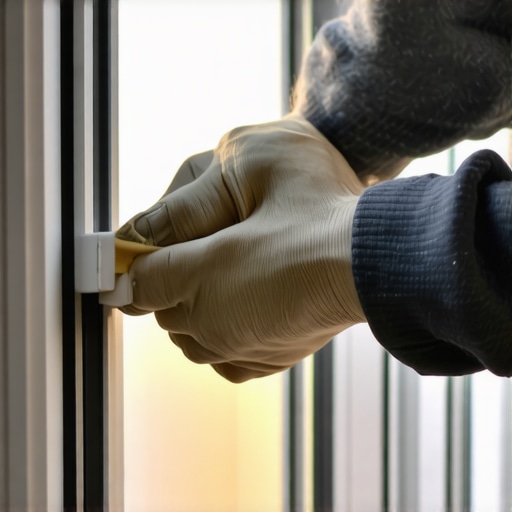
First, you must identify the gap. Close the window and lock it. A locked window pulls the sashes together, which is your first line of defense. If you still feel air, use a lit incense stick or a thin tissue to trace the perimeter of the sash. Where the smoke flickers or the tissue dances, you have an infiltration point. Open the window and clean the glazing bead and the channel thoroughly. Any dust or old window cleaner residue will cause the tape to peel within a week. Measure the gap. You want foam tape that is slightly thicker than the gap so that it is compressed by about 25 to 50 percent when the window is closed. Peel the backing and apply the tape in a continuous strip. Do not leave gaps at the corners; overlap them and trim with a sharp utility knife to ensure a ‘butt joint’ that is airtight. This is the difference between a pro job and a hack job. Once installed, the sash should feel slightly snugger when closing. That resistance is the sound of energy savings.
When to Stop Repairing and Start Replacing
I am the first person to tell someone to save their money, but there comes a point where foam tape is just a bandage on a gunshot wound. If your muntins are rotting, if the sill pan is holding standing water, or if the weep holes are completely bypasses by structural sagging, it is time to replace windows. Modern windows offer argon or krypton gas fills and multi-layer Low-E coatings that a simple repair cannot replicate. However, for a window that is structurally sound but simply ‘loose’ in its frame, the $5 foam tape fix is a master-level secret that keeps the heat in and the money in your pocket.