Detecting Thermal Infiltration: Beyond the Visual Inspection
In twenty-five years of glazing, I have seen it all: from magnificent curtain walls in skyscrapers to crumbling wood sashes in century-old farmhouses. One thing never changes: a window is a hole in your thermal envelope that requires precise management. Most homeowners think a draft is just a nuisance, but to a master glazier, it is a symptom of a failing system. Whether you are considering a full window repair or looking to replace windows entirely, you must first understand where your heat is escaping. The simplest way to do this is not with an expensive infrared camera, but with a humble matchstick.
“Installation is just as critical as the window performance itself. A high-performance window installed poorly will fail.” AAMA Installation Masters Guide
I recall a specific job in a freezing Chicago suburb where a homeowner was convinced their two-year-old double-pane units were defective. They complained of a constant chill in the living room. I walked in, not with a toolbox, but with a hygrometer and a simple match. Within minutes, I showed them that their indoor humidity was spiking at 65 percent, and the ‘drafts’ they felt were actually convective loops caused by the massive temperature differential between their humid air and the glass surface. It was not a window failure; it was a ventilation crisis. However, more often than not, that flickering flame reveals a literal breach in the rough opening or a failed glazing bead.
The Matchstick Diagnostic: A Step-by-Step Protocol
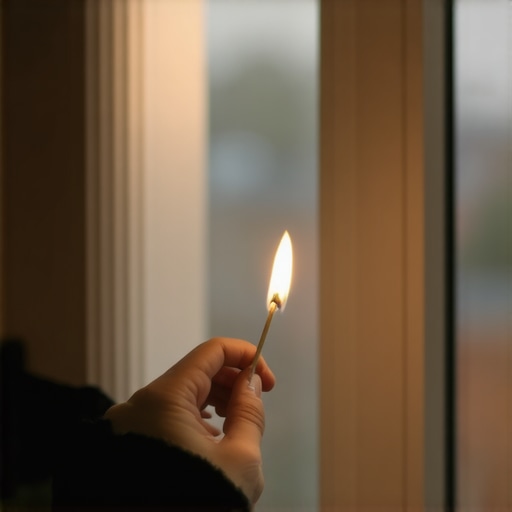
To perform the 30-second matchstick test, wait for a windy day or a significant temperature difference between the interior and exterior. Close all doors and turn off any forced-air heating or cooling systems to ensure the air inside is still. Light a match or a small stick of incense and hold it near the corners of the window sash. Watch the smoke or the flame intently. If the flame dances or the smoke dissipates horizontally, you have identified air infiltration. Focus specifically on the meeting rail where the two sashes overlap, and the bottom corners where the sash meets the sill. This is where most seals fail due to improper shim placement during the original installation.
Technical Anatomy of a Draft
Why do these drafts occur? In cold climates, the enemy is convective heat loss. When the air near a window cools, it becomes denser and sinks, creating a localized draft even if the window is technically airtight. This is why we prioritize the U-Factor. The U-Factor measures the rate of heat transfer; a lower number means the window is a better insulator. If the matchstick test shows air movement at the perimeter, the problem is likely the interface between the window frame and the rough opening. If the air is coming through the operable parts, your weatherstripping has likely compressed or lost its elasticity.
When we talk about high-performance glazing, we are discussing the physics of Low-E coatings. In northern regions, we typically want a Low-E coating on Surface #3. This allows the sun’s short-wave infrared energy to enter the home but reflects the long-wave infrared radiation (your furnace’s heat) back into the room. If your matchstick test reveals a draft at the glass edge, your warm-edge spacer may have failed, leading to a loss of the argon gas fill. Argon is denser than air and significantly slows down the convective currents between the panes of glass.
The Role of the Installer and Maintenance
Many homeowners call a window cleaner when they see streaks, only to find that the ‘dirt’ is actually permanent etching from condensation or a broken seal. A professional window cleaner often sees the first signs of frame rot or failing caulk long before the homeowner does. If the matchstick test confirms a draft, the next step is determining the remedy. A simple window repair might involve replacing the bulb seal or the wool pile weatherstripping. However, if the air is whistling through the frame itself, it suggests the installer failed to use proper flashing tape or omitted the crucial backer rod and sealant bead during the rough-in.
“Standard Practice for Installation of Exterior Windows, Doors and Skylights requires a continuous air barrier and proper water shedding through the shingle principle.” ASTM E2112
Materials Matter: Vinyl vs. Fiberglass vs. Wood
If the matchstick test reveals that your sashes are warped, the material science of your frames is likely the culprit. Vinyl windows are affordable and common, but they have a high coefficient of thermal expansion. In extreme cold, vinyl shrinks, potentially pulling away from the weatherstripping and creating the very drafts you are testing for. Fiberglass, on the other hand, is composed of glass fibers and resin, meaning it expands and contracts at nearly the same rate as the glass panes themselves. This stability maintains the integrity of the seals for decades. Wood remains the gold standard for thermal resistance, but only if it is maintained with religious fervor to prevent the rot that I have seen eat through many a structural header.
Strategic Remediation: Repair or Replace?
Do not be fooled by high-pressure sales tactics claiming that triple-pane glass is always the answer. In many moderate climates, the return on investment for triple-pane over high-quality double-pane with a low U-Factor can be decades. Instead, focus on the ‘Install.’ A pocket replacement, where the new window is slipped into the existing wood frame, is faster but often leaves the original, uninsulated weight pockets intact. A full-frame replacement involves stripping the opening down to the studs, allowing for new insulation, proper sill pans, and modern flashing tape. This is the only way to truly guarantee the matchstick stays still. In the end, the comfort of your home depends on more than just the glass; it depends on the technical precision of every shim, seal, and bead of caulk used to bridge the gap between your living space and the elements outside.