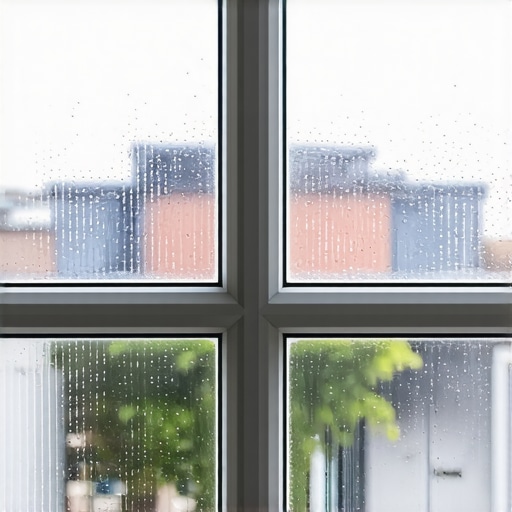
The Ghost in the Glass: Why Your View is Clouded
You notice it on a crisp autumn morning. You grab your favorite bottle of window cleaner and a microfiber cloth, ready to restore the clarity of your view, but the smudge won’t budge. You wipe the inside, then you walk outside to wipe the exterior, but the milky haze remains mocking you from the center. This is the visual obituary of an Insulated Glass Unit (IGU). As a glazier who has spent twenty five years in the trenches, from hanging off skyscrapers to shimming historic sash replacements, I can tell you that fog between the panes is not a cleaning issue. It is a fundamental failure of the window’s pressurized ecosystem. A window is not just a piece of glass; it is a sophisticated thermal barrier that has finally succumbed to the laws of thermodynamics.
The Condensation Crisis: A Reality Check
A homeowner called me in a panic because their new windows were ‘sweating.’ I walked in with my hygrometer and showed them the humidity was 60 percent. It was not the windows; it was their lifestyle, specifically their lack of a bathroom vent fan and a love for boiling pasta without a lid. However, when that moisture moves from the surface of the glass into the internal airspace, the conversation shifts from interior humidity management to mechanical seal failure. When you see fog between the panes, the hermetic seal has breached. The inert gas, usually Argon, has escaped, and the outside atmosphere, carrying moisture and dust, has moved in to take its place.
The Anatomy of an Insulated Glass Unit (IGU)
To understand why your windows are failing, you have to understand the Glazing Zooming of the IGU. An IGU consists of two or more lites of glass separated by a spacer bar. This spacer is not just a piece of metal or plastic; it contains a molecular sieve, or desiccant. These are tiny zeolite beads designed to absorb any residual moisture trapped during the manufacturing process. The perimeter of this unit is sealed with a primary seal of Polyisobutylene (PIB) and a secondary structural seal, often made of silicone or polysulfide. This dual seal system is designed to handle the ‘solar pumping’ effect. During the day, the sun heats the gas between the panes, causing it to expand and bow the glass outward. At night, the gas cools and contracts. This constant movement puts immense stress on the sealant. Eventually, a microscopic fissure develops. Once that happens, the desiccant beads begin to work overtime, absorbing the incoming moist air. They can only hold so much. Once they reach their saturation point, the moisture has nowhere to go but onto the glass surface as condensation.
“The durability of the perimeter seal of an insulating glass unit is the primary factor in the unit’s service life. Without a functioning seal, the thermal performance of the fenestration product is effectively neutralized.” – AAMA Installation Masters Guide
Climate Logic: The Cold Front Attack
In colder climates like Minneapolis or Chicago, the enemy is Heat Loss. In these regions, we focus heavily on the U-Factor, which measures the rate of heat transfer. A lower U-Factor means the window is better at keeping heat inside. When an IGU fails in the North, the fogging is often more severe because the temperature differential between the warm interior and the freezing exterior is extreme. To prevent this, modern high performance windows use ‘warm-edge’ spacers made of foam or composite materials rather than aluminum. Aluminum is a conductor; it pulls heat away from the edge of the glass, creating a cold spot where condensation is most likely to start. In the North, we typically want a Low-E coating on Surface 3 to reflect radiant heat back into the room. When that seal fails, you lose that thermal benefit, and your furnace starts working 15 percent harder to compensate for the ‘cold hole’ in your wall.
Window Repair vs. Replace Windows: The Brutal Truth
When clients ask about window repair for fogged glass, they are usually hoping for a miracle spray. There are companies that claim to ‘de-fog’ windows by drilling tiny holes and injecting a drying agent. As a master glazier, I find this practice to be a temporary bandage on a sucking chest wound. It does not restore the Argon gas, and it does not fix the breached seal. The moisture will return. Your real options are limited to two paths: IGU replacement or full window replacement. If the frames (the sash and the main frame) are in good condition, a skilled glazier can pop the glazing bead, remove the failed glass unit, and drop in a new, factory sealed IGU. This is cost effective and maintains the original look of the house. However, if the frame is a cheap vinyl that has warped or a wood frame that has developed rot in the rough opening, it is time to replace windows entirely. If you see the sash sagging or if you can feel a draft through the shim space, don’t throw good glass into a bad frame.
“Condensation resistance ratings are a guide to how well a window resists moisture formation on the interior surface, but internal fogging indicates a breach of the hermetic seal that cannot be reversed by surface cleaning.” – NFRC 500 Performance Standard
Technical Specifications: What to Look For
When you are shopping for replacements, stop looking at the stickers and start looking at the NFRC label. You need to understand three numbers: U-Factor, SHGC (Solar Heat Gain Coefficient), and VT (Visible Transmittance). If you are in a heating-dominated climate, you want that U-Factor below 0.27. Look for triple-pane units with a Krypton or Argon fill. Ensure the spacer is a non-metal, warm-edge design. Also, check the glazing bead. Is it easy to remove for future glass swaps, or is the unit ‘glazed in’ with permanent adhesive? A window should be a serviceable part of your home, not a disposable one. Don’t be swayed by high pressure sales tactics regarding ‘miracle glass.’ All glass follows the same laws of physics. The quality lies in the execution of the seal and the precision of the installation within the rough opening. A high performance window installed without proper flashing tape and a sloped sill pan is just a very expensive way to rot your house out from the inside. Water management is a science, not an afterthought. If your installer relies solely on a bead of caulk to keep the water out, tell them to get off your property. A ‘caulk-and-walk’ job is the leading cause of premature IGU failure because standing water at the base of the glass will eventually eat through even the best secondary silicone seal.