The Anatomy of Friction: Why Your Sliding Door is Failing
In the world of high-performance fenestration, the sliding glass door is a mechanical marvel that often suffers the most neglect. It is essentially a heavy, operable glass wall that must move with the pressure of a single finger while maintaining a strict thermal envelope. When that door starts to grind, catch, or resist your pull, most homeowners immediately assume they need to replace windows or call a professional for an expensive window repair. However, as a master glazier with a quarter-century in the field, I can tell you that 90 percent of sliding door failures originate at the sill, specifically within the track extrusion where grit and debris congregate. This grit is not just an aesthetic nuisance; it is a mechanical abrasive that slowly destroys the tandem rollers and compromises the air infiltration rating of your home. Before you spend thousands on a full-frame replacement, we need to talk about the physics of the track and the most effective $2 tool in your arsenal: the nylon-bristled toothbrush.
The Condensation Crisis: A Narrative of Neglect
A homeowner in a humid coastal climate once called me in a panic because their new, high-efficiency sliding doors were ‘sweating’ and leaking water into the floorboards. I walked into the room with my hygrometer and found the interior humidity was hovering at a staggering 65 percent. I knelt down at the sill and didn’t see a manufacturing defect; I saw a track choked with sand, pet hair, and salt spray. The debris had blocked the weep holes, preventing the pressure-equalized drainage system from functioning. The water wasn’t leaking from the glass; it was backing up over the interior dam because the door couldn’t sit properly on its track. I showed them how a simple cleaning routine could have prevented a thousand-dollar moisture remediation bill. It was a classic case where the window cleaner was more important than the window installer. The windows weren’t failing; their maintenance lifestyle was. This is why understanding the mechanics of your door is vital.
“Installation is just as critical as the window performance itself. A high-performance window installed poorly will fail, but a well-installed window that is not maintained will fail even faster.” – AAMA Installation Masters Guide
The Physics of the Sill and the $2 Fix
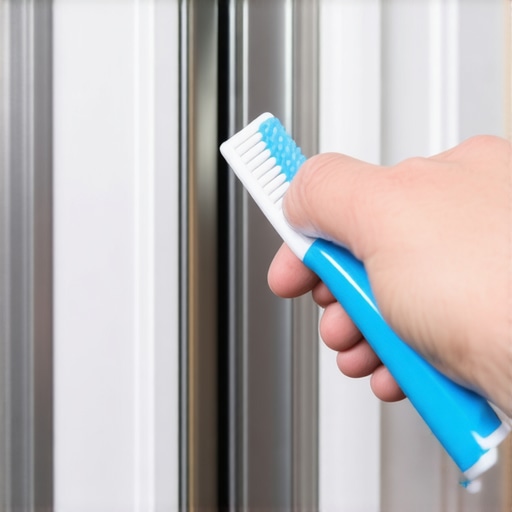
The track of a sliding door is a complex extrusion designed to manage water via the ‘shingle principle,’ where every layer overlaps the one below it to ensure gravity-fed drainage. Within this track, the operable sash sits on tandem rollers—usually stainless steel or nylon wheels—that ride on a raised rail. When dust and grit accumulate, they act like sandpaper. Every time you open the door, you are grinding those particulates into the rollers and the rail. To fix this, you don’t need industrial machinery. You need a standard toothbrush with stiff nylon bristles. Why a toothbrush? Because the geometry of the bristles allows you to reach the ‘glazing bead’ channels and the tight corners of the ‘interlocker’ where a vacuum nozzle or a standard rag cannot penetrate. The process begins by using the toothbrush to agitate the dry debris in the track. You must break the bond between the grit and the metal extrusion before applying any liquid window cleaner. By focusing on the ‘weep hole’ area, you ensure that the secondary drainage system remains clear. If these holes are blocked, the ‘Sill Pan’ will overflow during the next heavy rain, leading to rot in the subfloor.
Thermal Bridging and Air Infiltration
In colder climates, the performance of your sliding door is measured by its U-Factor and its resistance to air infiltration. A gritty track prevents the sash from fully engaging with the weatherstripping. If the door is lifted even one millimeter by a pebble or a buildup of hair, the ‘fin-seal’ or pile weatherstripping cannot create a compression seal. This results in a draft that brings in cold air and raises your energy bills. During my years of inspection, I have seen homeowners complain about the ‘Solar Heat Gain’ or the ‘Dew Point’ on their glass, when the real culprit was simply a dirty track that prevented the door from locking correctly. When the door is not fully seated, the thermal break in the aluminum or vinyl frame is bypassed. This is why meticulous track maintenance is a core component of window repair. You are not just cleaning; you are restoring the engineered tolerances of the rough opening.
“Air leakage through the bottom rail and sill interface often accounts for a significant percentage of total fenestration heat loss, particularly in sliding assemblies where debris interference is present.” – ASTM E2112
Step-by-Step Restoration Protocol
To perform a professional-grade cleaning, start by vacuuming the loose debris. Next, take your toothbrush and scrub the ‘intercostal’ spaces of the track. Pay special attention to the area where the ‘operable’ panel meets the ‘fixed’ panel. Use a mixture of mild soap and water—avoid harsh chemicals that can degrade the ‘glazing bead’ or the ‘muntin’ finishes. Once the track is scrubbed, wipe it down with a microfiber cloth. For lubrication, never use heavy grease or WD-40, which attracts more grit. Instead, apply a thin layer of dry silicone spray to the track. This creates a low-friction surface that allows the ‘sash’ to glide without the ‘tandem rollers’ bearing the brunt of the friction. If you find that the door still grinds after a thorough cleaning, you may need to adjust the ‘shim’ height of the rollers via the adjustment holes usually found at the base of the door. This ensures the door is level within the ‘rough opening’ and prevents the frame from racking.
When Maintenance Isn’t Enough: Knowing When to Replace Windows
While the toothbrush fix solves the majority of sliding door issues, there are times when you must transition from window repair to the decision to replace windows entirely. If the ‘tandem rollers’ have flat-spotted due to years of dragging through grit, cleaning won’t fix the vibration. If the ‘sill pan’ has been breached and the wood ‘rough opening’ is showing signs of fungal decay or ‘rot,’ a simple cleaning is a bandage on a gunshot wound. Furthermore, if your door is an older single-pane unit, no amount of cleaning will fix the ‘Radiant Heat Transfer’ that makes your living room feel like a sauna in July. In these cases, look for a replacement with a low ‘U-Factor’ and a ‘Solar Heat Gain Coefficient’ (SHGC) tailored to your climate. In northern zones, look for Low-E coatings on Surface #3 to reflect heat inward. In the south, you want that coating on Surface #2 to bounce the sun’s energy back outside before it ever enters your home. Proper maintenance with a simple toothbrush can extend the life of these high-tech systems by decades, ensuring that your investment in comfort and efficiency remains intact. Remember, a window is a hole in your wall that is meant to be managed, not just ignored. Respect the mechanics, and the mechanics will protect your home.