The Engineering Behind the Barrier
In my twenty-five years as a master glazier, I have seen more glass ruined by a spray bottle than by a hailstorm. People treat their windows as if they are indestructible sheets of fused sand, but once you introduce aftermarket films or factory-applied tints, you are dealing with a complex multi-layered thermal system. A window is a hole in the envelope of your home that must manage radiant energy, and the tint is your primary defense against Solar Heat Gain. However, if you use the wrong window cleaner, you are not just cleaning; you are initiating a chemical de-bonding process that will lead to bubbling, purple discoloration, and the dreaded edge lift at the glazing bead.
I once sat across from a homeowner who had just spent six thousand dollars on high-performance ceramic window films for his south-facing sunroom. He was furious because the film was clouding and peeling at the corners after only six months. I looked at his utility closet and saw a gallon of industrial-strength ammonia-based cleaner and a stack of coarse paper towels. I had to explain that he had essentially been acid-washing his investment. He was a victim of the common misconception that glass is glass. He did not realize that the scratch-resistant coating on his film was being dissolved by the very chemicals he thought were maintaining it. This is why understanding the chemistry of your window repair and maintenance is as vital as the initial installation.
“Installation is just as critical as the window performance itself. A high-performance window installed poorly will fail.” – AAMA Installation Masters Guide
The Physics of Solar Heat Gain and Tint Longevity
In hot, southern climates where the sun beats down with relentless UV radiation, the Solar Heat Gain Coefficient (SHGC) is the only number that truly matters. We often install Low-E coatings on Surface #2 of an insulated glass unit (IGU) to reflect heat before it even enters the air gap. When you add a tinting film to the interior surface, you are essentially creating a secondary thermal barrier. This film is bonded using a pressure-sensitive adhesive (PSA) that is designed to withstand the expansion and contraction of the glass. Glass has a specific coefficient of thermal expansion; it grows and shrinks as the temperature fluctuates from the cool of the night to the 120-degree radiant heat of a July afternoon. If you use a harsh window cleaner that contains ammonia or vinegar, these chemicals can seep under the edges of the film, especially near the sash or the muntin. The chemical reacts with the adhesive, making it brittle. Once that adhesive loses its elasticity, the mechanical stress of the glass expanding causes the film to separate. This is not a product failure; it is a maintenance failure.
[IMAGE_PLACEHOLDER_1]
NFRC Ratings and the Surface Chemistry of Glass
When we look at a National Fenestration Rating Council (NFRC) label, we see ratings for U-Factor and SHGC. These numbers are calibrated based on the glass being in its intended state. Tinting alters these properties by absorbing or reflecting specific wavelengths of the solar spectrum. Most modern tints are composed of multiple layers: a mounting adhesive, a polyester base, a dye or metallic layer, and a hard coat. The hard coat is an oleophobic or hydrophobic layer designed to resist fingerprints and light abrasions. However, it is not impervious to high pH levels. Using a high-alkaline cleaner is like using a stripper on a hardwood floor. It removes the protective layer, exposing the softer polyester underneath to the atmosphere. Once the polyester is exposed, it begins to oxidize and turn purple. This is why professionals never use a standard blue-dye cleaner on an operable window with a high-performance tint.
“The performance of any fenestration system is dependent upon the integration of the glazing material and the frame under specific environmental loads.” – NFRC Technical Manual
The Technical Protocol for Cleaning Tinted Glass
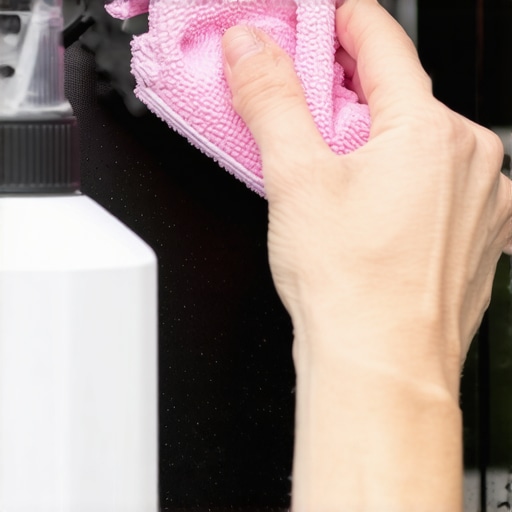
If you want to avoid a total window repair or the need to replace windows prematurely, you must follow a strict cleaning protocol. The goal is to remove particulates without inducing mechanical or chemical stress. First, you must address the rough opening and the tracks to ensure no grit is blown onto the glass during the process. Use a solution of distilled water and a tiny fraction of pH-neutral soap, such as a specialty baby shampoo or a dedicated film-safe window cleaner. Distilled water is critical because it lacks the minerals like calcium and magnesium found in tap water which can create micro-abrasions on the film surface. When you wipe, you should use a high-density microfiber cloth, not a paper towel. Paper towels are made of wood fibers which are abrasive at a microscopic level. You want to apply the solution with a soft spray, let it dwell for thirty seconds to encapsulate the dust, and then wipe in a single direction. Avoid circular motions which can trap grit and create ‘swirl marks’ in the soft coating of the tint.
When Maintenance Becomes a Window Repair Issue
Sometimes, the damage is already done. If you see ‘ghosting’—a milky white appearance under the film—it means moisture has already compromised the adhesive. At this point, no amount of cleaning will fix it. You are looking at a localized window repair where the film must be professionally stripped. This involves using a steamer to soften the adhesive without cracking the glass. You have to be extremely careful with the weep holes in the frame; if you get too much liquid or adhesive residue in them, you block the drainage system of the window, leading to sill pan rot. If the glass itself is damaged or if the seal of the IGU has failed due to thermal stress from an improperly selected tint, you may have to replace windows entirely. This is why I always tell homeowners to consult a glazier before applying aftermarket films to modern, high-efficiency glass. The wrong film can trap too much heat between the panes, causing the spacer to fail and the argon gas to leak out, which effectively kills the window’s R-value.