The Glazier’s Autopsy: Why Your Sliding Door is a Failed System
I pulled a vinyl sliding patio door out of a house in a damp suburban neighborhood last October and the subfloor was completely black with rot. The homeowner thought they just had a sticky door because the house was settling. They were wrong. The previous installer relied on the nailing fin and a prayer instead of a proper sill pan and flashing tape. The water had been wicking under the threshold for eight years, turning the OSB subfloor into a sponge. This is the reality of the ‘caulk-and-walk’ installation culture. A sliding door is not just a piece of glass; it is a heavy, operable piece of machinery that must manage thousands of pounds of structural pressure while maintaining a thermal barrier against the elements. If your door requires two hands and a bracing foot to open, you are not just fighting friction; you are fighting a failed installation or a compromised structural assembly.
The Physics of the Rough Opening and Structural Deflection
To understand why a door fails, we have to look at the rough opening. A standard 6080 (six-foot by eight-foot) sliding door represents a massive hole in your thermal envelope. When that door is installed, the header above it must be sized to carry the load of the roof or the floor above. If the header deflects by even an eighth of an inch, it puts downward pressure on the head jamb. This compresses the sash against the rollers, making it nearly impossible to move. A master glazier looks for this deflection first. We use a laser level to check the head and the sill. If the sill is not perfectly level within a 1/16th-inch tolerance, the entire weight of the insulated glass unit (IGU) shifts to one side of the tandem rollers, causing premature bearing failure. You do not fix this with a window cleaner; you fix it with a structural shim. We use high-density plastic shims because wood shims eventually rot and compress, leading to the same failure you started with.
“Installation is just as critical as the window performance itself. A high-performance window installed poorly will fail.” AAMA Installation Masters Guide
The Anatomy of the One-Finger Slide: Rollers and Tracks
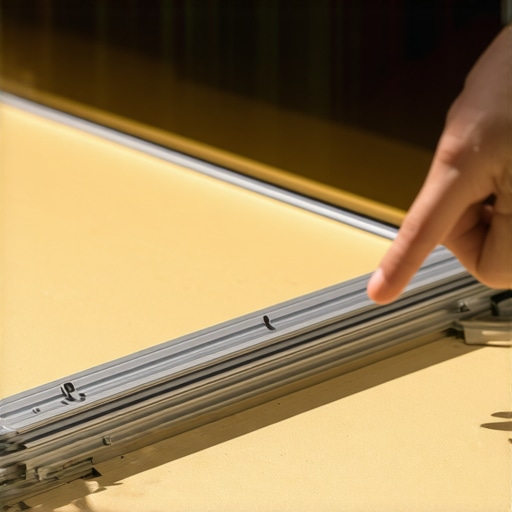
The secret to a door that glides with one finger is the interaction between the stainless steel cap and the tandem roller assembly. Most entry-level sliding doors use nylon rollers on a vinyl track. This is a recipe for failure in three years. Nylon flat-spots under the constant weight of the double-pane glass. Once a roller has a flat spot, it no longer rolls; it slides. This creates friction heat, which scars the vinyl track. Once the track is scarred, the door is effectively dead. To achieve that effortless glide, we specify stainless steel ball-bearing rollers with a precision-machined stainless steel track cap. The rollers should be tandem, meaning two wheels per assembly, to distribute the load of the heavy glass unit across a wider surface area. This reduces the PSI on the track and ensures that the door remains operable even if a small amount of debris enters the weep hole system.
Thermal Logic: The Cold Climate Battle
In northern climates where the January wind screams against the glass, a sliding door is a massive heat sink. The enemy here is heat loss and condensation. Because we are dealing with a large surface area, the U-Factor is the only number that matters. A U-Factor of 0.25 or lower is the target. We achieve this through triple-pane glass units filled with Argon gas. Argon is denser than air and slows the convection currents between the panes. However, the real secret is the Low-E coating. In a cold climate, we want the Low-E coating on Surface #3. This reflects the long-wave infrared radiation—the heat from your furnace—back into the room while allowing the short-wave solar radiation to enter and provide passive solar gain. We also utilize warm-edge spacers made of structural foam or stainless steel. Conventional aluminum spacers are highly conductive; they get cold, which cools the edge of the glass, leading to the dreaded condensation line at the glazing bead. If you see water on your sill every morning, your spacer is failing your home’s hygroscopic balance.
The Installation Autopsy: Water Management and Sill Pans
Water management is a science, not an afterthought. The ‘Shingle Principle’ dictates that every layer of the building envelope must overlap the one below it. This starts with the sill pan. A sill pan is a three-sided flashing element that sits under the door. If water bypasses the primary seals or the weep holes, the sill pan catches it and directs it back to the exterior. Without a sill pan, that water goes straight into your floor joists. When we replace windows or doors, we don’t just caulk the flange. We use a self-adhering flashing tape to integrate the door into the weather-resistive barrier (WRB). This creates a redundant seal. If the primary bead of sealant fails—and it will after seven years of UV exposure—the flashing tape ensures the rough opening remains dry. This is the difference between a window repair that lasts a season and an installation that lasts a generation.
“The building envelope is a system of integrated components. A failure in the fenestration flashing is a failure of the entire wall assembly.” ASTM E2112 Standard Practice
Maintenance: When a Window Cleaner is Not Enough
Many homeowners think a quick spray with a window cleaner is all a door needs. While keeping the glass clean is important for the longevity of the Low-E coatings, the real maintenance happens in the tracks. You must clear the weep holes. These are the small rectangular openings at the bottom of the frame designed to let water escape. If these are clogged with dirt or pet hair, water backs up into the track and eventually spills over into your home. Never use WD-40 or any petroleum-based lubricant on your tracks. Petroleum attracts dust, creating a grinding paste that destroys the rollers. Instead, use a dry silicone spray. It provides the lubrication needed for the rollers to spin freely without attracting the grit that causes premature wear. If the door still sticks, it’s time to look at the adjustment screws. Most sliding doors have an access hole at the bottom of the sash. Turning this screw raises or lowers the rollers, allowing you to square the door within the frame. If you have to raise the rollers to their maximum height to get the door to latch, your header is likely sagging, and you need a professional to assess the structural integrity of the opening.
Is it Time to Replace Windows and Doors?
There comes a point where window repair is no longer viable. If you have seal failure—manifesting as a permanent fog between the glass panes—your Argon gas has escaped and your desiccants are saturated. The thermal performance of the unit has plummeted. Replacing the glass unit (an IGU swap) is an option, but if the frame is vinyl and has begun to warp from heat expansion and contraction, a full-frame replacement is the only way to restore the thermal envelope. When you choose to replace windows, look for fiberglass frames. Fiberglass has the same thermal expansion coefficient as glass, meaning the frame and the glass move together. This maintains the integrity of the seals and ensures the door remains operable through forty-degree temperature swings. It is the gold standard for large-span sliding systems.