The Microscopic Reality of Commercial Glazing
To the untrained eye, a sheet of commercial glass is a smooth, impenetrable barrier. As a master glazier with over a quarter-century in the field, I can tell you that is a dangerous misconception. On a molecular level, glass is more like a sponge than a diamond. It is porous and chemically active. When we discuss how to clean commercial glass without leaving water spots, we are actually discussing a battle against physics and chemistry. Water spots are not just ‘dirt’; they are often mineral deposits like calcium carbonate and magnesium that have bonded to the microscopic valleys of the glass surface. If left untreated, these minerals can undergo a process called ion exchange with the glass itself, leading to permanent etching that no window cleaner can simply wipe away.
A few years ago, I was called to a high-rise office complex because the facility manager was convinced their new high-performance units were defective. ‘The glass is sweating and staining,’ he insisted. I arrived with my hygrometer and a high-powered jeweler’s loupe. I discovered the humidity levels inside the lobby were nearly 65 percent due to an overactive decorative fountain. The ‘sweating’ was actually interior condensation that was trapping airborne particulates. The homeowners or building managers often blame the glass, but the reality is usually found in the environment. I had to explain that it wasn’t the windows; it was the lifestyle of the building. This condensation crisis is a prime example of why understanding the dew point is as critical as knowing how to handle a squeegee. If you clean glass when the surface temperature is below the dew point, you are fighting a losing battle against immediate re-fogging and subsequent spotting.
“Installation is just as critical as the window performance itself. A high-performance window installed poorly will fail.” – AAMA Installation Masters Guide
The Glass Class: Thermal Performance and Its Impact on Cleaning
In our industry, we focus heavily on the NFRC label, specifically the U-Factor and the Solar Heat Gain Coefficient (SHGC). In northern climates where heat loss is the primary enemy, we prioritize a low U-Factor. This often involves triple-pane units with an Argon or Krypton gas fill and a Low-E coating on Surface #3. Why does this matter for cleaning? A window that effectively reflects heat back into the room stays colder on the exterior pane. When you apply a cleaning solution to a cold pane in humid conditions, the evaporation rate slows down significantly, increasing the window for ‘runs’ and ‘bleeds’ from the glazing bead. Conversely, in southern climates where the Low-E coating is on Surface #2 to reflect solar radiation away, the glass can become incredibly hot. Cleaning a hot window causes the solution to flash off instantly, leaving behind a jagged map of mineral streaks before you can even move your squeegee. Knowing the thermal orientation of your glass is the first step in achieving a spot-free finish.
The Chemistry of Water and Total Dissolved Solids (TDS)
If you are using tap water to clean commercial windows, you are already failing. Tap water is loaded with minerals. Professionals use the ‘Pure Water’ method, which involves deionization or reverse osmosis to bring the TDS count to zero. When water is truly pure, it becomes a hungry solvent. It aggressively attracts dirt and lifts it from the glass. Because there are no minerals left in the water, when the H2O evaporates, there is literally nothing left behind to form a spot. This is the gold standard for high-reach commercial work where hand-drying every inch is impossible. However, for storefronts where you are working by hand, the technique must be surgical. You must manage the rough opening of your strokes. I always start with a ‘cut-in,’ a thin strip of dry glass at the top and side of the frame. This prevents the solution from hiding under the sash or muntin and dripping down later to ruin your work.
“Surface temperatures of the glass play a pivotal role in the evaporation rate of cleaning solutions, which directly affects the formation of residue.” – NFRC Fenestration Guide
Mechanical Maintenance: Beyond the Squeegee
Sometimes, a water spot is a symptom of a larger mechanical failure. If you see spots that look like they are ‘inside’ the glass, you are likely dealing with a failed IGU (Insulated Glass Unit) seal. When the seal fails, the desiccant inside the spacer bar becomes saturated, and moisture begins to condense between the panes. At this point, no amount of scrubbing will help; you are looking at window repair or, more likely, a full glass replacement. During a window repair, we often inspect the weep holes in the frame. These are critical channels designed to allow water to exit the sill pan. If these holes are clogged with debris or over-caulked by a ‘caulk-and-walk’ installer, water will back up and seep into the building envelope. This moisture often migrates to the glass surface, creating persistent spotting issues that no cleaner can solve permanently.
The Proper Tooling for Professional Results
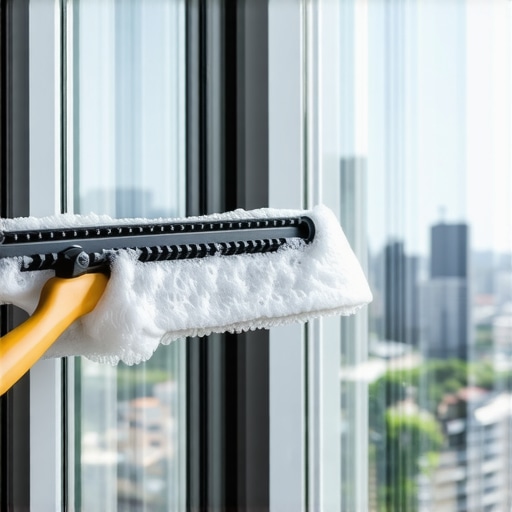
Throw away the paper towels. Professional commercial glass maintenance requires brass or stainless steel squeegee channels and high-grade rubber blades. The blade must be inspected for nicks; even a microscopic tear in the rubber will leave a line of water. When working around the glazing bead, use a surgical grade microfiber cloth to detail the edges. Unlike cotton, microfiber actually grabs the mineral deposits rather than just pushing them around. If you are dealing with heavy mineral buildup from irrigation overspray, you may need to use a mild phosphoric acid solution or a mechanical cerium oxide polish. This is a delicate operation. If you scratch the glass during this process, the structural integrity can be compromised, and the ‘fines’ of the scratch will attract even more dirt in the future. In extreme cases, where the glass has become ‘white-washed’ from years of neglect, it is often more cost-effective to replace windows with modern, high-efficiency units than to attempt a chemical restoration.
Structural Integrity and Water Management
When we install a commercial window, we aren’t just putting glass in a hole. We are managing a complex system of shims, flashing tape, and sealants. If the rough opening wasn’t prepared with a proper sill pan, the glass will eventually sit in standing water. This moisture wicks up into the glazing pocket and creates a high-humidity microclimate right against the glass. This is why you often see spotting and mold growth only at the bottom six inches of a commercial pane. It is a failure of the drainage system, not the cleaning method. A master glazier knows that the best way to keep glass clean is to ensure the building is shedding water correctly. This is why I have a zero-tolerance policy for installers who skip the flashing tape or use low-quality shims that rot over time. Proper installation ensures that the glass remains accessible and maintainable for the life of the building.