The Mechanical Reality of the Commercial Sash
In my twenty-five years of swinging a glazing hammer and setting curtain wall sections, I have seen thousands of perfectly good commercial windows sent to the scrap heap prematurely. Facility managers often mistake a seized hinge or a grinding sash for a structural failure. They see a window that will not close and they immediately think about the cost to replace windows. But more often than not, the issue is not the frame or the glass. It is a total failure of mechanical maintenance. A window is a complex machine that manages the thermal bridge between a controlled interior environment and the chaos of the outdoors. When the hardware fails, the thermal envelope fails. I remember sitting across from a regional manager for a retail chain who was convinced he needed a three-million-dollar capital expenditure for new glazing across twelve properties. He had been listening to a sales rep who told him his old aluminum frames were shot. I took out a simple stiff brush and a can of high-grade dry film lubricant, cleaned the grit out of one 4-bar hinge, and showed him that the window moved with the touch of a single finger. I had to explain to him that the ROI on a full replacement would have been decades, while a maintenance program would cost pennies on the dollar.
“Installation and subsequent maintenance of hardware components are critical to the long-term air and water penetration resistance of the fenestration assembly.” – AAMA Installation Masters Guide
The Physics of Friction in High-Traffic Glazing
To understand why lubrication is vital, we must perform a technical autopsy on the commercial hinge. Most commercial operable units utilize 4-bar hinges made of 300-series stainless steel. While stainless is resistant to the oxidation that plagues galvanized steel, it is highly susceptible to a phenomenon known as galling. When two sliding surfaces of stainless steel rub together under the weight of a heavy double-pane insulated glass unit (IGU), the friction generates localized heat. This can cause the metal fibers to tear and actually weld themselves together at a microscopic level. This is why you hear that high-pitched squeal when opening a neglected vent. This is not just a noise; it is the sound of the hardware destroying itself. In a cold climate like Chicago or Toronto, this is exacerbated by the contraction of the metal and the thickening of old, petroleum-based greases. When the hinge binds, the operator tries to force the window shut. This puts immense torque on the sash, often pulling it out of square. Once that sash is warped, no amount of window repair will fix the air leak. You have effectively compromised the U-factor of the entire opening because the weatherstripping no longer makes a compression seal. This is where the dew point becomes a nightmare, as warm interior air hits the cold glass and hardware, leading to condensation and eventual mold in the rough opening.
The Lubricant Selection: Why WD-40 is the Enemy
If you want to earn a permanent ban from my job site, let me catch you spraying a standard multi-purpose penetrant like WD-40 into a window track. These products are solvents, not long-term lubricants. They are designed to displace water and break rust, but they leave behind a thin, oily residue that acts as a magnet for urban pollutants. In a commercial setting, you have constant exposure to brake dust, pollen, and soot. These particles mix with the oily residue to create a grinding paste that accelerates the wear on the glazing bead and the hinge pivots. For longevity, we use dry film lubricants, typically PTFE (Polytetrafluoroethylene) or high-quality silicone. PTFE is the gold standard because it goes on wet to penetrate the tight tolerances of the hinge pins and then dries into a non-tacky, low-friction coating. It does not attract dirt, and it remains stable in extreme temperatures, whether it is the radiant heat of a Texas summer or the sub-zero wind of a Minneapolis winter. When you apply this, you must first ensure the weep hole is clear. If the sill pan is holding water because the weep holes are clogged with debris, your hardware is essentially sitting in a corrosive bath, which no lubricant can fully protect against.
“The performance of a window system is dependent upon the proper functioning of all components, including fasteners and hinges, which must be maintained to withstand design wind pressures.” – ASTM E2112 Standard Practice
The Anatomy of a Maintenance Routine
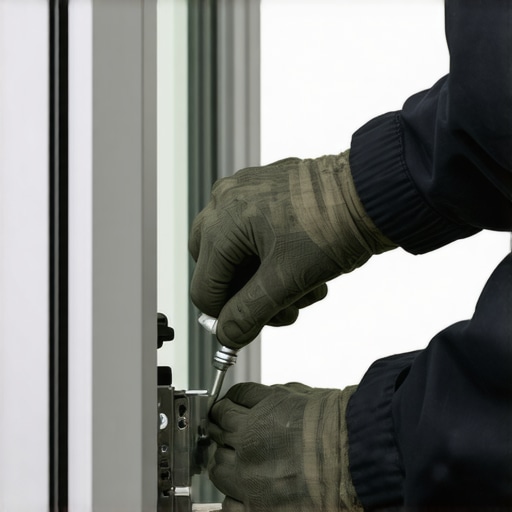
Every professional window cleaner should be trained to spot the early warning signs of hardware fatigue. A window cleaner is often the only person who sees the exterior side of the sash regularly. They should look for metal shavings in the track, which indicates the hinges are grinding. The process of lubrication must be methodical. First, the 4-bar hinge or butt hinge must be cleaned with compressed air or a soft brush to remove particulates. Second, the lubricant should be applied to all pivot points and sliding tracks. This is where the trade cant becomes important. You aren’t just spraying the metal; you are targeting the friction points where the sash attaches to the frame. After application, the window must be cycled at least five to ten times to ensure the lubricant is distributed through the entire range of motion. This is especially critical for heavy top-hung vents where the weight of the glass puts massive pressure on the upper pivots. If you find that the window still resists movement, you may need to check the shim spacing. If the rough opening has shifted and the frame is pinched, no amount of PTFE will solve the problem. In those cases, you are looking at a more intensive window repair or even the need to replace windows if the frame distortion has reached a point of no return. By maintaining the hardware, you ensure that the Low-E coating on Surface #2 or #3 can actually do its job by keeping the window tight against the gaskets, maintaining the thermal break and preventing energy loss. Don’t buy into the hype of the high-pressure salesman; buy into a rigorous maintenance schedule. A well-lubricated hinge is the difference between a window that lasts forty years and one that fails in five.