The Master Glazier Perspective on Lateral Movement
In my twenty-five years of handling everything from monolithic plate glass to high-performance thermally broken assemblies, I have learned one immutable truth: a sliding glass door is only as good as its vertical alignment. When a homeowner complains about a wobbly door, they often assume the glass is loose or the frame is failing. More often than not, the issue lies in the relationship between the Sash and the track system. This instability is not just a nuisance; it is a thermal liability. A door that rattles is a door that leaks conditioned air. In cold northern climates, this lack of stability leads to significant heat loss as the U-Factor of the entire unit is compromised by air infiltration at the interlocker. If you are noticing a draft, do not just reach for a window cleaner to clear the grime; you need to look at the mechanical tolerances of your rollers.
The Condensation Crisis: A Narrative of Misalignment
A homeowner called me in a panic because their new patio doors were ‘sweating’ and shaking every time the wind picked up. I walked in with my hygrometer and a digital caliper. I showed them that the relative humidity in the room was sixty percent, but the real culprit was the alignment. The door was sitting too low in the track, preventing the weatherstripping from engaging with the header. This caused the interior surface temperature of the glass to drop below the dew point, leading to heavy condensation. It was not a product failure; it was an installation and adjustment failure. By simply recalibrating the tandem rollers, we stabilized the door and eliminated the ‘sweating’ by restoring the thermal break. This is why window repair often starts with physics rather than replacement parts.
“Installation is just as critical as the window performance itself. A high-performance window installed poorly will fail.” AAMA Installation Masters Guide
The Mechanics of the Roller Adjustment
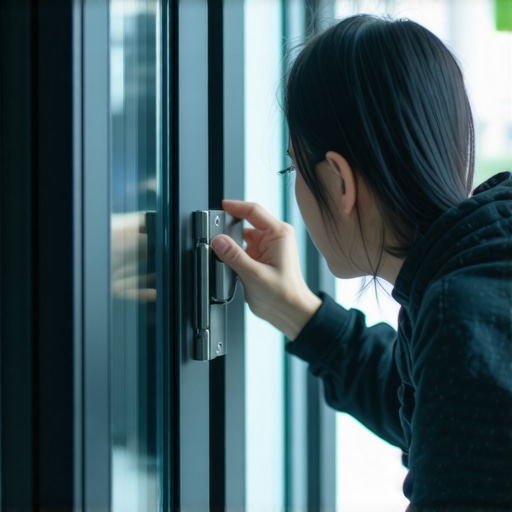
The secret to stabilizing a wobbly door usually hides behind a small plastic cap at the bottom of the door Sash. Inside this access hole is an adjustment screw that controls the height of the rollers. Using a Phillips head screwdriver, you can raise or lower each side of the door. The goal is to ensure the door is perfectly plumb. If the door is leaning, it will not seat properly in the side jamb, leading to a rattle. You must adjust the rollers so that the gap between the door and the jamb is uniform from top to bottom. This ensures the Glazing Bead remains under consistent pressure and the Weep Hole system in the Sill Pan can function without being obstructed by a sagging frame.
Analyzing the Rough Opening and Frame Integrity
Sometimes the wobble is not the rollers but the Rough Opening itself. If the house has settled, the header may be bowing downward, putting pressure on the top of the door. This is where we look at the Shim placement. A properly installed door uses shims to maintain a square frame regardless of how the house moves. If the installers ‘caulked and walked’ without proper shimming, the frame can flex, causing the door to vibrate within the track. In these cases, a simple adjustment won’t suffice, and you may need to replace windows or doors to correct the structural deficiency. [image_placeholder_1]
“The primary goal of a window or door installation is to provide a continuous seal between the window frame and the rough opening to prevent air and water leakage.” ASTM E2112 Standard Practice
The Physics of Heat Loss in Cold Climates
In regions like Minneapolis or Chicago, a wobbly door is a direct threat to your heating bill. When the door is not stabilized, the air seals are not compressed. We focus on the U-Factor, which measures the rate of heat transfer. A loose door allows for convective heat loss, where warm air escapes through the gaps at the top and bottom. By stabilizing the door, you ensure that the Low-E coating on Surface 3 can do its job of reflecting heat back into the room. If the door remains unstable, even the best triple-pane glass will underperform because the air bypasses the glass entirely. This is why technical precision in window repair is more valuable than expensive upgrades.
Maintenance Beyond the Adjustment
Once the door is stabilized, maintenance is key. Do not use an abrasive window cleaner on the track; instead, use a vacuum to remove silica dust and grit that can grind down the nylon rollers. Lubricate the track with a dry silicone spray. Wet lubricants attract dirt, which creates a grinding paste that will eventually cause the door to wobble again. Check the Muntin bars and the Flashing Tape around the exterior to ensure no moisture is penetrating the envelope. Water ingress can rot the subfloor, leading to a soft spot under the Sill Pan, which is a common cause of door instability. If you find significant rot, it is time to replace windows and doors before the structural damage spreads.