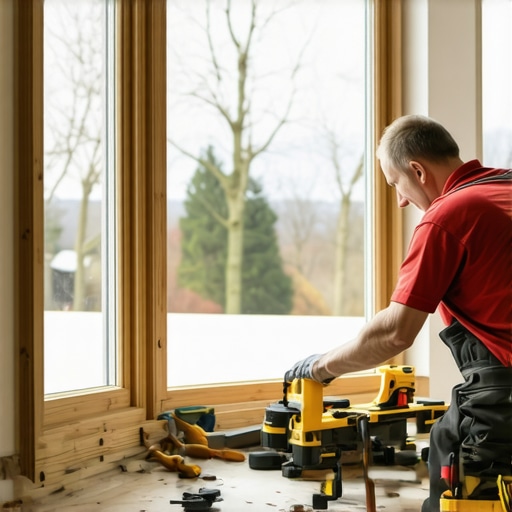
The Physics of the Bow: Why Your Window Frame is Failing
When you see a window frame bowing in the middle, you are not just looking at a cosmetic flaw. You are witnessing a structural failure that compromises the entire thermal envelope of your home. As someone who has spent over two decades in the glazing trade, I have seen every iteration of this problem. A bowing frame usually indicates one of three things: extreme thermal expansion, structural loading from a failing header, or improper shimming during the initial installation. If the head jamb is dipping or the side jambs are curving inward, your window is no longer a barrier; it is a liability. You might find that the sash no longer slides smoothly or that your window cleaner is reporting gaps where the glazing bead meets the frame. These are the early warning signs of a system in distress.
“Installation is just as critical as the window performance itself. A high-performance window installed poorly will fail.” AAMA Installation Masters Guide
I remember a specific case where I pulled a vinyl window out of a house in Charlotte and the header was completely black with rot. The homeowner thought they just needed a simple window repair because the top of the frame was sagging. Why did it happen? The previous installer relied solely on the nailing fin for support instead of using proper flashing tape and structural shims. Water had been wicking behind the flange for five years, rotting the wood header until it started to crush the window frame. This is why we don’t just ‘caulk and walk.’ We look at the Rough Opening and the load-bearing components before we even think about the glass.
Thermal Expansion and the Material Science of Frames
In hot climates, the Solar Heat Gain Coefficient (SHGC) is not just a number on an NFRC sticker; it is a survival metric for your window. If you have dark-colored vinyl frames in a southern-facing wall, you are dealing with a high coefficient of linear thermal expansion. Vinyl is essentially a plastic that wants to move. When the sun beats down on a black or bronze vinyl frame, the material reaches temperatures that can exceed 160 degrees Fahrenheit. If the installer did not leave enough tolerance in the Rough Opening, the frame has nowhere to go but inward, causing that dreaded bow. This is why for high-heat environments, I often recommend that clients replace windows with fiberglass or thermally broken aluminum. Fiberglass is made of pultruded glass fibers and resins that expand and contract at nearly the same rate as the glass itself, maintaining the integrity of the seal even in the peak of July.
The Structural Autopsy: Identifying the Root Cause
Before you attempt a window repair, you must diagnose the ‘why.’ If the bowing is at the top (the head jamb), the issue is likely the house’s structure. The header is the horizontal beam that spans the opening above the window. If that header is undersized or rotting, it will sag and put direct pressure on the window frame. A window frame is not designed to be load-bearing. If the bowing is on the sides (the side jambs), the installer likely over-tightened the installation screws or used too much expanding spray foam. Low-expansion foam is a must in this trade; high-expansion foam can exert enough pressure to bend a reinforced vinyl frame by a quarter-inch, which is more than enough to bind the sash and ruin the weatherstripping contact.
“The water resistive barrier must be integrated with the window flashing in a shingle-like fashion to ensure gravity-fed drainage to the exterior.” ASTM E2112 Standard Practice
The Step-by-Step Fix for a Bowed Frame
Fixing a bowing frame requires more than a hammer and a prayer. First, you must remove the interior casing (the wood trim) to expose the Rough Opening and the shims. Using a long level or a plumb bob, identify exactly where the frame is deviating from a straight line. If the frame is bowing because of over-shimming, you can carefully back out the installation screws and shave down the shims. However, if the frame is bowed due to thermal warping, you may need to use a ‘jamb jack’ or a structural screw to pull the frame back toward the stud. You must be extremely careful not to crack the glazing bead or the weld points of the frame. If the bow has caused the insulated glass unit to lose its seal, you will see fogging between the panes. At that point, a simple repair is off the table and you must replace the glass or the entire unit.
The Role of Water Management and Sill Pans
Every glazier knows that water is the enemy. When a frame bows, the first thing to fail is the flashing system. If the frame pulls away from the exterior siding, the flashing tape can tear, allowing water to penetrate the wall cavity. This is why a Sill Pan is non-negotiable. A sill pan is a flashing component that sits at the bottom of the rough opening, sloped toward the exterior. Even if the window leaks or the frame bows, the sill pan catches the water and directs it back outside through weep holes. If I open a wall and don’t see a sill pan, I know the window repair is going to be extensive. We often find that a bowing frame has allowed water to pool on the interior sill, leading to mold growth that stays hidden behind the drywall for years.
When to Repair vs. When to Replace Windows
Homeowners often ask me if they can just ‘straighten’ a window. If the frame is wood and has warped due to moisture, it is rarely fixable. Wood has a memory, and once the fibers have shifted, they tend to stay there. If the frame is vinyl and the bow is less than 1/8 of an inch, we can usually adjust the hardware and the shims to compensate. But if the structural integrity of the frame is compromised, or if the bowing has caused the muntins to pop out or the sash to stop functioning, it is time to replace windows entirely. Modern fiberglass units offer a much thinner profile with higher strength, which often prevents bowing altogether. Furthermore, a new installation allows us to fix the underlying issues like a sagging header or improper flashing that caused the first window to fail. Don’t let a high-pressure salesman convince you that triple-pane krypton-filled glass is the only solution; sometimes a well-installed double-pane unit with a low U-factor and a proper SHGC for your climate is the smarter investment.
Maintenance and the Window Cleaner’s Perspective
Routine maintenance is where you catch these issues before they require a total tear-out. A professional window cleaner does more than just wipe away dirt; they are the first line of defense. When they are cleaning the tracks and the operable parts of the window, they can feel if the sash is dragging. They can see if the weep holes are clogged with debris. If the weep holes are blocked, water backs up into the frame, increasing the weight and the thermal stress on the bottom rail, which can contribute to bowing. Keeping your windows clean and the tracks lubricated with dry silicone spray will reduce the physical stress on the frame every time you open and close it. If the frame is already bowing, stop forcing the window open, as you risk shattering the glass due to the uneven pressure on the glazing bead.