The Mechanical Anatomy of a Failing Threshold
That piercing, metal-on-metal scream that echoes through your house every time you try to step onto the patio isn’t just an annoyance. It is the sound of structural friction, a warning that the mechanical systems of your home’s largest operable aperture are in a state of advanced degradation. As a glazier with over two decades in the field, I can tell you that a screeching door is rarely just about a dirty track. It is a symptom of a larger failure in the rough opening, the roller assembly, or the track’s extrusion profile.
I remember a specific job in a coastal subdivision where the homeowner complained of a ‘sticky’ door. I pulled that sliding unit out and found the header was completely black with rot. Why? The previous installer relied on the nailing fin instead of proper flashing tape and a dedicated sill pan. The water had been wicking behind the frame for years, causing the wood to swell and put downward pressure on the door frame. That ‘screech’ wasn’t just friction; it was the entire weight of the house’s wall plate crushing the rollers into the aluminum track. This is what happens when you hire a ‘caulk-and-walk’ contractor instead of a specialist who understands the Shingle Principle of water management.
The Physics of the Screech: Rollers, Tracks, and Grit
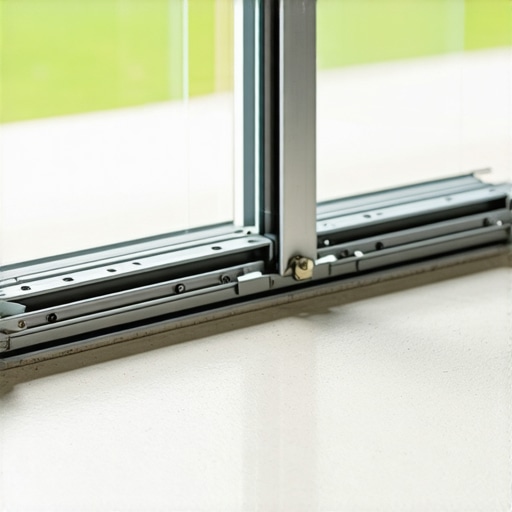
To understand the noise, we have to look at the metallurgy and polymer science of the door’s hardware. Most sliding glass doors operate on a pair of tandem rollers located in the bottom sash. These rollers are typically made of either stainless steel, brass, or a nylon polymer. When a window cleaner or homeowner neglects the track, abrasive particulates—sand, salt, and household dust—accumulate. These particles act as a grinding medium. In a high-humidity or coastal environment, this debris traps moisture against the metal, leading to galvanic corrosion or ‘pitting’ of the track.
Once the track is pitted, the rollers no longer glide; they bounce. This microscopic vibration creates the high-pitched frequency you hear. If you have nylon rollers, the grit eventually carves a flat spot into the wheel. Now, instead of rolling, the wheel slides. This is where the damage becomes permanent. Replacing the rollers is a standard window repair, but if the track itself is scarred, you are looking at a much more invasive procedure. A master glazier doesn’t just swap the parts; we analyze the wear pattern to see if the door is out of square. If the shim placement during the initial installation was improper, the frame will eventually ‘smile’ or ‘frown,’ meaning the track is no longer level, forcing the rollers to work against gravity and lateral tension.
“Installation is just as critical as the window performance itself. A high-performance window installed poorly will fail.” – AAMA Installation Masters Guide
The Thermal Logic: Why Your Door is a Heat Battery
In hotter climates, the screeching can be exacerbated by thermal expansion. Large sliding doors are essentially massive collectors of solar energy. If your door lacks a low Solar Heat Gain Coefficient (SHGC), the aluminum frame can reach temperatures high enough to cause significant expansion. Aluminum has a high coefficient of linear thermal expansion compared to the wood or vinyl frames of your windows. If the rough opening was framed too tightly, the expanding metal has nowhere to go but inward, pinching the rollers and creating that agonizing sound.
For homeowners in the South or Southwest, the solution isn’t just lubricant; it’s performance glass. You want a Low-E coating on Surface #2 (the inner face of the outer pane) to reflect long-wave infrared radiation back outside before it can heat the air gap and the inner frame. This reduces the thermal stress on the mechanical components. When we replace windows or doors in these zones, we look for ‘thermally broken’ frames, where a non-conductive material separates the interior and exterior halves of the frame. This prevents the heat from the sun-drenched exterior track from migrating to the interior rollers and melting their lubricant.
The Installation Autopsy: Why Most Repairs Fail
Most ‘handyman’ fixes involve spraying a can of silicone lubricant into the track. This is a temporary mask, not a cure. In fact, it often makes the problem worse by creating a sticky slurry that traps more grit. A real window repair requires a full autopsy of the installation. We look at the weep holes. If the weep holes are clogged, the track fills with water during rain, submerging the rollers. No roller, even stainless steel, is designed to live in a submarine environment. The bearings will seize, the axle will rust, and the screech will return within months.
“Standard practice requires that the sill be level and the side jambs be plumb. Deviations from these requirements can lead to operational failure and water infiltration.” – ASTM E2112 Standard Practice
We also have to consider the ‘Sill Pan.’ In modern high-end installations, the door sits inside a pre-manufactured or site-built pan with an integrated back dam. This ensures that even if the glazing bead fails or the weatherstripping reaches its end-of-life, the water is directed back to the exterior. Without this, the subfloor absorbs the moisture, the sill sags, and the door track bows. Once that track bows, the rollers are fighting an uphill battle every time you move the door. This is why I often tell clients that the noise they hear is the sound of their subfloor rotting.
Maintenance and the Role of Professional Cleaning
Can you prevent the screech? Yes, but it requires more than a casual wipe-down. A professional window cleaner who understands fenestration will focus as much on the tracks and muntins as they do on the glass. The track must be vacuumed, not just wiped, to remove the silica particles that act as sandpaper. The weatherstripping should be checked for ‘fin-seal’ degradation. When the brush-like fibers of the weatherstripping wear down, they allow more debris into the roller housing.
If the damage is done and you need to replace windows or doors, don’t just look at the price tag of the unit. Look at the installation protocol. Does the contractor use flashing tape that is compatible with the sealant? Do they understand how to shim a heavy sliding unit so it remains level over a ten-foot span? A 400-pound glass panel resting on two small wheels requires mathematical precision. If the installer ‘eyeballs’ the level, you’ll be hearing that screech again in five years. You want a door that moves with the touch of a finger, which only happens when the load is distributed perfectly across a clean, level, and thermally stable track system.